You want to know what manner of man is Joshua,
What manner of man, you want to know....
A man of the moment is Joshua,
and when the moment leads, there do I go!
I live to love, I love to live!
So, now that we have our Universal Mechanic for all older D&D editions, where does that leave us regarding Thieves? I’ve written before on how I felt the RAW versions of their skills are nearly useless, and my house-rule solution to that, but at the time I was trying to stick to the bonus chart and a d20 resolution. But if we were to go rogue, ahem ahem, we could completely supplant that with our lovely Turning mechanic.
Compare the Thief’s level with the level of the dungeon/degree of difficulty and roll 2d6 modified by DEX, INT, or CHA modifiers depending on what skullduggery the Thief is up to. We can use the 1/2 HD Skeleton row for mundane situations such as trying pick a pocket of some schmo in the town square, or pick the lock on an ordinary building in town. For opposed checks, such as bamboozling an ordinary shop-keeper, we can include any WIS or INT modifier they might have against the target number. E.g. a 2d level Thief (Footpad) would ordinarily automatically succeed in passing a dud coin against a 0-level merchant, but if the merchant had a Wisdom bonus of +2 then the Thief would actually have to roll a 7 or better… though he might have his own attribute mods to add in.
The universal mechanic that was hiding in D&D all along!
There are a lot of ways that DMs have turned to over the years since the D&D white box in order to adjudicate various actions players want to take that aren’t covered explicitly in the rules. While there are definitely defenders who claim part of the charm of old editions is that every way of adjudicating something in the game required its own idiosyncratic sub-system, over the years a lot of DMs have spent a lot of time and energy trying to come up with a universal mechanic, if not to replace any of the “core” mechanics at least to fall back on when there isn’t a clearly defined procedure in the rules.
One of the commonest stabs at this universal mechanic is “ability checks”, usually against the characters’ attributes. Vague Countries has a nice discussion here.
The classic method, enshrined in Tom Moldvay’s Basic D&D (p. B60) is just to roll d20 below an attribute the DM picks. On the one hand, it’s nice and simple, on the other it really makes attributes much more important that they are in OD&D or in other parts of the rules; instead of a 16 granting a mere +10% on a d20 roll it suddenly becomes an 80% chance of success. Another method, apparently used a lot by Gary Gygax and Rob Kuntz is roll 3, 4, or 5d6 under an attribute, depending on how hard the task is. Dan “Delta” Collins has an analysis of the odds of the various rolls here.
But aside from the various complaints about the odds and the inflation of importance of attributes, generally speaking I find attribute checks not particularly satisfactory. It strikes me as a problem that most of them neither scale well against harder and easier tasks nor take into account level, which is the overall scale of competence that D&D is built on.
Recently, though, I’ve realized that there has been an almost perfect universal mechanic hidden in plain sight in D&D ever since the white box: I’m talking about the Clerical Turning mechanic!
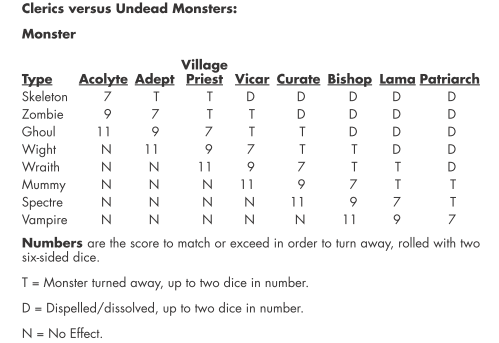
Here’s how it was presented in the white box, rolling 2d6 on the following table:
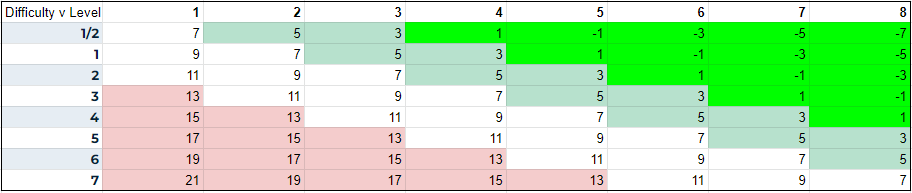
Typical of Gary’s approach to rules, it presents as a table something that’s actually a simple formula, but that’s by no means obvious shorn of the numbers. The columns are actually the cleric’s level, 1-8, and the rows are the monster’s hit dice, 1/2 through 7. So really what this is presenting is that clerics have a Target Number of 7 against undead 1 hit die less than them, and it gets 2 points harder for each additional hit die the undead has, and 2 points easier for each hit die less. If the number is below 7 turning is automatic, and if it’s literally impossible to fail the undead is destroyed; similarly if it’s impossible for the cleric to succeed, the result is No Effect. Building in the automatic success, critical success, and automatic failure in this way is really sweet, and pegging the target below which you don’t even need to roll to better than 50% chance of succeeding really speeds up play, in my experience.
HD
1
2
3
4
5
6
7
8
Skeleton
1/2
7
5
3
1
-1
-3
-5
-7
Zombie
1
9
7
5
3
1
-1
-3
-5
Ghoul
2
11
9
7
5
3
1
-1
-3
Wight
3
13
11
9
7
5
3
1
-1
Wraith
4
15
13
11
9
7
5
3
1
Mummy
5
17
15
13
11
9
7
5
3
Spectre
6
19
17
15
13
11
9
7
5
Vampire
7
21
19
17
15
13
11
9
7
Turning Table as Target Numbers
So here’s the thing: here we have a method of comparing a character’s level with a target difficulty. For undead it’s just their Hit Dice, but you could imagine it being the dungeon level a hazard or lock is found on, or any sort of ad-hoc decision by the DM. What’s more, the 2d6 scale fits in nicely with attribute bonuses ranging from -3 to +3 as per Moldvay and its descendants. +/-1 is not quite as good/bad as being 1 level higher, +/-2 is equivalent to a level, and +/-3 is a bit better than being a level higher/lower. That seems pretty nice to me.
But wait, there’s more! How much does each bonus improve your chances of hitting the Target Number? Here’s a quick chart:
Total
Exact
At least
+1
improvement
+2
improvement
+3
improvement
2
3%
100%
100%
0%
100%
0%
100%
0%
3
6%
97%
100%
3%
100%
3%
100%
3%
4
8%
92%
97%
6%
100%
8%
100%
8%
5
11%
83%
92%
8%
97%
14%
100%
17%
6
14%
72%
83%
11%
92%
19%
97%
25%
7
17%
58%
72%
14%
83%
25%
92%
33%
8
14%
42%
58%
17%
72%
31%
83%
42%
9
11%
28%
42%
14%
58%
31%
72%
44%
10
8%
17%
28%
11%
42%
25%
58%
42%
11
6%
8%
17%
8%
28%
19%
42%
33%
12
3%
3%
8%
6%
17%
14%
28%
25%
Chance of rolling at least N on 2d6, rounded nearest
The improvement in probability of success isn’t uniform, but you can see that the biggest differences fall right at the fat part of the distribution. It’s a bigger difference on your average roll than on the extremes, not surprisingly, and none of them are over 50%, so not overwhelming. Even nicer is that at best, a +1 is adding about 1/6 to your chances, a +2 is adding about 2/6, and a +3 is adding not quite 3/6. It could hardly be easier to remember or reason about.
To me this is actually pretty amazing: Roll 2d6 vs Target 9 against things that are even-on with the character in terms of level/hit dice, adding in any attribute modifiers, and Bob’s your uncle! If I were coming up with a mechanic de novo, I might be inclined to make even-on a target 7 but I can see an argument that if you have no particular reason to be good at a task it’s realistic that it’s more likely than not you’ll fail. I’m tempted to use Target 7 anyway as just being a little easier to remember, and being a bit more like the way combat works, with Level 1/HD 1 attackers being about 50-50 to hit unarmored foes, but I’m not sure whether I like Clerics vs. Undead then being a special case…
So there you have it, my new go-to Universal Mechanic for all older editions of D&D and their kin.
You know the bit in The Night of the Hunter where Robert Mitchum’s sinister itinerant preacher tells the “the story of right hand, left hand” using his hands tattooed with LOVE and HATE to illustrate man’s eternal struggle between the impulse of good and evil, love or hate winning the wrestling match between the two hands? If you don’t you should probably go watch The Night of the Hunter instead of spending your time reading my ramblings.
When it comes to D&D, I’ve got that going on, except my knuckles are labeled PLAIN and GONZO. On the one hand, I’m intensely attracted to fantasy settings with weird SF elements layered in or behind the pseudo-medieval trappings, as in the original little brown books D&D where Robots, Golems, and Androids were listed right along with Titans, Cyclopes, and the iconic Gelatinous Cube. For that matter, one of the first official dungeons for D&D, The Temple of the Frog, had a completely SF back-story of the original temple of a cult of crazy killer-frog breeders being taken over by extra-dimensional traveler with a battle suit, a mobile medical kit and “interstellar radio” who was part of a failed expedition sent to protect this world from other extradimensional incursions! It was released in 1975 as part of Blackmoor, the second supplement to D&D, five years before the famous Expedition to the Barrier Peaks module in which the adventurers explore a crashed space-ship. You could say that Science Fantasy is baked into D&D from the outset. Or perhaps you could say that D&D dates back to a time when the genres of Science Fiction and Fantasy were not so clearly separated as they are now.
On the other hand, I also really dig the idea of running D&D in a completely folkloric setting, inspired by The Hobbit, The King of Elfland’s Daughter, The Prydain Chronicles, the Book of Weird, and the like. Not an authentic medieval world (though that would be interesting and most players would find it genuinely weird), but more like a world as medieval folks imagined it to be, where superstitions are mostly true and “Up the airy mountain, Down the rushy glen, We daren’t go a-hunting. For fear of little men.”1
Whenever I am running or creating adventures and locales for one kind of setting, I find myself overflowing with ideas for the other kind. If I’m running a Plain campaign where the players are slowly exploring the first few leagues around their home base and gradually working their way further into the ancient forest where the Elves dwell, I’ll have this urge to put in a portal to Barsoom. If I’m running a Gonzo, anything goes, Sci-Fantasy campaign based on a psychedelic version of Oz (hello, Ultra-Violet Grasslands) I’ll find myself missing the intimacy and small-scale where if the party finds a footprint of something twice as big as a man they regard it as unusual and possibly worrisome, and speculate what it might be. There’s an often unappreciated advantage of a world where the players can assume that they can know or learn enough about the world that they can make educated guesses: a footprint like that could be an ogre, or possibly a troll. Are we prepared to face one of those? In a wilder setting there’s no point speculating because it could be anything at all, and there’s a good chance that it’s unique anyway2.
I will say that Gonzo is easier to run, or at least as my campaigns go on they tend to get more Gonzo from where ever they started. It’s easy to slip in Gonzo elements, it’s much harder to dial them back or remove them. How are you going to keep them down on the farm once they’ve seen Paree?
I don’t have any solution to this dilemma. I’m like the Rum Tum Tugger, the cat that’s always on the wrong side of every door. The real solution, I guess, would be to play enough D&D that I could scratch both itches.
1 – The Fairies, by William Allingham
2 – And no, before you ask, the player saying “Can I roll a Nature or Arcana check to see if I recognize the kind of footprint?” is not, to me, the same thing at all.
So, I’ve been thinking again (as one does) about Thieves’ skills and bonuses in OD&D and B/X lines. I wrote about this before, in It Takes A Thief back in 2008. Nowadays, Original Edition Delta has a nice simplification of calculating them to eliminate the weirdness of the percentiles (that are almost always increments of 5% anyway) by just using the Thief’s level as a modifier on a Target 20 roll, but by design it sticks very close to the RAW chances of success. The problem, for me and my players at least, is those numbers are so low for everything except climbing that the thief shouldn’t bother trying them unless there’s nothing really riding on it or they’re almost to “name” level: you don’t hit 55% in anything except climb until level 7 in OSE(B/X) . That’s pretty much the opposite of how you want a thief to play. There is a school of thought that you should just drop the Thief as a class, and “if you want to be a Thief, steal something” but I’ve encountered a lot of players over the years whose favorite class is Thief, so there’s something about the archetype that speaks to them and I want to accommodate that.
Using the interpretation that Thief skills are near-magical abilities (I think due to Philotomy: anyone can hide, but a Thief can hide in shadows) doesn’t really help. Even if you don’t mind the flavor of thieves with semi-mystical abilities, they’re still not going to do it with any degree of reliability until near the end of the campaign. Other adjustments such as allowing repeated tries or treating a miss as indicating success but after a delay, proportionate to how much you missed by kind of works for some things like picking a lock that it might be possible to attempt until you get it right… but for something like moving silently that’s no help at all, and still leaves it that you shouldn’t bother rolling unless it’s either desperate enough that you have nothing else useful you could try on your turn or you have no real pressure and the Referee should just give it to you and move on.
Taking a step back, how reliable should these skill be at first level? Well, how powerful are they? The answer is “not very.” A first level Fighter will hit an unarmored opponent about half the time (give or take about 5% depending on edition), and on the average that hit will kill a 1 HD foe. A first level Magic User can cast a spell (admittedly once a day) that can also on the average slay a 1 HD creature regardless of AC (Magic Missile) or put up to 2 dice worth of 1 HD creatures to sleep (or proportionately less up to a max of 4 HD creatures). And the first level Thief can… open a lock? Hide?
Looking at it this way, is there any reason in the game not to make the default success rate for Thieves’ abilities pretty much the same as for Fighters? About 50% of the time it works, at least in the typical situation you’d find on the first level of the dungeon or back in town? If you can actually open the chest, or find the trap, or move silently past the guard that doesn’t seem like it would break the adventure… unless your adventure assumes that the players would never be able to do that. And if you’re writing adventures like that, well I won’t tell you to stop, but maybe you should get rid of Thieves as a class.
So, where does that leave us? I think for OED, I’d just make it Target 10; for more or less by-the-book B/X or Old School Essentials you could keep the percentiles and just add 50%, but my inclination is to make it about half-way between OSE and OED. Use a d20 and resolve, but adjust the percentiles by dividing by 10% (rounding down) giving a bonus range from +0 to +10 and allowing the Thief’s Dexterity modifier to apply. The Target Number would 10 for 1st level challenges (the kind you’d find while fighting 1 HD creatures) but scale with the level of the dungeon (5th level dungeon has TN 15 locks) or the equivalent in overland/city adventures. A wealthy merchant can probably afford Target 15 locks, a 10th level Lord Target 20. That way the challenges for Thieves roughly keep pace with the challenges that the Fighters and Magic Users are facing in terms of AC and spells saves. I like that this makes it really easy to convey a sense of some tasks are harder than others even for master Thieves while still letting the players have a good guess of how hard it’s likely to be instead of springing modifiers on them lock-by-lock. Keep the usual 1 is automatic miss, 20 is automatic success from the combat system. For Pick Pockets instead of looking for rolls of more than twice the chance of success to see if the Thief is caught, I’d change it to getting caught if the Thief misses by more than the Thief’s own level.
There you have it, a pretty minimalist change that I think opens up the play possibilities for Thieves a great deal. Even a first level Thief has at least a coin-flip’s chance of accomplishing any of their core abilities, while retaining the flavor of the old school Thief with the slightly different advancement of the distinctive Thief skills.
Update: Just to make it clear, I do let non-Thieves try any of the Thief skills (except read scrolls). They roll as 0-level Thieves: 1d20 versus whatever the target is with no bonus, not even attribute modifiers. High attributes only help if you have the slightest idea how to apply them properly; I don’t want high Dex, say, to automatically be as good as a Thief who had to work for those levels.
One of the things that I really like about Original Edition Delta (Dan Collins’ restatement/mild reworking of Original White-box D&D) is how he adjusted the attack bonus charts for men attacking monsters to make a smoother progression as characters level up. The original chart divided Fighting Men into groups of three levels, e.g. 1-3, 4-6, 7-9, and then had the number you had to roll to hit each armor class improve by 2, 3, or 4 each successive category. I have literally no idea why Gygax & Arneson did it that way, unless it was desperation to save space in the tiny booklets. To make it worse, the instructions told you to rework the columns into groups of 4 or 5 for Clerics and Magic Users. Apparently they couldn’t even spare the space for two extra header rows! Though I’m not sure I’d have the patience to do much better with nothing more than a typewriter to do the layout.
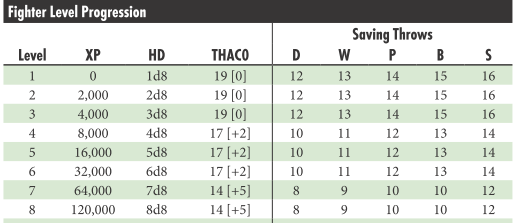
I’ve been playing a bunch of Old School Essentials lately, which reworks this so that instead of a clunky chart, each character class lists its bonus to hit/THAC0 (for ascending/descending Armor Class), in a beautifully laid-out, easy to read fashion thanks to modern tools, more space, and a better graphic design sense than Gary had.
OSE Fighter Progression Chart
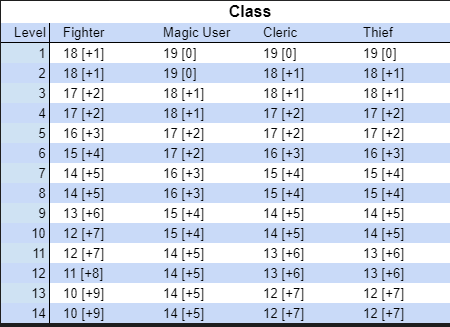
Unfortunately, it keeps the odd, bumpy progression so characters can go level after level with nothing improving except their hit dice or maybe spells for spell-casting classes. I found I really missed Dan’s approach to it, which ended up nearly the same place give or take a pip on a d20 at each level break, so I implemented a similar progression as a house rule in my game. If you’d like to do the same, here you go. Just replace the Thac0/Attack Bonus listed in the OSE Class tables with the bonus from the appropriate column in the following. Dwarves, Halflings, and Elves advance as fighters (in OSE every three levels). I tried to stick as closely as I could to matching the OSE tables, particularly when it came to the earliest level that the character got the improvement for their “band”, e.g. if a Thief got the +5 bonus at Level 9 I tried to preserve that.
Smoother Attack Progression for OSE
Unfortunately, WordPress’ stupid custom html doesn’t show the table correctly except in preview mode, so I used an image. The actual sheet as a web page is available here, if you need it.
Random thought that occurred to me about spell memorization and spell-books in D&D. As we all know, the traditional way of doing it requires that Wizards “memorize” their spells each day and they require access to their spell book to do it. The whole thing, while probably motivated by game-play aspects of limiting wizards and making them make strategic choices, is clearly influenced by the way magic works in Jack Vance’s Dying Earth books where the spells are some kind of alien math that are “so cogent that Turjan’s1 brain could know but four at a time.” So when GMs are looking for a rationalization for the weirdness of it, that’s usually what they reach for. GMs and players too bothered by the weirdness generally remove the spell books entirely, so that spells learned are permanently known, and limits on how many times they can be cast are approached another way, such as by spell points or “slots.”
But what if it wasn’t that the spell, forcibly impressed on the wizard’s puny human brain, is magically erased when cast, but rather the formula such as the words, gestures and intonation that need to be used are so complex to figure out they require a concordance of astrological and mystical tables and a whole bunch of long-hand calculations such that you have to have your reference book and a fair bit of time to do the calculations before you can next cast the spell? What if you needed to know the exact date you are going to cast the spell to have any hope of solving the formulas and doing the look-ups to succeed. What you’re memorizing is that day’s solution once you’ve calculated it, and you don’t literally forget it, but it’s no longer of any use once you’ve cast the spell (because the formulas also depend on whether you’ve already cast it that day or not). Maybe you can’t just sit down and re-memorize the spell even if you’re carrying the book because doing so at any other time than the specific time in the morning the tables were compiled for is just too complex for mere mortals.
This seems like a good explanation for why the spell-book of a 1st level Magic User with only one spell (if you’re using Basic D&D/OSE by-the-book) is still a hefty tome but a higher level wizard with dozens of spells doesn’t require a library in his backpack. The bulk of the volume is the charts and concordances necessary for all spells, while the specific constants and formulas for any given spell are comparatively slight. That would also explain why a scroll is just a single sheet of paper but that can be enough to add a spell to your book (assuming you’re using that common convention). If you allow Magic Users to keep a spell memorized until they cast it, you could easily tweak the assumption to be that it’s the day that you sit down to memorize the spell that needs to be worked into the calculation, not the day it’s going to be cast.
I kind of like this for a more down-to-Earth explanation of most of the odder features of the traditional D&D spells system. It’s not that I particularly object to spells as alien mental constructs as much as that definitely flavors the world in a particular Dying Earth way, and I don’t always want that flavor in my setting. Now, if you really follow the logic of the rationalization, it does have some implications that are slightly different from the by-the-book traditional method…like you might be able to memorize a spell and keep it around if you did the calculations to be able to cast it on a specific future date. You could, of course, patch that by saying the calculations get too complex more than at most a day in advance, or you could roll with it. Maybe you don’t dare take your spell-book along, but you believe you won’t have to use certain of your spells until you reach your destination three days hence. I think that might be an interesting consideration for a wizard.
1- Turjan being one of Earth’s mightiest magicians in those latter times.
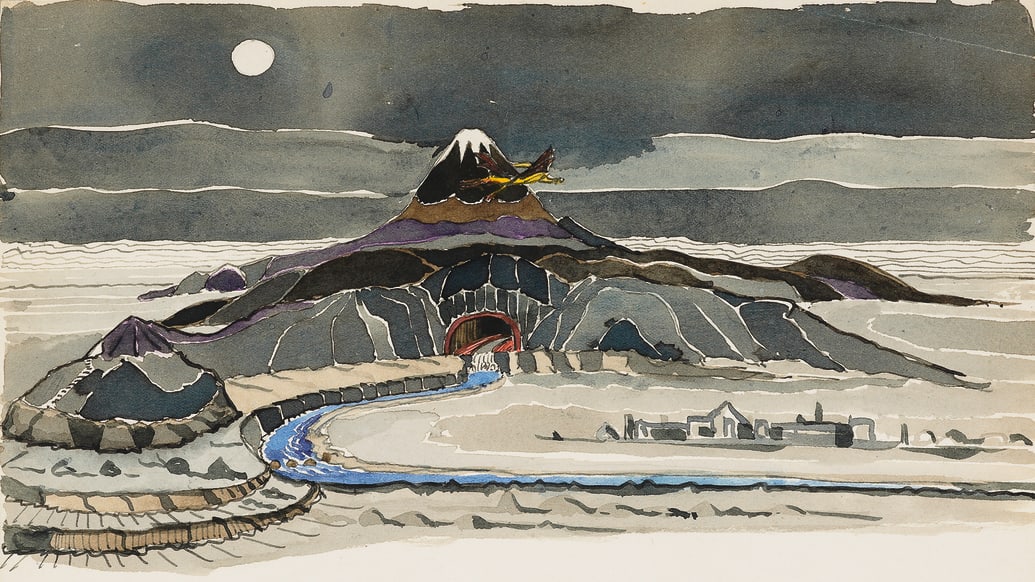
I’ve been rereading the Hobbit, for the first time in maybe thirty years, and I can’t help but be struck by it being possibly the most D&D thing I’ve ever read… including some books that were directly set in D&D worlds. It’s not just the moments where something in the early D&D rules was clearly taken from bits in the book, like “Oh, werebears can summon normal bears because Beorn the skin-changer could” or that the whole bit about intelligence and ego in magic swords probably spun out of the one line about Glamdring being “bright as blue flame for delight in the killing [of the Great Goblin]”, it’s much more fundamental: this is D&D at its core.
This is what a party looks like, even if early accounts are to be believed in the numbers of adventurers: 13 dwarves, a hobbit, and a wizard; this is what motivates them: gold and to a lesser extent adventure, maybe a little bit of back-story; these are the places they go: across dangerous countryside where there is no king or law, through giant spider-infested forests, into subterranean lairs that stretch beneath entire mountain ranges where live goblins and worse, into lost mines inhabited by dragons. But most of all, these are the shenanigans that PC’s get up to: uncovering secret routes on a treasure map; discovering magic swords in a monster’s pile of loot; hiding while giants fight; killing goblins with sword and magic; nearly getting burned alive by clever, ruthless goblins; using rope, grappling hook, and convenient boat to try to solve the puzzle of crossing the creepy magical river; escaping via a hare-brained plan to hide in barrels to float downriver; discovering a secret door that is revealed once a year; running away from a dragon; aid in defeating a dragon through something they discovered while adventuring. Honestly, I could probably pull something from nearly every chapter. And throughout it all, what’s at stake is primarily their survival and whether they’ll actually emerge wealthy at the other end. Despite the presence of a prophecy, they aren’t the destined ones, the fate of the world doesn’t hang in the balance, and while arguably the party’s greed and foolishness after their success semi-accidentally led to a better outcome than if they’d stayed home they are not really the heroes of the Southlands.
Much more than The Lord of The Rings, but also more than the stories of Conan or Fafhrd and the Grey Mouser, The Hobbit is what it’s all about.
Roads go ever ever on, Over rock and under tree, By caves where never sun has shone, By streams that never find the sea; Over snow by winter sown, And through the merry flowers of June, Over grass and over stone, And under mountains in the moon.
I think when it comes to RPG books, it’s good to have an eclectic mix of art styles in the illustrations. The early D&D books were aces at this, ranging from the actual cartoons of Tom Wham, to the grounded illustrations of Dave Trampier, to the trippy works of Errol Otus. I think this kind of diversity is important because you never know what will strike a chord and provide inspiration for a game. Books that have a very clear “house style”, like some of the later editions of D&D, have a harder time of this, imo. If it hits, it hits, but if it doesn’t there may not be anything in the whole book that really sparks your imagination.
Now some of the time, like maybe a setting guide or something based on some specific IP like StarWars, setting tight boundaries on the tone and imagery might be exactly what you want. But I think in the general case, you want to have the art run the gamut.
Not playing at conventions, but conventions I’ve adopted in my games (mostly regardless of system or genre) to try to shape the play experience to encourage or avoid certain kinds of play at my table. These aren’t house-rules, most of them being meta-rules about what is and isn’t allowed by the GM or the players. Also most of these are guidelines, and might be relaxed on certain occasions or if everybody is agreeable.
No Player-vs-Player action. No attacking other PCs, no stealing from them, no actual intra-party conflict. “Pretend” intra-party conflict, where the players roleplay that their characters are squabbling like Legolas and Gimli, but pull together as a team when the action starts, is fine. But if tempers start to rise, I cut it off. There are a lot of players and groups where this kind of stuff is meat-and-potatoes to them, but I’ve been burned too many times by what’s started out as a bit of fun and escalated until it ruined the game for everybody, so I take a hard line on it now.
No Torture. Torture is something evil NPCs do off-screen to other NPCs, or a player might have as something that happened to their character as part of their back-story, but it never gets any play time. As a corollary, captured NPCs will always spill their guts to the PCs at the slightest encouragement; they may not know much, but I explicitly promise to the players that as GM I will never create a situation where they would be better off torturing a captive for the information they need regardless of how plausible they might find that in real life.
No Using PC’s Attachments Against Them. Unless the player volunteers for it, I promise as GM that if they form bonds or connections with various NPCs and locales, I’m not going to use that for cheap drama or as a way for an NPC villain to compel their cooperation. Yes, that cuts off a bunch of seemingly interesting stories and scenarios, but you know what also cuts off a bunch of interesting RP? Players refusing to form any bonds or connections with any of the setting for fear of having it held hostage or weaponized against them.1
Mercy Works. There’s a thing that some GMs like to do (and I admit I’ve done sometimes in the past) where if you let a bad-guy get away, it’ll come back to haunt you. It’s tempting because recurring villains are a staple of a lot of genre fiction, and the players having a back-story with the villain can be so satisfying, particularly when the players come to really hate the villain. He shows up again and they’re automatically invested. The same thing can happen with un-named mob monsters or bandits, where if you don’t kill them when you have the chance, they’ll just bother you another day. The problem is that players are usually very rational, and very ruthless, so unless you’re enforcing genre conventions that forbid it (e.g. codes against killing in super-hero games) the players learn to leave no living enemies… but that can really mess up the tone of the game, and I think contributes to murder-hoboism. It’s also relatively unrealistic, at least if you go by the history of warfare in our world. There were lots of reasons historically to take captives and not kill them, or to let fleeing soldiers get away, if for no other reason than it stiffens the resolve of the enemy to die rather than be captured but the structure of a lot of games (especially dungeon crawls) makes that difficult to implement. My solution to keep my players from committing war-crimes (or at least reduce their number) is to have the players’ intelligent foes be permanently defeated: if the players show mercy, they will never again oppose them (whether from fear or gratitude) and if the players are generous they might change their allegiance. They explicitly will not be constantly searching for ways to backstab the players. This one is a bit more squishy than the others, because it really depends on what it means to defeat the enemy. If they fail a morale check and rout, then yeah, they might regroup and be a problem later. What I’m really trying to prevent is pushing the players into feeling they have to slaughter helpless captives or go around the battle-field applying a coup de grâce against anybody who might merely be injured or unconscious.
Surrender is an Option. Bad-guys in my games will usually accept surrender, and it doesn’t mean the end of the PC who surrenders. Even for unintelligent monsters I might think about whether it would drag the victim back to its lair to eat later or something. There will usually be consequences, a ransom to be paid, or they’ll have to escape, but I try not to ruin the character for acting reasonably in the face of overwhelming force. At the very least I’d prefer that Death before Surrender! be a choice that says something about the character and not, well the GM is going to kill my character anyway so might as well go down fighting.
Naturally there are exceptions for game/genres where it’s an explicit part of the game; if you’re playing a super-hero game with the concept of a “Dependent NPC” like Aunt Mae who will get into trouble as a complication for the PCs heroic guise, then something happening like her getting engaged to Doc Ock is still on the table.
At the risk of turning this into a blog for commenting on Delta’s blog, here are some thoughts on a post of his back in March about the big error in the infamous Greyhawk and AD&D Weapons vs AC charts.
Basically, Dan observed that there’s a fundamental error in the way the chart was derived from Chainmail to convert it to the d20 “alternative” combat system in original Dungeons and Dragons (specifically the Greyhawk supplement), and that chart was just reproduced and elaborated on in AD&D. The error was in converting Chainmail’s chart showing with this weapon vs. this type of armor roll this number on 2d6 to kill the target into D&D’s roll this on d20 to hit the target, they forgot to adjust for the armor class! Basically, the difficulty of hitting the armor is baked into the Chainmail table, but it’s a completely separate consideration in OD&D, so that e.g. in Chainmail a mace has pretty much the same chance of killing regardless of armor (roll 8 or better), that’s presented in Greyhawk as a mace has no bonus vs. any particular armor so the mace gets worse and worse chance of hitting as armor gets better! Oopsie.
So what would a “correct” version of the Weapon vs. AC chart for Greyhawk look like? That is, one that preserves the logic worked into the Chainmail chart as to which weapons are better against which armors, which seem to have at least rough approximation of what weapons historically were preferred against which prevailing types of armor.
The Chainmail Man-to-Man combat chart looks like this:
Armor Class
No Armor
Leather
Shield
Leather+ Shield
Chain
Chain+ Shield
Plate
Plate+ Shield
Weapon
9
8
7
6
5
4
3
2
Dagger
6
7
8
8
9
10
12
12
Hand Axe
7
7
8
9
10
10
11
12
Mace
8
8
8
9
8
8
7
8
Sword
7
8
8
9
8
9
10
11
Battle Axe
8
8
8
8
7
7
9
10
Morn. Star
6
6
7
7
6
7
8
8
Flail
7
7
7
7
6
7
6
7
Spear
8
8
9
9
10
10
11
12
Pole arms
6
6
6
7
7
8
9
10
Halbard
8
8
8
7
6
6
7
8
2 Hnd. Swd
6
6
6
6
5
5
6
7
Mtd. Lance
5
5
5
5
6
7
8
9
Pike
8
8
8
8
8
8
9
10
Chainmail Man-to-Man combat
The first thing we have to deal with is all the target numbers in this chart represent kills; in Chainmail there were no hit-points or variable weapon damages. So this chart represents both the deadliness of the weapon and its ability to penetrate various types of armor.
What I’m going to do is assume that the relative deadliness of the weapon is represented by the target number vs. unarmored men, while the penetration ability of the weapon vs the various armors is thus the difference between its “normal” ability to kill an unarmored man and its lessened ability to kill armored men. This normalization gives the following chart of how much worse a weapon is against the various ACs relative to its ability to kill an unarmored man; we’ll presume that in D&D that ability to kill an unarmored man is represented by the weapon damage, from d4 to d12 or whatever.
Armor Class
No Armor
Leather
Shield
Leather+ Shield
Chain
Chain+ Shield
Plate
Plate+ Shield
Weapon
9
8
7
6
5
4
3
2
Dagger
0
-1
-2
-2
-3
-4
-6
-6
Hand Axe
0
0
-1
-2
-3
-3
-4
-5
Mace
0
0
0
-1
0
0
1
0
Sword
0
-1
-1
-2
-1
-2
-3
-4
Battle Axe
0
0
0
0
1
1
-1
-2
Morn. Star
0
0
-1
-1
0
-1
-2
-2
Flail
0
0
0
0
1
0
1
0
Spear
0
0
-1
-1
-2
-2
-3
-4
Pole arms
0
0
0
-1
-1
-2
-3
-4
Halbard
0
0
0
1
2
2
1
0
2 Hnd. Swd
0
0
0
0
1
1
0
-1
Mtd. Lance
0
0
0
0
-1
-2
-3
-4
Pike
0
0
0
0
0
0
-1
-2
Normalized
So here we see the relative values of armor against a given weapon. Against a mace, no armor really helps, though leather + shield is a tiny bit better than unarmored and plate is a tiny bit worse. Swords, though, quickly become ineffective against heavier armors, which take a two-handed sword to punch through. Mounted lances and spears are almost completely ineffective against plate + shield combination. This all seems plausibly historically accurate.
Finally, though, we have to convert this to d20, taking into account the way armor class is worked into the target number to hit on a d20 (the crucial step the author(s) of that section of Greyhawk forgot). This yields the following chart of modifiers that preserve the penetrating power of weapons from the Chainmail rules:
Armor Class
No Armor
Leather
Shield
Leather+ Shield
Chain
Chain+ Shield
Plate
Plate+ Shield
Weapon
9
8
7
6
5
4
3
2
Dagger
0
0
0
1
1
1
0
1
Hand Axe
0
1
1
1
1
2
2
2
Mace
0
1
2
2
4
5
7
7
Sword
0
0
1
1
3
3
3
3
Battle Axe
0
1
2
3
5
6
5
5
Morn. Star
0
1
1
2
4
4
4
5
Flail
0
1
2
3
5
5
7
7
Spear
0
1
1
2
2
3
3
3
Pole arms
0
1
2
2
3
3
3
3
Halbard
0
1
2
4
6
7
7
7
2 Hnd. Swd
0
1
2
3
5
6
6
6
Mtd. Lance
0
1
2
3
3
3
3
3
Pike
0
1
2
3
4
5
5
5
Weapon vs Armor Adjustment Corrected
And here we see, as intended, against an unarmored foe a 1st level Fighting Man armed with a mace would need to roll a 10 to hit, and against somebody with plate + shield would need… a 10 to hit. (To Hit of 17 from the Men Attacking Matrix in original D&D, with a bonus on the roll of +7) Armed with a dagger he’d need the same 10 to hit an unarmored man, but a 16 vs plate armor + shield.
Is it worth it? Frankly, I have my doubts. If Gygax himself never bothered with it, it’s hard to see the added complication of the table lookup every time you switch weapons or foes (assuming they’re not all equipped identically) adds that much. On the other hand, it is kind of logical that you ought to prefer the weapons that were historically favored against particularly heavy armors. One thing that is clear to me, though, is that if you want to have that kind of mechanic in your game you’re better off starting with the Chainmail assumptions and not their mistranslation.









 Tales of the Rambling Bumblers