More Thoughts on RuneQuest

I’m reconsidering part of the rule I proposed for special effects like impale in RuneQuest. The problem with any die showing a 0 is an impale as long as it’s a success is that it skews the chances of impaling at low skills quite a bit. With 20% skill, half your successful hits are impaling. Not what I’d really like to see.

Instead, I’m thinking of making it 0 or 5 showing on the 1’s die. This restores it to about 20% chance regardless of the skill. I think this works out to where rounding would happen with the original RQ: skill 15%, say, you have 3 chances out of 15 (05, 10, 15), while at 19 it’s still 3 but now out of 19, not becoming 4 out of 20 until you hit 20.

In some ways this is even easier to spot: multiples of 5 are special. Hard to imagine even my math phobic players objecting to that.

Simplifying Spell Resistance in RuneQuest 2e

As part two of “The Macy Conventions”, I want to look at Spell Resistance.

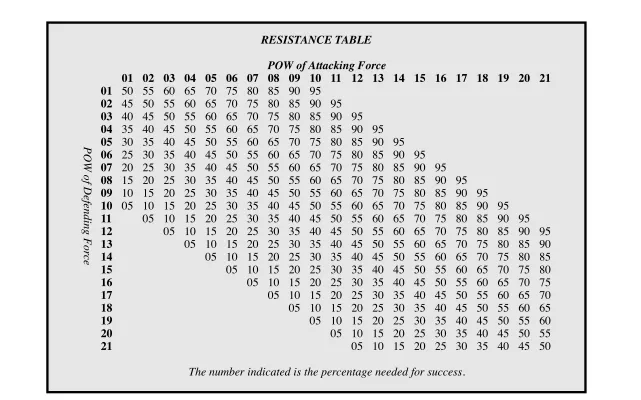
Spell resistance is another thing that’s needlessly complicated in RuneQuest 2e, or at least expressed in a needlessly complicated way. The rule is that to cast a spell on a resisting target, you need to roll 50%, plus 5% for every point your POW is higher than theirs, -5% for every point lower. 96-00 always fails. They even gave you a handy chart to cross index the POWs and see what you need to roll

Chart showing the percentile you would need to roll for each POW between 1 and 21 against POW 1 to 21.

That strikes me as an ugly way to achieve this result. My house rule is:

Spell Resistance

  1. Roll d20 and add (Your POW – 10)
  2. If result exceeds (not equals) target’s POW, spell succeeds
  3. If result is less than or equal to target’s POW, spell fails
  4. A 1 always fails.

That’s mathematically identical, but seems to me much easier at the table. Most people are very fast at subtracting 10 from a number, even when it results in a negative number, compared to subtracting arbitrary numbers between 1 and 21 and then adding 50.

POW Gain Rolls

If you qualify for a POW gain roll after an adventure (cast a spell that could fail other than the auto fail on a 1 in a stressful situation during an adventure), roll strictly higher than your current POW on a d20 and you can increase your POW according to the regular rule (10% chance of +3 POW, 30% chance of +2, otherwise +1).

This is mathematically equivalent to the original subtract POW from racial max, multiply by 5 and roll less than the result on %.

Let’s Make a Deal!

A System-Neutral Trading Mini-game

So here’s a reworking/system neutralization of the trading system from my Zap! game.

Note, has not been play-tested at all in its current form. To use it you have to fill in some details from your particular system and setting, like what 1 point of cost/profit actually amounts to, how big a cargo is a small or large cargo. But by design it’s easily scaled so you can use the same basic procedure whether you’re trading in back-packs full of goods for copper, wagons full of goods for silver, or shiploads of goods for gold.

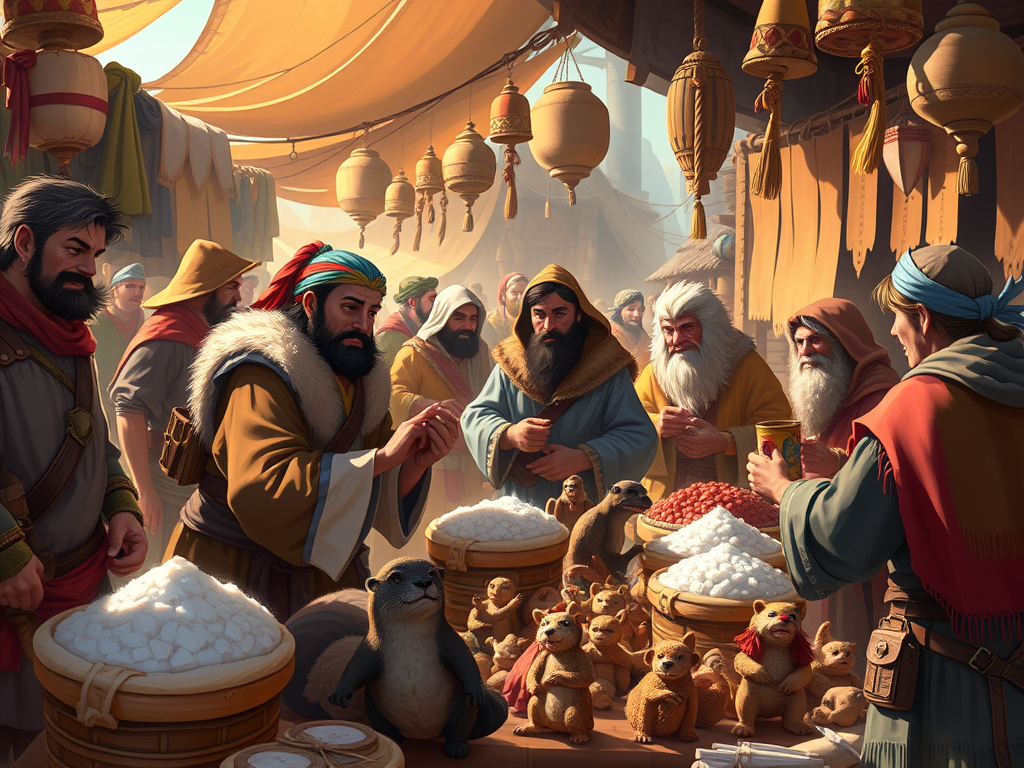
Even though the mechanics are in terms of completely generic trade goods, the intent is to make up flavor details on the fly about what the cargo actually is, like otter pelts, bags of salt, sets of fertility figurines of the goddess Whut, or whatever.

Simple Trading Mini-Game

Core Mechanics

  • Characters use cargo space to transport goods between locations
  • Each cargo space can hold either one large shipment or two small shipments
  • Trading requires finding goods at one location and selling them at another

Location Ratings

Each location has a Wealth Rating from 4-12:

  • Higher ratings mean more money to spend but pickier buyers
  • Even ratings use matching dice (e.g., 2d4 for rating 4)
  • Odd ratings use mixed dice (e.g., 1d4 + 1d6 for rating 5)
  • Take the higher roll of the two dice

Goods and Cargo

  • Goods have a Value Rating from 4-12 using the same dice system
  • Higher-rated goods are easier to sell but harder to acquire
  • Lower-rated goods are easier to find but harder to sell at wealthy locations
  • Small shipments: Roll trading skill at -2 when buying, Value Rating is normal when selling
  • Large shipments: Roll trading skill normally and get +2 to Value Rating when selling

Trading Process

Buying:

  1. Choose what type of goods to look for (set Value Rating) and shipment size
  2. Roll your trading skill (with -2 for small shipments) vs. the good’s Value Rating
  3. If you succeed, goods are available at the price shown by the lower of the two Value Rating dice
  4. If you fail or don’t like the price, must wait 3 actions before trying again

Selling:

  1. Roll the good’s Value Rating (+2 for large shipments) vs. location’s Wealth Rating
  2. If successful, buyers offer the amount shown on the Wealth Rating dice
  3. Profit/loss is the difference between selling and buying price
  4. Must sell at a different location than where you bought
  5. If you fail or don’t like the offer, must wait 3 actions before trying again

The Mistakes of Greyhawk

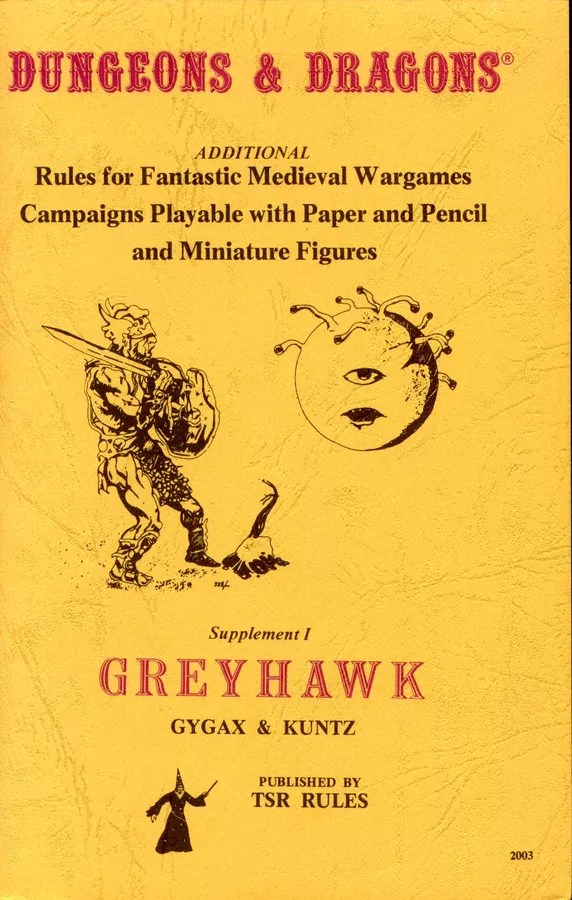
The other day I said offhandedly in the Wandering DM’s discord that I’m halfway inclined to categorize Greyhawk, the first supplement to original Dungeons & Dragons, as a series of mistakes that we’re still paying for. The more I think about it, the more I want to make that case.

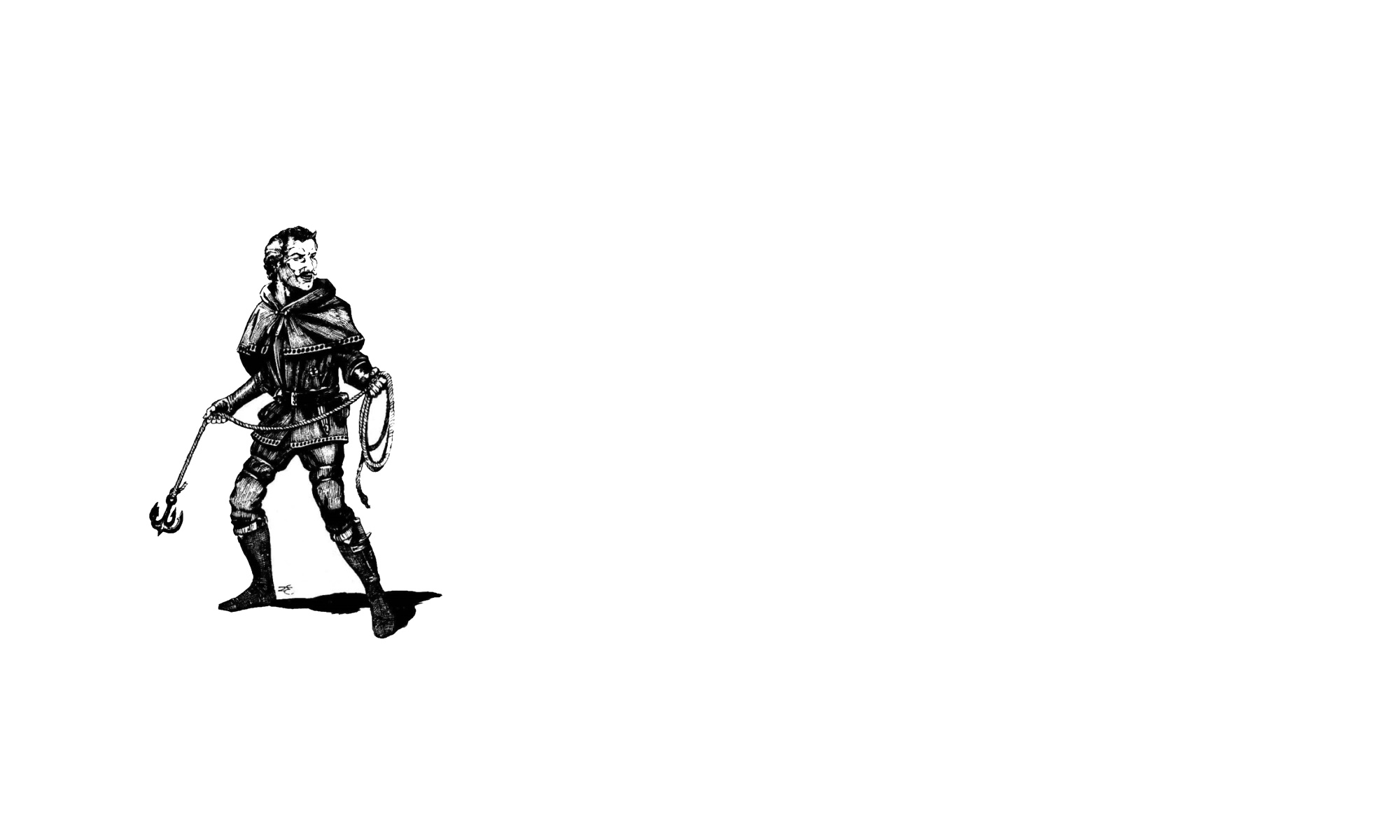
Mistake 1: Thieves

The Thief was the first step on the slippery slope of a class for everything, and everything needs a class. Before the Thief, if somebody wanted to perform an action like attempt to pick a pocket or disarm a trap, or even hide in shadows, the Referee would just have to adjudicate it based on assessing the situation and maybe considering things like Dex or armor worn, to taste. After the Thief not only was there a specific mechanic for it, but the Thief’s chances were so low (<50% for almost everything except climbing until about 7th level) that clearly nobody but a Thief should be allowed to attempt it at all. Much ink has been spilled over the years since trying to rationalize or make it workable (e.g. making Thieves skills nigh supernatural, not just hiding but hiding with nothing but a shadow to conceal you). All of that, though, is clearly a band-aid on something that wasn’t originally a wound.

Mistake 2: ATTRIBUTE Inflation

The little brown books (LBB) of original D&D had the Referee (!) rolling up the attributes, called Abilities, for the characters, and then little else there were explicit rules for. The following is pretty much it.

Bonuses and Penalties to Advancement due to Abilities:
(Low score is 3–8; Average is 9–12; High is 13–18)
Prime requisite 15 or more: Add 10% to earned experience
Prime requisite 13 or 14: Add 5% to earned experience
Prime requisite of 9–12: Average, no bonus or penalty
Prime requisite 8 or 7: Minus 10% from earned experience
Prime requisite 6 or less: Minus 20% from earned experience
Constitution 15 or more: Add +1 to each hit die
Constitution 13 or 14: Will withstand adversity
Constitution of 9–12: 60% to 90% chance of survival
Constitution 8 or 7: 40% to 50% chance of survival
Constitution 6 or less: Minus 1 from each hit die*
Dexterity above 12: Fire any missile at +1
Dexterity under 9: Fire any missile at –1

minimum score of 1 on any die

There was guidance in the description of what the abilities mean that hinted ways the Referees might use them, e.g. “Dexterity applies to both manual speed and conjuration. It will indicate the character’s missile ability and speed with actions such as firing first, getting off a spell, etc.” but no formal procedures. There was also some confusing stuff about using your abilities to raise your prime requisite, but it mostly made little difference in play.

So when Greyhawk adds a bunch more explicit rules around abilities, that seems like a welcome change. Finally, this is what the scores in abilities were for! Unfortunately, the way this was done was a mistake and led directly to the current hell of Attribute Inflation where in D&D 5e “Dex-based builds” should be aiming for a 20 in Dex. Where in the LBB, having an 18 Str is no better or worse than a 12 Str unless the Referee deems it important in the situation, starting in Greyhawk a 1st level fighter with 18 STR is better at attacking than a 6th level fighter with 12 STR (same chance to hit, but on average double the damage)… and that’s before the wackiness of the “percentile strength” that gets tacked on once you roll an 18 in STR. The scale is wrong when a lucky roll (or persistence in rolling up new characters) counts for more than months of advancement in play.

If anything Magic-users have it worse with the new intelligence rules. Before Greyhawk a high Int wizard was benefited primarily by leveling up ever-so-slightly faster than an average Int wizard. According to Greyhawk, though, average Int wizards have only a 50-50 shot at knowing any given spell, have a strict maximum on how many spells of a given level they can ever know, and are cut off from learning the highest level spells completely. The exact details don’t matter, though, as much as the fact that now for the first time there’s really an optimal “build” for a character class, and it really matters. You can see this play out in subsequent editions, starting with AD&D where they abandon 3d6 in order in favor of various methods of skewing the numbers towards higher averages (e.g. 4d6 drop lowest, roll 3d6 12 times and take the best 6, etc.) until in 5e you get here, here are your numbers, arrange them.

Mistake 3: Hit Point Inflation

Greyhawk introduced the variable-sized hit die by class “expressly aimed at raising fighters and lowering magic-users with regard to hit points which can be sustained.” Fighters would now get d8, while Magic-users were lowered to d4 (and Thieves came in at d4). Moreover if you used this system all monsters would get d8 hit dice. Since not all weapons were adjusted, the effect was either to draw out combats or funnel everybody into using the weapons that kept parity with the monsters. I’m not sure what problem this was solving (was there anybody who thought too many MUs were surviving to 2nd level?), I think the trend towards both monsters and PCs (except wizards) being ever larger bags of HP was clearly set in motion.

Mistake 4: XP Deflation

Maybe not one of Greyhawk’s biggest sins, but since we’re going through the pages in order… Declaring the original 100 XP per HD ridiculous, Greyhawk adds a lookup table of XP awards that slash them to about a 1/5 to 1/3. Again I’m not sure what problem this solves, although maybe if you’re running games every day of the week anything to slow leveling down is a plus. In theory this tilts the playing field farther towards getting most of your XP from gold, but I believe in practice it just led to more calls for getting XP for other things, or per session and eventually to the current fad of ditching XP completely and leveling up when the GM or module feels it’s appropriate.

MISTAKE 5: THE SINGLE BEST WEAPON

Greyhawk added a number of things that changed how weapons worked in the “Alternative Combat System” (the d20 system that everybody, including Gary, uses). First is variable damage dice per weapon, which I admit I kind of like, but as implemented means that really the only weapons that stay on par with Monster HP are the ones that fighters use. The weapons that do more damage than a 1 handed sword are all flagged as requiring so much space on either side of the wielder that they require the wielder to stand alone in the front line. How Gary reconciled his love of historical polearms with the new requirement that polearm users can never actually form ranks, requiring a minimum of 6′ on either side, I don’t really know. My suspicion is that he only intermittently enforced that rule, if at all. The next widely ignored bit was to-hit bonuses per weapon by AC and different weapon damage against larger-than-man-sized creatures. The interaction between the tables is messy, but the net effect is once again sword is the all-purpose weapon (military pick being better to-hit against the heaviest armor but losing in damage, particularly when it comes to large creatures).

Before Greyhawk all characters would use whatever weapon they liked best (or was most magical) within class restrictions. After Greyhawk, regardless of the specifics, most of which weren’t carried over past AD&D, there was seldom any better weapon than a sword so everybody who can uses that. Heck, one of the most common restriction to relax on Clerics is the one forbidding them from using swords. There have been various attempts, particularly in house rules, to introduce some easier to work with reasons for favoring this or that alternative weapons, such as differentiating between piercing, crushing and slicing damage and making those interact with various monster damage resistances or armor types but frankly they’re all kind of messy. Given the abstract nature of D&D’s combat and Hit Point system the addition of various distinctions between weapons and how they interact with what kind of target seems like yet another mistake. It’s a lot of work to add very little to the decision making process of combat.

Mistake 6: Armor Class Inflation

Or perhaps that’s Deflation, given the descending armor class. For the first time Greyhawk contemplates how magic armor and shields can stack to give you AC even better than plate armor and shield, introducing the dread negative AC, all the way out to AC -8! No, just no. Even when ascending AC became a thing, there were still ACs that went up to 30. 5e eventually tried to rein this in with the concept of “bounded accuracy” but it’s not actually clear they succeeded.

Mistake 7: Monster Attack Inflation

Greyhawk greatly complicated the monsters attacks with a chart of how many attacks and what damage each monster rolled (unfortunately expressed as a range like 2-8 instead of a set of dice to roll, requiring the Ref to back into the roll), most of them becoming very much more dangerous. In the LBB only a handful of the most dangerous monsters like Giants or Hydras ever had more than one attack or did more than 1d6 damage, now more than half the creatures do multiple attacks, more than 1d8 damage, or both. This was the beginning of needing a monster stat block to express what a monster can do, and the beginning of the headaches for the Referee to keep track of all that and use it, culminating in things like The Monsters Know What They’re Doing. Keith Ammann seems like a great guy, and he writes entertainingly, but something has gone off the rails if this kind of thing is really a helpful resource.

MISTAKE 8: Spell Inflation

Greyhawk introduced several of D&D’s most iconic spells like Magic Missile, Web, Magic Mouth, and Explosive Runes. It also introduced entirely new, and imo unnecessary, spell levels: a whole three new levels of MU spells including such game breakers as Reverse Gravity, Mass Charm, Time Stop, and Wish. Clerics get another two whole levels, because Raise the Dead just isn’t miraculous enough. Several of these seem to just exist to excuse Refs putting such effects in the dungeons. Others are, OK, but do you really have 18th level MUs who are going to cast them? What’s going on with your campaign?

On the whole these are relatively harmless, except maybe really blowing out the end-game expectations of what PCs are capable of… and to extent you accept those as goals really putting the emphasis on choosing races and playing characters with scores that can reach those lofty levels. Maybe it upped the temptation to go full Monty Hall just so your players could get there, but the drive to level up was always pretty much the core motivation of the game.

Mistake 9: Infra-Vision

Update: I can’t believe I missed this first time around, but I was just discussing how I removed infra-vision from demi-humans in my games, and I looked it up and found that infra-vision was another thing added in Greyhawk. In the LBB only monsters have infra-vision, and they actually lose it if they become part of a PC party! Not having infra-vision, even for monstrous humanoids like goblins and orcs makes it closer to the way things worked in the Hobbit, reduces the perceived need to have all demi-human parties so as not to worry about light sources, and to makes stealth a more viable option in the dungeon. If the goblin and orcs in the dungeon need light sources it’s no longer the case that the party using a light source will instantly alert all the monsters.

The Rest of the Book

Most of the rest is new treasure, new monsters including several of the most iconic D&D monsters such as Gelatinous Cubes, Umber Hulks, Rust Monsters and Stirges, new traps and some errata. Except maybe the monsters that are really more of a trap and the wild proliferation of cursed items there’s nothing much that stands out as clearly a mistake or a step along a perilous path.

The Prosecution Sums Up

Over all, the biggest effect of Greyhawk taken in toto is to greatly enhance the importance of ability scores, buff fighters, and nerf everyone else, particularly Magic Users. Making MU’s twice as fragile while half as effective at fighting really contributed to the both their perception as not being fun to play (unless you could start at higher levels) and the whole 15-minute workday phenomenon that even 5e is still struggling to counteract. In retrospect I see Greyhawk as being in some ways a product of the so-called “death spiral of improvements” that besets many fields of endeavor as new works cater more and more to jaded experts, lessening if not ruining much of their initial charm and approachability for novices. When you’re running a campaign for many players, nearly every day of the week, lots of new high-end toys for them to play with and more procedures that offer minor variation even if somewhat more baroque and cumbersome can seem especially attractive, while making things increasingly frustrating and difficult for low-level characters or reducing the variety of viable characters seems like a minor price to pay. At this point in an established campaign, you might hardly have anybody playing 1st through 3rd level characters as even when characters die you’re letting them start at a higher level or inherit the funds and equipment of the original character or they’re catching up in a few session from their split of loot in higher level adventures.

So what would I actually use from Greyhawk? Honestly I’m not sure. If I were to run a specifically OD&D game, and not some kind of B/X hybrid, I probably would pull in most of the new spells but not the new spell levels, all of the monsters and treasure. Beyond that I’m really not sure any of it is worth it. There’s a strong temptation to do something explicit for high or low ability scores and to provide some incentives to use different weapons, but I think I would really try to rely more on just applying more Referee’s discretion to work things out.

Break! Kickstarter is live!

Apparently it’s been in the works for 10 years now. Funny, it feels like only seven.

BREAK!

I’ve lost touch with Reynaldo since the great G+ diaspora, so I wasn’t really sure if this was still going to be a thing. I’m pretty pleased that it is, though I have no idea if I’m going to find anybody to play it with. I’m not sure anyone in my home group is that into the anime and JRPG influences that are its inspiration. Maybe if I pitched it as Studio Ghibli meets D&D…

ReTurning to Thieves

So, now that we have our Universal Mechanic for all older D&D editions, where does that leave us regarding Thieves? I’ve written before on how I felt the RAW versions of their skills are nearly useless, and my house-rule solution to that, but at the time I was trying to stick to the bonus chart and a d20 resolution. But if we were to go rogue, ahem ahem, we could completely supplant that with our lovely Turning mechanic.

Compare the Thief’s level with the level of the dungeon/degree of difficulty and roll 2d6 modified by DEX, INT, or CHA modifiers depending on what skullduggery the Thief is up to. We can use the 1/2 HD Skeleton row for mundane situations such as trying pick a pocket of some schmo in the town square, or pick the lock on an ordinary building in town. For opposed checks, such as bamboozling an ordinary shop-keeper, we can include any WIS or INT modifier they might have against the target number. E.g. a 2d level Thief (Footpad) would ordinarily automatically succeed in passing a dud coin against a 0-level merchant, but if the merchant had a Wisdom bonus of +2 then the Thief would actually have to roll a 7 or better… though he might have his own attribute mods to add in.

I like this pretty well.

To everything turn, turn, turn

The universal mechanic that was hiding in D&D all along!

There are a lot of ways that DMs have turned to over the years since the D&D white box in order to adjudicate various actions players want to take that aren’t covered explicitly in the rules. While there are definitely defenders who claim part of the charm of old editions is that every way of adjudicating something in the game required its own idiosyncratic sub-system, over the years a lot of DMs have spent a lot of time and energy trying to come up with a universal mechanic, if not to replace any of the “core” mechanics at least to fall back on when there isn’t a clearly defined procedure in the rules.

One of the commonest stabs at this universal mechanic is “ability checks”, usually against the characters’ attributes. Vague Countries has a nice discussion here.

The classic method, enshrined in Tom Moldvay’s Basic D&D (p. B60) is just to roll d20 below an attribute the DM picks. On the one hand, it’s nice and simple, on the other it really makes attributes much more important that they are in OD&D or in other parts of the rules; instead of a 16 granting a mere +10% on a d20 roll it suddenly becomes an 80% chance of success. Another method, apparently used a lot by Gary Gygax and Rob Kuntz is roll 3, 4, or 5d6 under an attribute, depending on how hard the task is. Dan “Delta” Collins has an analysis of the odds of the various rolls here.

But aside from the various complaints about the odds and the inflation of importance of attributes, generally speaking I find attribute checks not particularly satisfactory. It strikes me as a problem that most of them neither scale well against harder and easier tasks nor take into account level, which is the overall scale of competence that D&D is built on.

Recently, though, I’ve realized that there has been an almost perfect universal mechanic hidden in plain sight in D&D ever since the white box: I’m talking about the Clerical Turning mechanic!

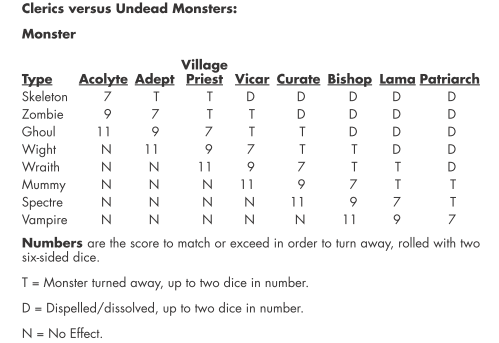
Here’s how it was presented in the white box, rolling 2d6 on the following table:

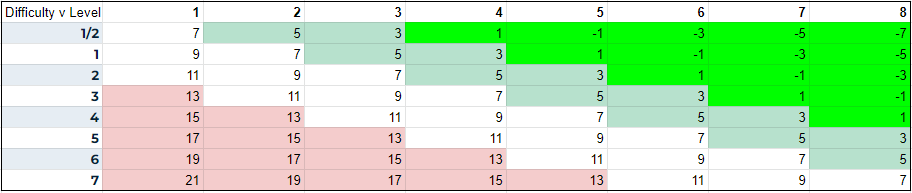
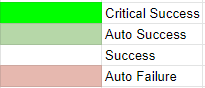
Typical of Gary’s approach to rules, it presents as a table something that’s actually a simple formula, but that’s by no means obvious shorn of the numbers. The columns are actually the cleric’s level, 1-8, and the rows are the monster’s hit dice, 1/2 through 7. So really what this is presenting is that clerics have a Target Number of 7 against undead 1 hit die less than them, and it gets 2 points harder for each additional hit die the undead has, and 2 points easier for each hit die less. If the number is below 7 turning is automatic, and if it’s literally impossible to fail the undead is destroyed; similarly if it’s impossible for the cleric to succeed, the result is No Effect. Building in the automatic success, critical success, and automatic failure in this way is really sweet, and pegging the target below which you don’t even need to roll to better than 50% chance of succeeding really speeds up play, in my experience.

HD12345678
Skeleton1/27531-1-3-5-7
Zombie197531-1-3-5
Ghoul21197531-1-3
Wight3131197531-1
Wraith415131197531
Mummy5171513119753
Spectre61917151311975
Vampire721191715131197
Turning Table as Target Numbers

So here’s the thing: here we have a method of comparing a character’s level with a target difficulty. For undead it’s just their Hit Dice, but you could imagine it being the dungeon level a hazard or lock is found on, or any sort of ad-hoc decision by the DM. What’s more, the 2d6 scale fits in nicely with attribute bonuses ranging from -3 to +3 as per Moldvay and its descendants. +/-1 is not quite as good/bad as being 1 level higher, +/-2 is equivalent to a level, and +/-3 is a bit better than being a level higher/lower. That seems pretty nice to me.

But wait, there’s more! How much does each bonus improve your chances of hitting the Target Number? Here’s a quick chart:

TotalExactAt least+1improvement+2improvement+3improvement
23%100%100%0%100%0%100%0%
36%97%100%3%100%3%100%3%
48%92%97%6%100%8%100%8%
511%83%92%8%97%14%100%17%
614%72%83%11%92%19%97%25%
717%58%72%14%83%25%92%33%
814%42%58%17%72%31%83%42%
911%28%42%14%58%31%72%44%
108%17%28%11%42%25%58%42%
116%8%17%8%28%19%42%33%
123%3%8%6%17%14%28%25%
Chance of rolling at least N on 2d6, rounded nearest

The improvement in probability of success isn’t uniform, but you can see that the biggest differences fall right at the fat part of the distribution. It’s a bigger difference on your average roll than on the extremes, not surprisingly, and none of them are over 50%, so not overwhelming. Even nicer is that at best, a +1 is adding about 1/6 to your chances, a +2 is adding about 2/6, and a +3 is adding not quite 3/6. It could hardly be easier to remember or reason about.

To me this is actually pretty amazing: Roll 2d6 vs Target 9 against things that are even-on with the character in terms of level/hit dice, adding in any attribute modifiers, and Bob’s your uncle! If I were coming up with a mechanic de novo, I might be inclined to make even-on a target 7 but I can see an argument that if you have no particular reason to be good at a task it’s realistic that it’s more likely than not you’ll fail. I’m tempted to use Target 7 anyway as just being a little easier to remember, and being a bit more like the way combat works, with Level 1/HD 1 attackers being about 50-50 to hit unarmored foes, but I’m not sure whether I like Clerics vs. Undead then being a special case…

So there you have it, my new go-to Universal Mechanic for all older editions of D&D and their kin.

Eclectic ART IN RPGS

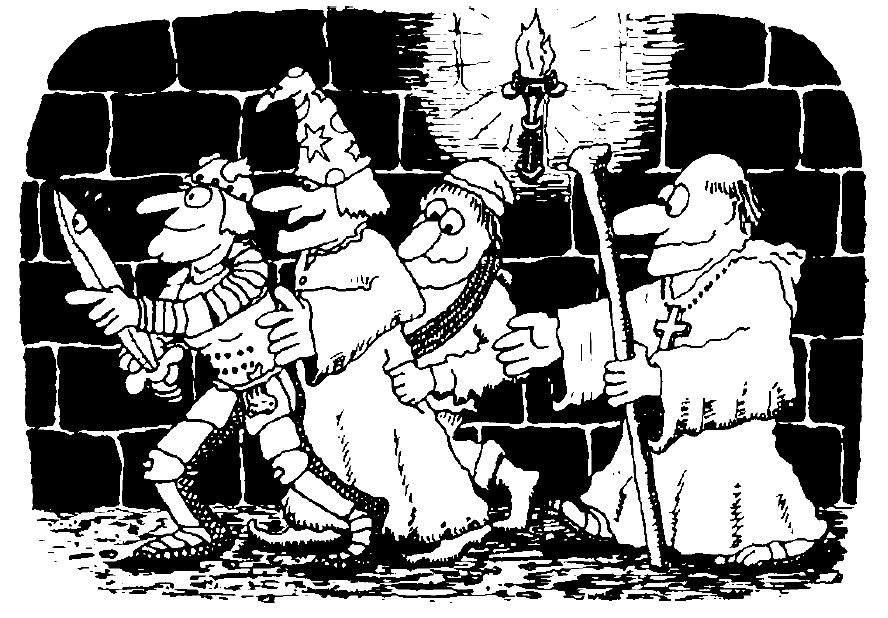
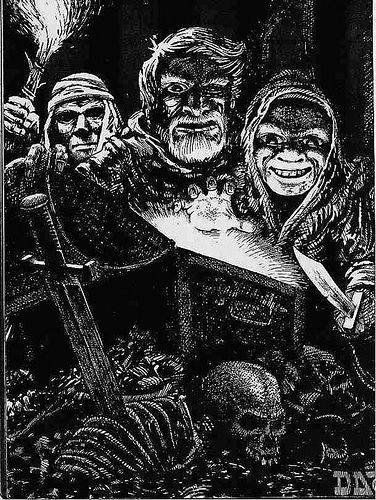
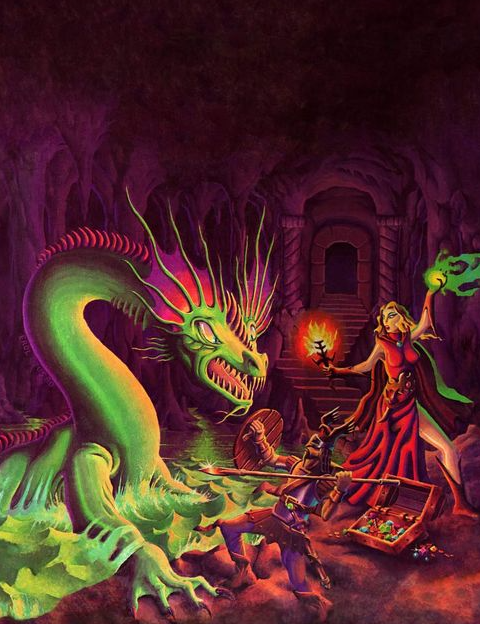
I think when it comes to RPG books, it’s good to have an eclectic mix of art styles in the illustrations. The early D&D books were aces at this, ranging from the actual cartoons of Tom Wham, to the grounded illustrations of Dave Trampier, to the trippy works of Errol Otus. I think this kind of diversity is important because you never know what will strike a chord and provide inspiration for a game. Books that have a very clear “house style”, like some of the later editions of D&D, have a harder time of this, imo. If it hits, it hits, but if it doesn’t there may not be anything in the whole book that really sparks your imagination.

Now some of the time, like maybe a setting guide or something based on some specific IP like StarWars, setting tight boundaries on the tone and imagery might be exactly what you want. But I think in the general case, you want to have the art run the gamut.

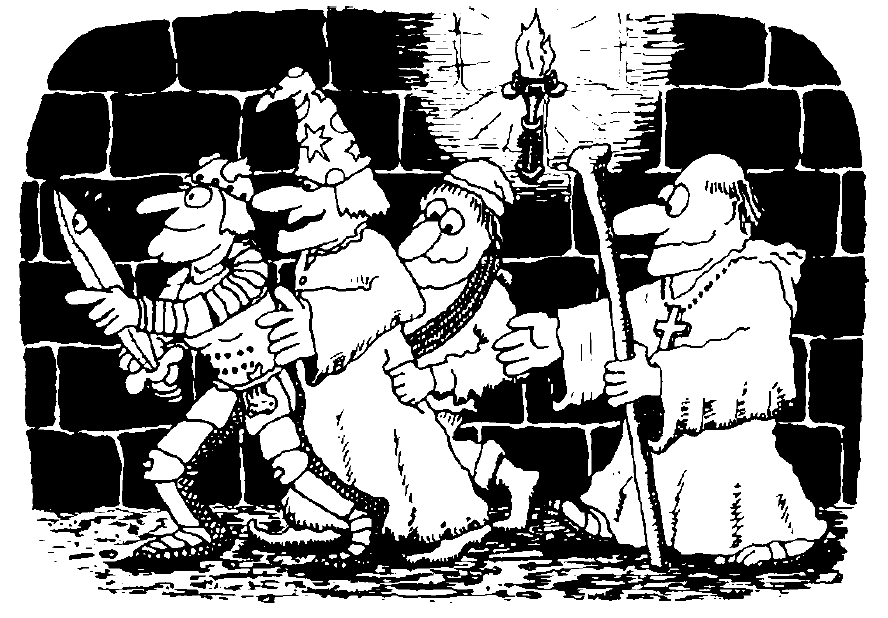
The Adventuring Party – Tom Wham

Players Handbook – Trampier

The Discovery of Treasure -Trampier
Sutherland – Versus the Orcs

Basic D&D – Errol Otus

Conventions of Play

Not playing at conventions, but conventions I’ve adopted in my games (mostly regardless of system or genre) to try to shape the play experience to encourage or avoid certain kinds of play at my table. These aren’t house-rules, most of them being meta-rules about what is and isn’t allowed by the GM or the players. Also most of these are guidelines, and might be relaxed on certain occasions or if everybody is agreeable.

  1. No Player-vs-Player action. No attacking other PCs, no stealing from them, no actual intra-party conflict. “Pretend” intra-party conflict, where the players roleplay that their characters are squabbling like Legolas and Gimli, but pull together as a team when the action starts, is fine. But if tempers start to rise, I cut it off. There are a lot of players and groups where this kind of stuff is meat-and-potatoes to them, but I’ve been burned too many times by what’s started out as a bit of fun and escalated until it ruined the game for everybody, so I take a hard line on it now.
  2. No Torture. Torture is something evil NPCs do off-screen to other NPCs, or a player might have as something that happened to their character as part of their back-story, but it never gets any play time. As a corollary, captured NPCs will always spill their guts to the PCs at the slightest encouragement; they may not know much, but I explicitly promise to the players that as GM I will never create a situation where they would be better off torturing a captive for the information they need regardless of how plausible they might find that in real life.
  3. No Using PC’s Attachments Against Them. Unless the player volunteers for it, I promise as GM that if they form bonds or connections with various NPCs and locales, I’m not going to use that for cheap drama or as a way for an NPC villain to compel their cooperation. Yes, that cuts off a bunch of seemingly interesting stories and scenarios, but you know what also cuts off a bunch of interesting RP? Players refusing to form any bonds or connections with any of the setting for fear of having it held hostage or weaponized against them.1
  4. Mercy Works. There’s a thing that some GMs like to do (and I admit I’ve done sometimes in the past) where if you let a bad-guy get away, it’ll come back to haunt you. It’s tempting because recurring villains are a staple of a lot of genre fiction, and the players having a back-story with the villain can be so satisfying, particularly when the players come to really hate the villain. He shows up again and they’re automatically invested. The same thing can happen with un-named mob monsters or bandits, where if you don’t kill them when you have the chance, they’ll just bother you another day. The problem is that players are usually very rational, and very ruthless, so unless you’re enforcing genre conventions that forbid it (e.g. codes against killing in super-hero games) the players learn to leave no living enemies… but that can really mess up the tone of the game, and I think contributes to murder-hoboism. It’s also relatively unrealistic, at least if you go by the history of warfare in our world. There were lots of reasons historically to take captives and not kill them, or to let fleeing soldiers get away, if for no other reason than it stiffens the resolve of the enemy to die rather than be captured but the structure of a lot of games (especially dungeon crawls) makes that difficult to implement. My solution to keep my players from committing war-crimes (or at least reduce their number) is to have the players’ intelligent foes be permanently defeated: if the players show mercy, they will never again oppose them (whether from fear or gratitude) and if the players are generous they might change their allegiance. They explicitly will not be constantly searching for ways to backstab the players.
    This one is a bit more squishy than the others, because it really depends on what it means to defeat the enemy. If they fail a morale check and rout, then yeah, they might regroup and be a problem later. What I’m really trying to prevent is pushing the players into feeling they have to slaughter helpless captives or go around the battle-field applying a coup de grâce against anybody who might merely be injured or unconscious.
  5. Surrender is an Option. Bad-guys in my games will usually accept surrender, and it doesn’t mean the end of the PC who surrenders. Even for unintelligent monsters I might think about whether it would drag the victim back to its lair to eat later or something. There will usually be consequences, a ransom to be paid, or they’ll have to escape, but I try not to ruin the character for acting reasonably in the face of overwhelming force. At the very least I’d prefer that Death before Surrender! be a choice that says something about the character and not, well the GM is going to kill my character anyway so might as well go down fighting.
  1. Naturally there are exceptions for game/genres where it’s an explicit part of the game; if you’re playing a super-hero game with the concept of a “Dependent NPC” like Aunt Mae who will get into trouble as a complication for the PCs heroic guise, then something happening like her getting engaged to Doc Ock is still on the table.

Fixing Weapons vs. Armor Class

At the risk of turning this into a blog for commenting on Delta’s blog, here are some thoughts on a post of his back in March about the big error in the infamous Greyhawk and AD&D Weapons vs AC charts.

Basically, Dan observed that there’s a fundamental error in the way the chart was derived from Chainmail to convert it to the d20 “alternative” combat system in original Dungeons and Dragons (specifically the Greyhawk supplement), and that chart was just reproduced and elaborated on in AD&D. The error was in converting Chainmail’s chart showing with this weapon vs. this type of armor roll this number on 2d6 to kill the target into D&D’s roll this on d20 to hit the target, they forgot to adjust for the armor class! Basically, the difficulty of hitting the armor is baked into the Chainmail table, but it’s a completely separate consideration in OD&D, so that e.g. in Chainmail a mace has pretty much the same chance of killing regardless of armor (roll 8 or better), that’s presented in Greyhawk as a mace has no bonus vs. any particular armor so the mace gets worse and worse chance of hitting as armor gets better! Oopsie.

So what would a “correct” version of the Weapon vs. AC chart for Greyhawk look like? That is, one that preserves the logic worked into the Chainmail chart as to which weapons are better against which armors, which seem to have at least rough approximation of what weapons historically were preferred against which prevailing types of armor.

The Chainmail Man-to-Man combat chart looks like this:

Armor Class
No ArmorLeatherShieldLeather+
Shield
ChainChain+
Shield
PlatePlate+
Shield
Weapon98765432
Dagger67889101212
Hand Axe778910101112
Mace88898878
Sword7889891011
Battle Axe888877910
Morn. Star66776788
Flail77776767
Spear889910101112
Pole arms666778910
Halbard88876678
2 Hnd. Swd66665567
Mtd. Lance55556789
Pike888888910
Chainmail Man-to-Man combat

The first thing we have to deal with is all the target numbers in this chart represent kills; in Chainmail there were no hit-points or variable weapon damages. So this chart represents both the deadliness of the weapon and its ability to penetrate various types of armor.

What I’m going to do is assume that the relative deadliness of the weapon is represented by the target number vs. unarmored men, while the penetration ability of the weapon vs the various armors is thus the difference between its “normal” ability to kill an unarmored man and its lessened ability to kill armored men. This normalization gives the following chart of how much worse a weapon is against the various ACs relative to its ability to kill an unarmored man; we’ll presume that in D&D that ability to kill an unarmored man is represented by the weapon damage, from d4 to d12 or whatever.

Armor Class
No ArmorLeatherShieldLeather+
Shield
ChainChain+
Shield
PlatePlate+
Shield
Weapon98765432
Dagger0-1-2-2-3-4-6-6
Hand Axe00-1-2-3-3-4-5
Mace000-10010
Sword0-1-1-2-1-2-3-4
Battle Axe000011-1-2
Morn. Star00-1-10-1-2-2
Flail00001010
Spear00-1-1-2-2-3-4
Pole arms000-1-1-2-3-4
Halbard00012210
2 Hnd. Swd0000110-1
Mtd. Lance0000-1-2-3-4
Pike000000-1-2
Normalized

So here we see the relative values of armor against a given weapon. Against a mace, no armor really helps, though leather + shield is a tiny bit better than unarmored and plate is a tiny bit worse. Swords, though, quickly become ineffective against heavier armors, which take a two-handed sword to punch through. Mounted lances and spears are almost completely ineffective against plate + shield combination. This all seems plausibly historically accurate.

Finally, though, we have to convert this to d20, taking into account the way armor class is worked into the target number to hit on a d20 (the crucial step the author(s) of that section of Greyhawk forgot). This yields the following chart of modifiers that preserve the penetrating power of weapons from the Chainmail rules:

Armor Class
No ArmorLeatherShieldLeather+
Shield
ChainChain+
Shield
PlatePlate+
Shield
Weapon98765432
Dagger00011101
Hand Axe01111222
Mace01224577
Sword00113333
Battle Axe01235655
Morn. Star01124445
Flail01235577
Spear01122333
Pole arms01223333
Halbard01246777
2 Hnd. Swd01235666
Mtd. Lance01233333
Pike01234555
Weapon vs Armor Adjustment Corrected

And here we see, as intended, against an unarmored foe a 1st level Fighting Man armed with a mace would need to roll a 10 to hit, and against somebody with plate + shield would need… a 10 to hit. (To Hit of 17 from the Men Attacking Matrix in original D&D, with a bonus on the roll of +7) Armed with a dagger he’d need the same 10 to hit an unarmored man, but a 16 vs plate armor + shield.

Is it worth it? Frankly, I have my doubts. If Gygax himself never bothered with it, it’s hard to see the added complication of the table lookup every time you switch weapons or foes (assuming they’re not all equipped identically) adds that much. On the other hand, it is kind of logical that you ought to prefer the weapons that were historically favored against particularly heavy armors. One thing that is clear to me, though, is that if you want to have that kind of mechanic in your game you’re better off starting with the Chainmail assumptions and not their mistranslation.