Strength is Size

One thing I tend to do in D&D-esque games is treat the Strength attribute as indicating size as well. (Other games, such as Chaosium’s Basic Role Playing and its kin have a separate Size attribute.) It seems to me, though, that there’s a bunch of pretty good arguments that the two are at least highly correlated, if not one and the same.

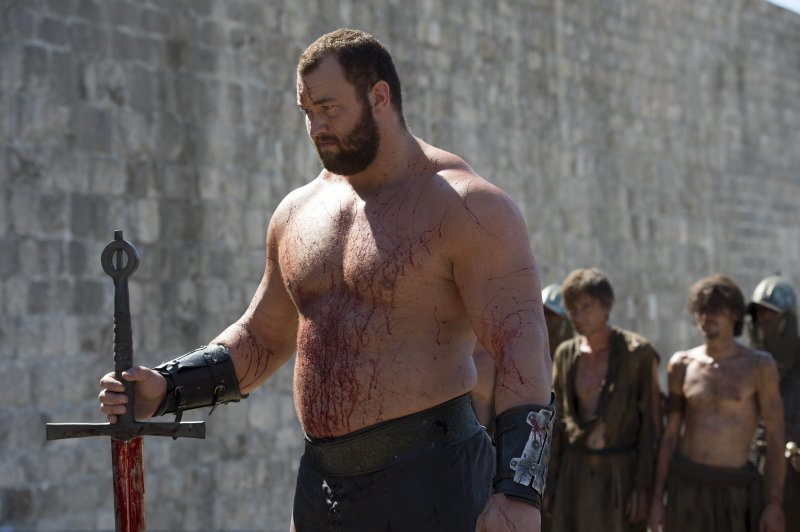
In most combat sports, from boxing and wrestling to taekwondo, as well as sheer strength-based sports like weight lifting, competitors are divided into weight classes for both health and safety reasons as well as to make the competitions more fair (and interesting). The average winner of the World’s Strongest Man competition stands 6′ 4″ and weighs in at 390 pounds!

Moreover, at least in the earliest editions of D&D starting with Supplement I Greyhawk, the two biggest mechanical differences from exceptionally high or low strength scores are to-hit, damage, and carrying capacity. To-hit I think makes perfect sense as reach, which is a huge factor in hand-to-hand combat, as does damage as function of mass (again thinking about weight classes in combat sports). Carrying capacity is a little less clear, in that the additional weight of your body seems to count against your maximum carrying capacity, at least over distances1, but since the bonuses tend to be linear while body weight increases exponentially, I call it good enough for D&D.

As a quick approximation for human, you can look up Strength in the following chart. I leave it as an exercise for the reader to apply adjustments for non-humans, and of course you might decide that any particular character is a bit bigger or smaller than the chart indicates. 2 Or you might decide (as my long-time Friday night GM did) to just roll size separately on 3d6.

SDMaleFemale
HeightHeightWeightHeightHeightWeight
Strength5′ 9″69.301695′ 4″64.10135
SD2.962.922.92272.752.7524
3-2.535′ 2″61.901014′ 9″57.1373
4-2.205′ 3″62.891104′ 10″58.0682
5-1.865′ 4″63.871194′ 11″58.9990
6-1.525′ 5″64.861284′ 0″59.9298
7-1.185′ 6″65.851375′ 1″60.85106
8-0.845′ 7″66.831465′ 2″61.78115
9-0.515′ 8″67.821555′ 3″62.71123
10-0.175′ 9″69.301695′ 4″64.10135
110.175′ 10″69.791735′ 5″64.56139
120.515′ 11″70.781825′ 5″65.49148
130.845′ 0″71.771915′ 6″66.42156
141.186′ 1″72.752005′ 7″67.35164
151.526′ 2″73.742095′ 8″68.28172
161.866′ 3″74.732185′ 9″69.21181
172.206′ 4″75.712275′ 10″70.14189
182.536′ 5″76.702365′ 11″71.07197
  1. Backpack Weight and the Scaling of the Human Frame
  2. Distribution of Body Weight and Height . It’s actually pretty hard to look up data on raw weights instead of BMI, and I’m not particularly confident that the standard deviations in weights correlate exactly with standard deviations in height as the chart would indicate, but whaddaya want for nothing?
D&D & Me (Part III)

For the first Gygax Day, back in 2008, I wanted to try running a one-shot purely Old School D&D adventure in his honor. I didn’t have a copy of OD&D, so I ended up using the Mentzer Basic and a free dungeon that had a good reputation that had been put together by the folks on the Dragonsfoot forums.

It did not go well.

Basically, I had lost all my chops at running D&D, and had not yet steeped myself in the wisdom of the OSR and identifying what was good about the old school way. Despite the fact that I had in days gone by been part of that Old School, my expectations as to what the rules would cover and wouldn’t and my habits of DMing had changed so much over the intervening years that the whole thing was incredibly awkward. The players were frustrated by not having skill checks to rely on to interpret the world, that the dungeon seemed so arbitrary, that they didn’t have their usual ability to craft the characters and backstory for roleplaying opportunities. Most of the players had started playing with Vampire: The Masquerade, or even later, so they didn’t have any nostalgia or even knowledge of the older styles of play. I was frustrated that I couldn’t really keep the momentum of the game up, there were too many times when I thought I had to look something up and it turned out there wasn’t a rule for it, or there was but not where I expected, or it didn’t make sense to me. It didn’t help that I had gotten it into my head that I really wanted to try it “rules as written” instead of just winging something that was inspired by those old dungeon crawls that I remembered fondly.

After that one-shot they were pretty much done with that. I still felt there was something that I was missing; I knew that even if D&D wasn’t everything you could want in an RPG, back when we played D&D regularly it was tense and exciting. It certainly shouldn’t have been boring. It was around then that I began reading a bunch of blogs that focused on old-school play, especially Grognardia and Jeff’s Gameblog.

I began thinking a lot about Old School play, and what I could take from it, and what we had the most fun with back then. It was also around then, maybe a bit before, that my friend Mac’s kids were old enough to be interested in playing D&D (in her household, all RPGs were “D&D”… she’s the DM of the AD&D campaign I mentioned before, that had been running since she was in high school). Playing as a player with them, and later as a DM, let me see thing from a fresh perspective, with players brand new to role playing, including my then new bride, who played with us and had even less exposure to RPGs than the kids had. Seeing them play, and contrasting how confusing my wife had been finding the much more open-ended and free-form RPGs that she’d been trying with my regular group with the much more structured play and environment of Mac’s dungeon-delves, and how things suddenly “clicked” for her gave me a healthy new respect for the “outmoded” design choices of Old School Dungeons and Dragons. Limiting the new player’s choice when creating a character to what class given your randomly rolled stats was brilliant compared to “What do you want to play? we can help you design anything!” Ditto for leveling up. Constraining the decisions you need to make when interacting with the environment initially to things like “do you want to go left towards where you hear the noise of growling, or right towards where you see the cobwebs?” really helped my wife in particular understand her “role” in making decisions for her character, where analogies to improv theater or storytelling left her confused and timid about not “making a mistake” regardless of how many times the other players had reassured her that there was no wrong answer to the question “what do you do next?”

Over the next few years I continued to toy around with D&D-related OSR stuff, mostly in as a player in on-line campaigns, or running games using Michael Curtis’ Stonehell dungeon for the kids. I was fiddling a lot with different retro-clone rulesets or kitbashing my own, because there always seemed to be things that just didn’t sit right with me with how these versions of D&D worked… I could play in them or even run them and have fun, but they always seemed like compromises between what I would have preferred running and what the players I was with wanted and expected.

Eventually 5th Edition came out, and my home group tried that with the Mines of Phandelver; it was reasonably fun, but I could see it would be a lot of work to GM as characters went up in level and got more and more abilities that the GM would have to pretty thoroughly understand. Maybe not as bad as the days of the old 3e “splat-books” where selling new game-bending rules and feats for the players to bring into the game became the business model, but way more than my ideal of being able to hold more-or-less everything in my head to run without having to look up rules at the table. When the party TPK’ed in the last session in the Mines, I was actually planning to keep running 5e, but we took a quick break to run a DCC adventure and all the players liked that more so the Out of the Abyss campaign I was planning for the TPK’ed party (they had mostly fallen to 0, not been killed outright) never got off the ground.

Fast forward to the present, where thanks to the pandemic we have to play online and I’m actually running the group through The Mines of Phandelver again. Originally I planned to call it Re:Phandelver and make use of the trope where the protagonist(s) fail at the end and then somehow wake up back in the past as their younger selves, but with all their memories of how things played out in the original timeline intact. Except it turned out none of them actually remembered what had happened when we played through the first time, not even which characters they’d played… so instead we’re doing in straight. The online tools really help with running the game, and using Roll20 with the maps and dynamic lighting is different and interesting. I can still foresee a time when the complication of high-level 5e play may wear me down, but hopefully this whole social distancing thing will be over before we reach that point.

D&D & Me (Part II)

The next phase of my involvement with D&D came decades later, barring a terrible AD&D campaign a friend of mine ran in college that I only participated in for a month or two, around the year 2000 when I started playing a heavily-house-ruled version of AD&D after I move to Pennsylvania, with a friend who’d been playing that same homebrew campaign-world since she was in high-school. She was one of those DMs who did all the rolling, and the the players were never sure what the rules actually were beyond what was on the character sheet. While I really loved getting together with these friends every week, I was actually kind of relieved on the weeks when we played board-games instead. The almost exclusive emphasis on dungeon crawling through fun-house dungeons, with turn-by-turn foot-by-foot mapping and minimal interaction between characters was pretty much everything I disliked in D&D. Eventually I learned to find the fun in it, mostly by trying to make each character memorable and distinct despite having basically no customization other than choosing a class (even race was restricted by a random roll for place of origin). Once her kids had all gone off to college we played D&D very rarely, though we still got together every Friday until the pandemic hit.

When Dungeons and Dragons 3rd edition was released, originally, I wasn’t much interested. I felt I had moved on from D&D, and a lot of what I liked in RPGs I viewed as being in opposition to the design of D&D. Eventually, though I picked up a copy just to see what everybody was talking about, and while I wasn’t smitten with it, it did seem to be a significantly more “modern” design as far as character customization and detailed resolution went. I wasn’t going to immediately switch my home group over to it, but around 2005 I was open to running it online for some friends who were interested in trying it and were having trouble finding local gamers.

This was in the long, long ago before there was anything like Roll 20 or Fantasy Grounds, but I found a (now discontinued) program called ScreenMonkey from NBos that promised to be at least a step up from playing purely over AIM or irc, and we gave it a whirl. That campaign actually lasted almost three years, and was set in the Forgotten Realms. Eventually what made me tire of it was exactly that… I really didn’t know or care much about Forgotten Realms, but some players were very into it, which is why they’d asked for an FR campaign in the first place. There wasn’t any blow up, but the mismatch between the effort it took to provide them with what they were looking for each week and how much I enjoyed running FR-based materials created entirely from scratch caused me to put it on hiatus that became permanent.

Meanwhile at some point my home group *did* switch over to playing 3e, at least as one of the games in our rotation, mostly because my friend Russell liked it and my group really liked his GMing and the setting he’d created. We had some really fun and memorable adventures, but I eventually noticed that the crunch was a real drag on the players as they leveled up. It got to the point where when they reached a new level, they just handed their character sheets over to Doug, our rules monkey, to do all the grunt work leveling them up. When Russell’s job stopped being bi-coastal, the once a month game turned into once-in-a-blue-moon, and that was pretty much it for our 3e experience.

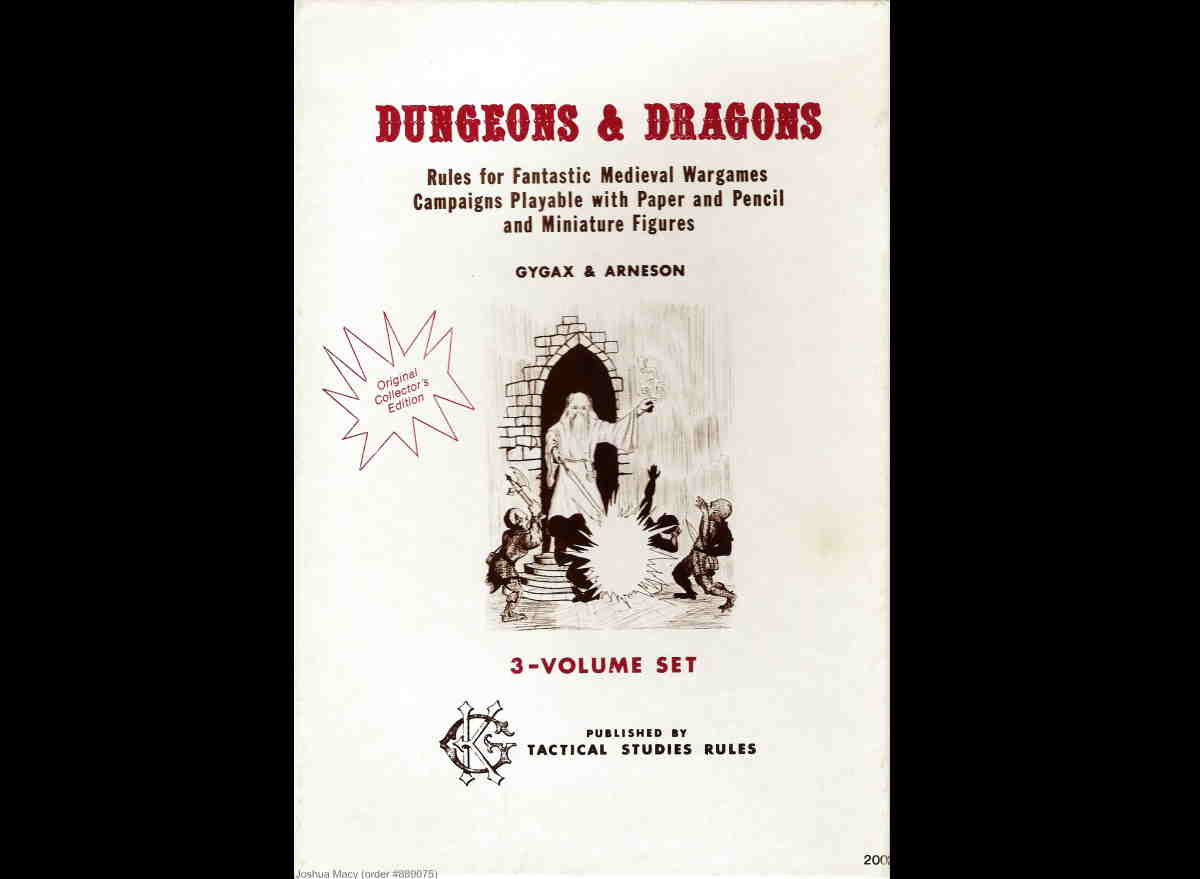
D&D & Me (part 1)

Back in 1975 my father took me to The Games People Play in Cambridge, Massachusetts, and bought me a copy of the new game Dungeons and Dragons, which he had read about somewhere (I think in some science fiction magazine). That gift literally changed my life. Hardly a day has gone by since then when I haven’t read, written, or done something to do with RPGs. All of my closest friends, save one, are people I met doing RPGs, and almost all them I still game with at least semi-regularly.

My first game group was my 6th grade friends, none of whom had ever even heard of the game, and a teacher I roped into running an after-school club for us to play D&D. I played D&D almost every chance I got, and when I wasn’t playing I was making dungeons, doodling monsters, or reading fiction that would work its way back into the game. I remember actually running a fairly longish campaign in High School set in Xanth, based on the first two books. The girls in our group1 liked that better than the previous Arduin Grimoire-based campaign; I’m not sure whether it was because it was more whimsical or they just liked having what were in effect super-powers instead of magic spells.

In the beginning I was the only DM in our group, but my step-brother started to DM as well, and we played a lot of two person games with one or the other of us as DM and the other as a lone PC, possibly with retainers; it never seemed to occur to us that one person could run more than one PC and having a party would make things such as recovering the bodies of fallen adventurers easier. We never worried much about lethality, because resurrection was easy in our games. In my Arduin game, it was something that the inn-keeper at the home base could do for you; granted, influenced by the over-the-topness of some of the Arduin random encounter charts the inn-keeper was a Platinum Dragon, whose human form was a 70+ level “techno.” We made all of our own dungeons and setting materials; I never actually even purchased any of the classic adventure modules, although I did get the Judge’s Guild City-State of the Invincible Overlord and my step-brother used it pretty heavily for a while before making his own cities and overland maps. We heavily modded the combat and magic systems, borrowing from Steve Jackson’s Melee and Wizard tactical fantasy arena combat games.

Actually, though, I moved on from D&D pretty quickly, both through D&D-likes such as Empire of the Petal Throne, and Arduin Grimoire, and also outward to different takes and genres: Chivalry and Sorcery, Runequest, Traveller (lots and lots of Traveller), Villains and Vigilantes, Metamorphosis Alpha, Gamma World, The Fantasy Trip… if it was an RPG of the era, I probably tried it. By the time the Advanced Dungeons & Dragons Players Handbook came out in 1978 I mostly thought of myself as an ex-D&D player. It had been fun at the time, but it was too limited and clunky. There were so many better, more coherent, and “realistic”2 systems out there. It chapped my hide that to the general public they were all “D&D.”

My complaints about D&D were the usual ones: what’s a hit point, anyway? How can one person have so many multiples of how much another person has? In what world is a cat a deadly threat to a wizard? Class restrictions are so pointless, and invalidate so many good character concepts. Balancing wizards by making them nearly useless at low levels and god-like at high levels doesn’t actually accomplish anything useful when it comes to day-to-day play. How does armor make you harder to hit, shouldn’t it just reduce the damage? How can people possibly be moving so slowly both in and out of combat?

I kept trying new systems, but eventually most of my gaming moved to various home-brews of my own devising that–mostly by design–rejected most of the features of D&D. It would be a long time before I played D&D again. But that’s a story for Part 2.

1- We had girls in our groups, even from the earliest years. The stereotype of D&D being something that was only played by boys never matched my experience.

2- Yes, I used to value realism, or at verisimilitude, in RPGs very highly, while having a pretty narrow view of what counted. But I’m much better now.

House Rules Swiped from DCC

In my last post I mentioned playing OD&D using Dan Collins’ Original Edition Delta plus some house rules that I swiped from DCC because I feel they’re essential. Commenter tipsta asks which ones and why.

  • Luck replaces Wisdom. Clerics don’t exist as a class (as per OED), which makes Wisdom a dead stat except for things that I really don’t favor rolling for (“insight checks” as modern editions would have it). Replace it with Luck and everything is golden.
    Why?
    • Allowing players to spend Luck from their very limited supply gives them some say in what rolls are really, really important to them, and somewhat mitigates the fact (mentioned before on this blog) that streaks of unlucky rolls can make a competent character seem like a yutz because every time we see them perform we see them fail.
    • Rolling against Luck or having things that hit a random party member hit whoever has the lowest Luck is a dead simple mechanic that covers a lot of things that come up during adventures that need some kind of decision procedure, and adds flavor.
  • Rolling the Body Roll under Luck after a combat to see if your character thought dead miraculously survived, but permanently reduce Con by 1.
    Why?
    It’s a great rule for making D&D a tiny bit less lethal. OED has a roughly equivalent Save vs. Death at 0 HP, and white box had a %chance to survive (survive what? It never said) attached to high Con scores. 5e’s Death Checks are maybe more tense, but they’re not self-limiting the way Rolling the Body is: eventually if they keep rolling your body you’re going to run out of Con.
  • Halfling Luck. Halflings get to spend luck on other people’s rolls or themselves and recover level in Luck per day. When Halflings spend luck they get 2 points for every point spent (Halfling Thieves rolling luck dice instead, as normal).
    Why?
    Differentiates them more from Elves and Dwarves, in a way that really feels like the source material.
  • Mighty Deeds for Fighters. Fighters can attempt a Mighty Deed of Arms by declaring what kind of combat stunt or maneuver they’re attempting (such as knocking a foe down or back, blinding them, disarming them, tumbling between their legs, etc.) They forgo their normal Attack Bonus based on level and roll a Deed Die which gets used as the bonus instead; in addition if the deed die shows 3+ and the attack hit the DM rules on how effective the maneuver was based on how much it exceeds 3. E.g. A blinding attack that rolls a 3 on the Deed Die might get blood in their eyes and give them a -2 next round, while a 7+ might force them to Save vs. Paralysis or be blinded permanently.
    Why?
    Gary Gygax, with his “fast and furious” one-minute combat rounds didn’t see any need for anything more than the DM adjudicating attempts to do combat stunts like knock somebody down, blind them with your torch, or what-have-you, while later editions piled on rules and maneuvers for special cases. The Deed Die solves all that with a universal mechanic for off-the-wall stunts that still leaves enough room for DM interpretation to keep it from becoming some kind of story-game narrative push. I also allow non-Fighters to use a Deed Die, but theirs is always a d6 with success on a 6, instead of the Fighter’s growing Deed Die with success on a 3+.
  • Luck Die for Thieves. As per DCC Thieves cans add their Luck Die to any of their rolls by spending a point of Luck, which they recover 1 point per level per night.
    Why?
    Thieves skills suck, and always have. Except for climbing, all of their signature skills start at around a 1 in 6 chance to succeed rising all the way to a 3 in 4 chance at 9th level. Even if you interpret it Philotomy-style as being an extraordinary ability (anybody can hide, thieves can hide in shadows!) for most of the Thief’s career they are going to fail at most things they attempt. OED makes rolling to fail not require looking up anything on a chart, but doesn’t change the probabilities (which, admittedly, is kind of the point of how Dan derived the rules). As soon as you add Luck Dice and Luck regeneration to Thieves they probably *can* succeed in the clutch, when lives or fortunes are on the line… but only a few times a day. In a game where a first level Wizard can have an encounter-winning spell like Sleep once a day at first level, being able to probably guarantee success roughly as often for picking a lock or moving silently is only fair.
  • Re-Casting Spent Spells Through Spellburn. Same as DCC rules, it’s a point of Spellburn (a point off of either Con, Str, or Dex) per level of spell… plus to succeed they’ll have to roll a check d20+Int Bonus+Caster Level-Spell Level against Target 20. The Spellburn has to be done each time you want to cast a spell you’ve already use up for the day. Attribute points recover at the same rate as Hit Points, which in OED is level per week of rest and relaxation in comfortable surroundings.
    Why?
    The single thing that players have complained most about in all the time I’ve been playing D&D, going all the way back to 1975, is the limited number of spells per day at low levels. A couple of times per day, the wizard gets to be a wizard, the rest of the time he can cower behind everybody and toss daggers. This is one of the first things that used to get replaced with some sort of spell-point system with many fewer spells known but some pool of points limiting how many times they can be cast, or in modern editions “cantrips” that are roughly equivalent to throwing a dagger but can be cast infinitely. The thing is I like the strategic aspect of the Magic User having to decide which spells to equip each day; I think it adds a lot to the game. I also think that encouraging players to use a variety of spells, rather than to save all their spell points/slots to cast their single best spell (usually Sleep at low levels) is an important consideration. Keeping the Vancian casting limits, but including the DCC “out” that you’re never completely out of spells as a wizard as long as you’re prepared to sacrifice something valuable gives you the best of both worlds.
  • Dwarves can smell gold, and Elves are allergic to iron.
    Why?
    The RP aspects of both of these are just too much fun to do without.

The Fallen Lands

I’ve created an Obsidian Portal site for my online Fallen Lands campaign. My Sunday group has actually switched to doing 5e Phandelver on Roll20 during the quarantine, but I fell in with a new group that was playing OD&D and they expressed interest in playing a second night a week with me refereeing. People have a lot of time on their hands thanks to the pandemic.

So far we’re three sessions in, with the next session scheduled for tomorrow, (Wednesday the 26th of August, 2020). I’m using Dan Collin’s Original Edition Delta house rules, which smooths out some of the rough bits of the white box edition, plus some house rules of my own, mostly swiped from the bits Dungeon Crawl Classics that I can’t really do without any more.

It seems to be going well, and it’s a real pleasure to run compared to some of the later, fancier editions. Even 5e, which does away with a lot of the cruft, and with support of some excellent tools in Roll20, feels like heavy lifting compared to OED. But more on that later.

Infravision

I was just watching a whole discussion that Dan “Delta” Collins and Paul Siegel were having on their Wandering DMs YouTube channel all about Infravision, and just when I was going to leave a comment about how I would rule it, they came to my preferred solution: treat it like thermal imaging.

Basically, if you’re going back to the beginning when Elves and Dwarves had “infravision” and not “dark vision” or “low light” vision, the question is what exactly can they see, and how far. Can they see details?  Colors?  Is the ability washed out by torches? The LBBs are actually silent on the whole matter, while Chainmail says Dwarves and Elves “can see in normal darkness as if it were light”.  Interestingly, so can Wizards (in OD&D that must be the purpose of the Infravision spell).  Greyhawk specifies that Dwarves can see monsters up to 60′ away in the dark.

I’m not 100% sure of how we ran it back in the day, when we didn’t even have Chainmail but did get Greyhawk shortly after it showed up in the local game store.  As best as I can recall, though, we took the “see monsters” and “infravision” description pretty seriously, treating it as the ability to see heat.  That meant no ability to discern anything that wasn’t hot: no stone walls, doors, statues, traps… if it wasn’t warmer than the surroundings it just wasn’t visible without a light source.

Interestingly, I don’t think we arrived at that because of concerns of the distances lanterns and torches worked vs. the 60′ for infravision, because we mostly didn’t track light sources and the like.  It was too finicky for us, we just wanted to kick down doors and kill monsters and take their stuff.  Maybe there was an occasional trap or something that  dunked you in water and doused your torch, but I just don’t recall much if any discussion of how far down a corridor you could see…but I do recall discussions of things like whether zombies were room temperature or not.

The only thing I think I would do differently now is I’d probably let Dwarves and Elves operate in “ordinary darkness”, that is to say outdoors at night, as if it were daylight as per the Chainmail rules.   It’s only in dungeons and caverns where you have near total darkness,with barely a stray photon, that I’d be more strict about the limits of infravision. And I think that Paul has a good point in the video, that you don’t want characters able to see up to 60′ in a dungeon with perfect clarity: most published dungeon maps are drawn to a scale where seeing that far spoils all the surprise about what’s down at the end of the corridor, or lurking in the far side of a big room.  On the other hand, being able to see if there’s a living creature down there, but nothing about its surrounding or maybe even what it is… that’s giving the players options while keeping things still a bit spooky and mysterious.

Having infravision washed out by nearby heat sources like torches, as in later editions of D&D, strikes me as more trouble than it’s worth, particularly if you’re limiting it to only what infravision as thermal imaging would show.

One bit that I  don’t recall seeing much online discussion of, and that Dan and Paul didn’t touch on, is that it’s clear from Book III of the LBB that “Monsters are assumed to have permanent infravision as long as they are not serving some character.”  I recall somebody somewhere pointing to that as evidence of the “Mythic Underworld” nature of dungeons, and I may run with that for my End Times campaign.  Or I may forget about it  as just another thing that’s too fiddly to worry about.

Original Edition Delta Plus DCC

As much as I’m looking forward to getting back to the stark simplicity of OD&D (as streamlined and simplified by Original Edition Delta) there are certain rules from Dungeon Crawl Classics that I’m unwilling to do without because they fix what seems to me to be genuine problems with OD&D (at least for me and my players).

  1. Mighty Deeds for Fighters. The DCC Mighty Deeds rule just makes Fighting Men more fun to play, and really makes up for the relative lack of options that FM get as they level up and the other classes get more and better abilities.  More than that, it gives me as Dungeon Master and simple and consistent way of adjudicating all the crazy shenanigans that Fighting Men ought to be getting up to: tripping, disarming, swinging from chandeliers, throwing sand in the face of the foe, etc. Of course I can make rulings on the fly, but I appreciate having a rough framework to help.  Gygax, et. al. had an actuarial approach to combat: as long as over hundreds of rolls the statistics worked out, who cares what happens moment by moment in a combat round.  Only everybody I play with regularly, that’s who.  Even back in the 70’s we never really paid attention to the “fast and furious” one minute combat rounds.
  2. Luck instead of Wisdom.  Since OED removes Clerics, and I agree with the reasons for doing that, it leaves Wisdom as a dead stat.  Luck is better for a pulpy game, and the ability to spend Luck when you really need to succeed, coupled with the sure knowledge that your Luck is running out when you do that does great things for the game, IMO.  It also helps with the the problem I sometimes perceive of an allegedly competent character getting a few unlucky rolls and coming across as a useless twerp; yes, in the long run the probabilities will prevail, but in a game with a decent dose of lethality we may all be dead before the long run. I’m not usually a fan of “meta” game currencies like Hero points and the like, but Luck is different… characters like Fafhrd and the Gray Mouser worry about their luck in a way that makes more sense with Luck as a spendable resource than just what you get from rolls of the dice.
  3. Luck Die for Thieves. as per DCC Thieves cans add their Luck Die to any of their rolls by spending a point of Luck, which they recover 1 point per level per night. Thieves in OD&D suck, and OED just simplifies the math around that.  I know all the apologetics for really low chances of success at anything except climbing (not even reaching 50-50 chances until nearly name level), and probably have written a few myself.  The fact remains that, except for climbing, you’d be better off playing a Fighting Man or Magic User that sneaks around and steals stuff.  The Luck Die fixes all that.  Even with your terrible starting probabilities, if you spend Luck you can make it count when it’s important.
  4. Recovering Spells Through Spellburn. I’m not going whole hog into the DCC spell charts, because as great as I think they are, some of my players seem to really resent the randomness.  So we’ll be using the clearly defined OED Book of Spells and the usual spells per day charts, but since I think that oh, you’re out of spells, you can just throw daggers is and always was lame, while the 5e solution of endless cantrips makes the game feel like a JRPG setting I’m going to let Wizards attempt to cast an already expended spell via Spellburning. Same as DCC rules, it’s a point of Spellburn per level of spell… plus to succeed they’ll have to roll a check against DC 11+ spell level. The points of Spellburn to recover the spell won’t add to the roll, but I’ll probably let them burn more to try to make sure that the spell actually goes off. I’m definitely going to make them roll on the creepy Spellburn actions chart instead of just ticking off the points of STR, DEX or CON.
  5. Rolling the Body. Instead of death at zero HP or Delta’s rule allowing a Death Save, just roll the body after combat per DCC: roll less than your remaining Luck and you miraculously survived… you haven’t burned all your Luck, have you?  Heh. Heh.  The loss of a point from a random physical attribute will keep this from being a permanent “Get Out of Death Free” card even for players who hoard their Luck.
  6. Crits and Fumbles from DCC. I like Delta’s rule about being able to save against crits and fumbles, as well as 1 HD or less creatures not generating crits, but the Good Hits and Bad Misses chart from the Dragon magazine that he uses strikes me as both too bland and too punishing.  I think I prefer the DCC charts as well as the way that Fighters’ crits are better than other classes and improve with level.  I think I’m also going to keep DCC’s rule that Thieves crit on back-stab, too, instead of just boring old double damage; the victim will still get a save as per Delta.
  7. Dwarves can smell gold, and Elves are allergic to iron. Those are just too much fun in RP terms to part with.  Magic armor and weapons won’t pose a problem to elves, that would be too cruel, but they better stick to leather and weapons like bows and spears or try to find some mithril until they can get magic. I note that in OD&D encounters in the wild, bands of Elves have AC 5, which implies either chain without a shield or (more likely at least in this setting) Leather, Shield and a +1 from DEX.

Touché: touch attacks in DCC

This one isn’t even a House Rule as much as an observation that any attack that would have hit but for the AC bonus armor grants presumably smacked the target but failed to penetrate the armor. I like to emphasize this when describing the result of the attack. In DCC this is dead easy because the dividing line between a clean miss and at least hitting the armor is just 10, give or take agility modifiers.

I like this both because it makes the description more vivid at almost no cost and because otherwise some folk get hung up on the notion that armor is making you dodgier and want to introduce some sort of damage reduction instead. Best nip that in the bud.

I think it’s a toss-up whether you want to extend that observation to true 3e-style “touch attacks” where spells like Chill Touch only need to beat the AC before armor bonus in order to take  effect, or you stick with beating the AC.  On the one hand, if the caster has to get into melee and beat the AC that makes all the levels of Chill Touch where it only lasts one round pretty damn punk.  A spell that probably has less than 50% chance of affecting a target even if you succeed in casting it (up to a check of 17), and then only if you put your unarmored wizard in the thick of things, and always costs a point of Spell Burn to cast? What a rip-off.   On the other hand, if you allow that kind of touch you actually need to worry about how much of a foe’s AC is armor vs agility bonus, and that’s the kind of finicky drag that I play DCC to avoid. How much of a griffon’s AC 17 is tough hide vs. speed?  Obviously you can just make a ruling and go, but it’s one more thing to remember when it comes up. That said, I’m inclined to allow it, if only because of how much my one player who got stuck with the spell hates it when he’s reduced to trying it.

TL;DR Make note of when an attack roll beats 10 but not the AC and use that to inform your description of the attack bouncing off the armor.

Paltry Deeds: A DCC House Rule

Mighty Deeds are one of my favorite bits in DCC, but I sometimes feel that if you have this elegant way of resolving everything that might be a maneuver in a clunkier system (push back, knock down, disarm, blind, feint, etc.) it would be nice if you could apply that to 0-level characters and other classes trying the same kind of stunts.  You just wouldn’t want them to be as good at it, since making  Warriors cool and special is part of the point.

Thus, the following house rule: anybody can at least try a minimal deed in conjunction with their regular action (called here a Paltry Deed) by rolling a d6. Whatever they roll isn’t added to their to-hit or damage, but if they get a 6 and their Action Die is also a success then they accomplish their declared Deed as if they’d the rolled the lowest level of a Mighty Deed.

Variant 1: You don’t want them trying all the time, so to attempt a Paltry Deed they have to drop their action die 1 level.

Variant 2: That’s all very well, but shouldn’t they be slightly better if they have a high attribute value in the thing they’re attempting?  Well, the attribute value will help them in the roll on the Action Die, but if you want to tie it to Attribute Bonus then they have to get the highest result possible on a :

Paltry Deed succeeds on highest possible roll on
-3 d12
-2 d10
-1 d8
0 d6
+1 d5
+2 d4
+3 d3

Variant 3: The real problem with Paltry Deeds is you never improve as you level up, except insofar as your attack bonus improves your chance of a success on the Action.  OK, then look at the Attack Bonus for your level:

Paltry Deed succeeds on highest possible roll on
0 d6
1-2 d5
3-4 d4
4-5 d3
6+ d2

Variant 4: Some wacky combination of the above.  Left as an exercise for the reader.