As part two of “The Macy Conventions”, I want to look at Spell Resistance.
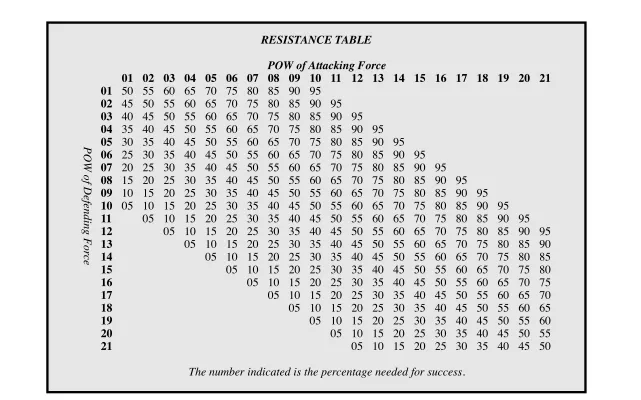
Spell resistance is another thing that’s needlessly complicated in RuneQuest 2e, or at least expressed in a needlessly complicated way. The rule is that to cast a spell on a resisting target, you need to roll 50%, plus 5% for every point your POW is higher than theirs, -5% for every point lower. 96-00 always fails. They even gave you a handy chart to cross index the POWs and see what you need to roll
That strikes me as an ugly way to achieve this result. My house rule is:
Spell Resistance
Roll d20 and add (Your POW – 10)
If result exceeds (not equals) target’s POW, spell succeeds
If result is less than or equal to target’s POW, spell fails
A 1 always fails.
That’s mathematically identical, but seems to me much easier at the table. Most people are very fast at subtracting 10 from a number, even when it results in a negative number, compared to subtracting arbitrary numbers between 1 and 21 and then adding 50.
POW Gain Rolls
If you qualify for a POW gain roll after an adventure (cast a spell that could fail other than the auto fail on a 1 in a stressful situation during an adventure), roll strictly higher than your current POW on a d20 and you can increase your POW according to the regular rule (10% chance of +3 POW, 30% chance of +2, otherwise +1).
This is mathematically equivalent to the original subtract POW from racial max, multiply by 5 and roll less than the result on %.
As is my wont, I’ve been noodling on some older games that have come up in conversation recently, and in particular RuneQuest 2e. I ran a RuneQuest campaign, back in the day, and I’m pretty sure we started with 1st edition, and later switched to 2e (or maybe I just did a different campaign of 2e… wouldn’t be the first time my memory of those long ago events was a little blurry). There were a lot of things I liked about RQ, and later the whole BRP line, particularly Call of Cthulhu, and its percentile dice system was one of the easiest things ever for players to grok. Your skill at driving was 32%, cool, roll under 32 on the percentile dice and you’re golden. Now, what exactly it meant to fail that roll when it was something as mundane as driving was a matter of interpretation and sometimes heated debate, but the basic principle couldn’t be simpler.
But I was never quite happy with the way things like criticals and fumbles were worked into the roll, or in RuneQuest things like impaling with your pointy weapon. The basic rule, with many variations on the exact numbers, was always something like compute 5% of your skill, if you roll that or less you’ve scored a critical hit. For instance if your skill was 100, then 01-05 was a crit; if your skill was 50, then only 01-02 (or maybe 03 depending on rounding). An impale would be similarly 01-20 with skill 100, while proportionally less the lower your skill. Fumbles were the reverse, though explained rather confusingly as starting at 5% (96-00) for skills less than or equal to 20 and being reduced by 1% for every full 20% in your skill (97-00 for skill 40, 98-00 for skill 60, etc.) This meant that unless you were great at mental arithmetic, you had to write down your critical, impale, and fumble range for each and every skill on your character sheet, updating it whenever the skill improved. And if you reached the point with skills at 100+ where you could split your skill into two actions with any division you liked as long as both were at least 50, recalculating with what you chose at the moment (or sticking to a split that you precalculated). Bleh, and double-bleh.
So, I’ve come up with a dice-rolling method for RuneQuest, BRP, and really any other percentile system that I really quite like. As far as I know this is original, though my memory being what it is and with all the time people have spent fiddling with things like this some pieces of it may have been published elsewhere and I’ve just forgotten running across it. As far as I can tell glancing through my Chaosium books, though, none of them have used this, sticking to variations on what I’ve laid out above. I think RoleMaster had a special convention for 66, maybe for all doubles, but I’m hazy on the details. Here it is, though, for your entertainment, with a tip of the hat to the famed Perrin Conventions that started the whole RuneQuest thing, the Macy Conventions:
The basic idea is to read the percentile roll cleverly, to simulate (more or less) the odds that calculating it the old way would have given you, and incidentally incorporating the 1d20 Hit Location roll into the same roll through more shenanigans in how you read off the result. Moreover, we want the whole thing be so simple and easy to remember that you wouldn’t have to keep looking it up once you understood it. Basically all doubles are special, either a crit or or fumble based on whether the roll qualifies as a hit or miss.
Special Results
Critical Hit: Any doubles (11, 22, etc.) that would normally hit
Fumble: Any doubles that would normally miss
Special Effect (Impale/Slash/Crush): Any roll that would normally hit with a 0 in either digit
Always Hit: 05 or less
Always Miss: 96 or higher
Hit Locations
Read the ones digit of your roll:
If tens digit is even: Use ones digit as location (0 = 10)
If tens digit is odd: Add 10 to ones digit
For reference the following is the hit location table from RQ 2. I haven’t really given much thought yet to whether there’s a way to simplify it to reduce the need to look it up, but the one look-up doesn’t strike me as that burdensome compared to the original. And of course if anybody finds the process of checking the tens digit this way a pain, they can just roll a separate d20. You probably should roll the separate d20 when you crit anyway, so crits don’t cluster in a couple locations. But for Ernalda’s sake, roll it at the same time as you roll your damage!
Humanoid Hit Location Table
D20
Area
Description
01-04
Right Leg
Right leg from hip joint to foot
05-08
Left Leg
Left leg from hip joint to foot
09-11
Abdomen
Hip joint to just under the floating ribs
12
Chest
Floating ribs to neck and shoulders
13-15
Right Arm
Entire right arm
16-18
Left Arm
Entire left arm
19-20
Head
Neck and head
Example: if you hit with a 27, that’s location 7, so left leg; if you hit with a 37 that would be 17, so left arm.
Examples
You have a skill of 39.
You roll 33! It’s a crit, and strikes the right arm (13)!
You roll a 55! It’s a fumble, roll on the fumble table.
You roll a 19! It’s a hit.
You roll a 20! It’s a hit to the abdomen (10), and the attack impales/crushes/slashes depending on your weapon!
You roll an 07! It’s a hit to the left leg (7), and again the attack impales/crushes/slashes.
You roll a 70! It’s a miss.
You have a skill of 65.
You roll a 34, it’s a hit to the right arm (14)!
You roll a 44, it’s a critical hit to the right leg (4)!
You roll a 66, it’s a fumble!
You roll a 100, it’s a fumble!
You roll a 01, it’s an impaling/slashing/crushing hit to the right leg!
Stuck Weapons
Addendum: I had forgotten that a successful impale left the weapon stuck in the target unless you rolled again immediately looking for double the chance of an impale, i.e. if you had 4% chance of impale, you had 8% chance of freeing the weapon that same turn. On subsequent turns you just had to roll an ordinary hit. So:
Freeing stuck weapon: roll again, looking for a hit with either 0s or 1s on either die.
Later turns it’s still just looking for an ordinary successful hit. Automatically successful after 5 turns trying, just as in the original rules.
A Look at the Odds
So, how close is this method to the original? The answer is pretty close. Crits are about twice as common, but ranging from 0% if your skill is <11 to 9% if your skill is 99+. For instance if your have skill 25 you have 2 chances in 100 of scoring a crit (11 and 22 instead of just on an 01); if you have skill 99 you have 9 chances in 100 (11, 22, 33, 44, 55, 66, 77, 88, 99), while a 91 score it would be only 8. Fumbles are the same but in reverse, just being more common at lower skills and less common at higher ones. Double sounds like a lot, but twice a small number is still pretty small, and at least some later editions of RQ switched to 10% of the skill anyway, to make the calculation easier and the combat more spicy.
Chance of impalement (or crushing/slashing if you use that option) is a bit closer to the original. Once you get past 10% skill, you have 9 chances to impale (01-09) + 1 chance for every 10% more skill. So at 50% skill that would be 14% (01-09, 10, 20, 30, 40, 50) instead of the original 10%, while at 100% it would be 18% instead of 20%. My experience is that differences that small are very hard for the players to even perceive, though your mileage may vary, and it’s not like the original was arrived at by any rigorous examination of the odds in real combat.
The always hit/always miss odds are straight from the original, while the hit locations are nearly identical: there are exactly 10 digits on the ones die, and exactly half of the the digits on the tens die represent adding 10 to get the upper half of the d20. The nearly part comes from the fact that since 00 is always a miss, you only get 4 out of 100 ways of rolling a 10 (20, 40, 60, 80). All the others are spot-on. There’s also the slightly odd fact that the always hit numbers are always going to be blows to the legs, but I’m not sure I’m that worried about it; if I were I could say that if you roll an automatic hit then you roll a d20 for hit location instead of just reading it off the dice. Is the one special case better or worse than people’s legs being slightly more vulnerable than the rest of them?
Characteristic Checks
Don’t multiply by 5 and roll under the stat, just roll a d20 directly against the stat. Unless you plan on using the crits and fumbles rules on the stat checks, it’s mathematically identical.
I just realized I never posted this here, but here are my generic rules for overland travel and encounters for D&D-like games. The overloaded encounter die is pretty similar to the one Gus L uses in HMS Appolyon.
Checking for Events
Each day there are at least two checks for events: one during the day and one at night. Roll 2d6 to see if there are any additional events: if you roll doubles there’s an extra event that day. If the number on the face of the die is even, it’s an extra daytime event; odd is an extra nighttime event. If there is an extra event roll again… keep doing this, tallying the extra events, until you don’t roll doubles.
Examples
You roll a 9. No extra events that day, so just the one daytime and one nighttime.
You roll double 3’s, which is an extra nighttime event, and then roll again and get a 7. So that’s a total of one daytime event and two nighttime events to check for that day’s travel.
You roll double 2’s, then double 1’s, then a 4 (3 and 1). That’s an extra daytime event, and and extra night time event, for a total of two daytime event checks and two nighttime checks.
Daytime
For the daytime, check the travel speed of the group in hexes and roll a die to indicate in which hex the event will take place. E.g. if the group can travel 20 hexes a day on the current scale of the map, roll a d20. If the number of hexes doesn’t neatly fit on a die, use the next higher die and re-roll any that fall outside of the range. Count off the hexes traveled and when it reaches the number the event die shows, roll a d6 for the type of event. Note that hexes that are difficult terrain count as multiple hexes. E.g. if the event is supposed to happen in hex 7 of the day’s travel and after the fifth hex they enter a mountain hex that costs 3, the mountain hex counts as hexes 6, 7, and 8 of the day’s travel, so the event will happen mid-way through the hex.
If more than one event is going to happen in the day, roll as many times as there are events; if you roll a duplicate that means they happen at the same time.
Night Time
At night, roll once for the type of event, ignoring anything except an encounter or environmental.
If the players are setting watches, just roll a die to see which watch the event check occurs in.
Otherwise, or if you need an exact time (e.g. because some pre-planned event is going to happen at midnight) roll 1d12 to see what hour of the night the event occurs, starting at 5 P.M. You can either count, or add 17 to the roll, subtracting 24 if the result is 24 or higher and read that as the hour on a 24 hour clock. E.g. a roll of 1 indicates the event is at 18:00 (6 P.M.), a roll of 10 indicates the event is at 27 – 24 = 03:00 (3 A.M).
If more than one event is going to happen in the night, roll as many times as there are events; if you roll a duplicate that means they happen at the same time.
Type of Event
Encounter
Environmental/Potential Encounter
Exhaustion/Potential Encounter
Clue
Consume Resources
Setback
Encounter: Encounter some potential hostiles. See below.
Potential Encounter: Encounter some potential hostiles if the terrain cost is greater than or equal to the die roll. That is, if the hex costs 2 to enter then a 2 is an encounter but a 3 isn’t; if the terrain costs 3 to enter then a 2 or 3 is an encounter. This is cumulative with any other results on the table: a 3 in a mountain hex means an encounter and Exhaustion.
Environmental: Non-combat event specific to the particular environment. This can include encounters that are unlikely to be hostile even if they get a poor reaction, such as local peasants, travelling merchants, game animals, and so on.
Exhaustion: Take a short rest (1-hour) or suffer one level of Exhaustion.
Clue: Gain some information about something: evidence nearby monsters, settlements, other travelers, etc.
Consume Resources: Some of your resources are expended (lights, food, rope, etc.)
Setback: Something goes wrong and you lose some time, get lost, suffer an injury, find the way is blocked, etc.
Encounters
Surprise
Both sides roll a d6, on a 1 or 2 that side is surprised and cannot act this turn.
Encounter Distance
Roll a d6 during the day and a d4 at night, subtracting the hex’s terrain cost. The result is the distance at first sighting.
Bump into each other (can melee this turn)
Close (can charge this turn)
Medium (1d6 turns away, within direct arrow shot)
Long (2d6+6 turns away, within indirect arrow shot)
Extreme (2d6+12 turns away, 6 turns from being within indirect arrow shot)
Barely Visible (10 minutes+ from being within indirect arrow shot)
Evasion
If you want to avoid an encounter, then presuming you’re not surprised and the range is at least Medium, you can attempt to evade. If you have surprise you can evade automatically. Otherwise, the difficulty of evading the encounter depends on the size of your party and the size of the group you’re encountering. Roll less than or equal to the Target Number on 2d10.
Size of Party
Target Number on 2d10
15
Small (<=4)
13
Medium (5-12)
11
Large (12-24)
9
Huge (25+)
7
5
If the pursuing group is larger than your party, the target number becomes one step easier; if the pursuing group is smaller, it becomes one step harder. If the terrain isn’t clear, increase the TN by the terrain cost minus one. So, e.g. woods increase the TN (make it easier to evade) by 1, mountains or jungles by 2.
If you don’t like the odds, you can split your party into smaller groups in order to evade; of course the pursuers can do the same, but then at least if they catch up there are fewer of them.
Reactions
When you encounter potentially hostile NPCs or creatures they aren’t necessarily going to attack, depending on their purpose in the area and how your party is conducting itself. If you’re in enemy territory during wartime and you run into a patrol, a good roll on the reaction table isn’t going to save you from a confrontation, but guardsmen in a city are unlikely to simply attack you even if they’re “Hostile”…though they may look for an excuse to arrest you or run you out of town.
Here’s a handy little chart showing the difference between a linear distribution like rolling a d20 and a bell curve distribution like 3d6 when it comes to rolling versus a target. The first column is the d20 roll, the second is the approximate percent chance of rolling that or less on d20. That’s pretty obvious, but the next column is what the target number would be on 3d6 to have that chance to succeed (i.e. roll target or under). So a 50% chance is right in the middle of the curve at 10… but by the time the target is 12 you’ve got a 75% chance of succeeding. Next we have columns for a d20 skill roll/Basic Attack Bonus (as in 3e or 5e). The final four columns show THAC0 (to hit AC 0) and what level you would have to be to have that chance of hitting an unarmored person, using the D&D Rules Cyclopedia as a reference point. Hitting an unarmored person is the standard we’re using because that directly translates to scoring a hit in Heroes & Other Worlds/TFT (and similar games like Runequest) where armor reduces damage from a successful hit but does nothing to make success less likely.
From this you can see that, for instance, having a 13 DX in HOW is like being a 10th level Fighter, at least in terms of being able to land a blow. (On the other hand, a 10th level Fighter in D&D can sustain multiple times the damage a HOW fighter could, so you can’t just translate back and forth quite that easily.) Another thing to pay attention to is the s20 skill column, where you can see that in terms of stat bonus, a D&D score of 18 is equivalent to DX 11 (if 18 is +3 as in original D&D), or maybe DX 12 (if 18 is +4 as in later editions). Using the stat bonus in D&D is much more common than a straight roll-under against the stat.
Still, I find thinking of things this way as instructive.
Roll Under
Rules Cyclopedia
d20
Approximate %
3d6
d20 skill/BaB
THAC0
Fighter
Cl/Th/D
MU/Normal
0
0.00%
3,4
-11
1
5.00%
5
-10
2
10.00%
6
-9
3
15.00%
7
-8
4
20.00%
-7
5
25.00%
8
-6
5
25.00%
-5
6
30.00%
-4
7
35.00%
9
-3
8
40.00%
-2
9
45.00%
-1
10
50.00%
10
0
10
1
1
1
11
55.00%
1
9
12
60.00%
11
2
8
4
5
6
13
65.00%
3
7
14
70.00%
4
6
7
9
11
15
75.00%
12
5
5
16
80.00%
13
6
4
10
13
16
17
85.00%
7
3
18
90.00%
14
8
2
13
17
21
19
95.00%
15
9
1
20
100.00%
16,17,18
10
0
16
21
26
Here’s an Anydice page with the 3d6 info, and just for the heck of it, the 1d20
C.R. Brandon, In a recent post on his blog, entitled Sacrifice, talked about some of the changes he’s contemplating for the revised edition of Heroes & Other Worlds. I left some thoughts on them on his blog, but I think blogspot ate the comment. Or maybe it’s just stuck in moderation. So herewith:
Not really thrilled with the idea of a shield-splintering rule, and particularly not with reducing all the types of shield into one. The availability of choices in arms and armor is, in my mind, the good type of complexity: extra choices in the down-time when you’re equipping your character but not a lot of extra decisions weighing down each combat round. If I were to create a rule about damaging shields, it would be something like if you block a critical hit, then if the hit does 8 more damage than the shield’s AR (enough to knock you down if it had gotten through), the shield stops the blow but is broken. This actually keeps the choice about whether to risk the high probability of breaking your shield, since in HOW you get to see the attack roll before committing to a shield block as a reaction…and a crit from anything heavier than a dagger is very likely to do the required damage.
Or maybe the even simpler, if you roll to block with your shield and roll a fumble, it breaks. No real decision there, but it does produce broken shields that occur naturally as part of fighting with them.
As for the other changes mentioned:
Eliminating All-Out Defense
I’m against it. I see it as important in offering a somewhat practical way to do a “fighting retreat.” In fact I just realized that by-the-book HOW gives you no real option except stand there and take it, and then hope to win initiative next turn and succeed in your 4/DX check to disengage. So, I’d be in favor of liberalizing it back to the TFT rules that as long as you forgo attacking, you can choose Defend and make attempts to hit you use 4/DX (i.e. it would no longer count as a reaction, but instead be an alternative to attack). That way you at least stand a better chance of surviving until you can win the init and attempt to disengage. (If you don’t win the init then even if you disengage the enemy can just follow you and you’ll have already forgone your attack.)
Eliminating Berserk Attack
Wouldn’t actually miss this, though there probably ought to be some way of throwing everything you’ve got into attacking and damn defense. Still giving up armor protection never really made that much sense. Maybe it would work better as your attack is 2/DX, but attacks on you that turn are also 2/DX?
When people badmouth realism in RPGs, they’re usually complaining about one of two things: unwarranted complexity or endless arguments over the facts of the matter. Sometimes both, tossing in nobody actually wants it anyway, or it’s pointless to discuss realism in games where there are things like dragons and magic. Reality, though, is the bedrock on which all RPGs lie, because the world and scope of action in RPGs is radically under-determined by the rules. Players have complete freedom of action in a wide-open world, and in order to function they (and the GM) need some starting point: reality is what we’ve got. It’s the jumping off point for making those decisions and interpreting the rules, even if it’s often filtered through the lens of genre1 or what would be playable and fun before a final determination is made.
Board games no matter how simple (Snakes & Ladders, Parcheesi), or complex (Advanced Squad Leader, or Drang Nach Osten) completely detail all the legal moves and all the relevant details at every point in the game. In Monopoly there is no “Can I bribe the cop so I don’t go to jail?” There is no cop, there’s just a square that you land on and the rules detail the consequences for landing on it. You can’t elect to just stop for the night in the hotel you own at Marvin Gardens, and continue your trip next turn. In an RPG those things are possible, and more. Anything the players can conceive can be tried, and no RPG can possibly detail rules that cover every circumstance. None of them even try, relying instead on the mutual ability of the players and GM to appeal to reality to either interpret the circumstances in light of the rules or come up with a ruling on the spot to determine the outcome in the case.
This process is so fundamental to the very nature of RPGs that a lot of people don’t seem to notice that it’s going on. The people who scoff that it’s ridiculous to look to reality in a game where there are wizards casting fireballs don’t stop to think that if an alien who knew nothing about humans saw that happen in a game, it would be justified in assuming that’s something all human characters can do, until it found evidence to the contrary. We humans see the same thing and know that there has to be magic (or the equivalent) at work because we implicitly compare it to the baseline of reality. Even in a fantasy setting, we understand it to be Reality+, in this case + magic that follows certain rules; it does not follow that just because there’s magic in the setting anything goes. A player in the setting would justifiably believe that if a fireball was cast, it was a wizard not a peasant or a cow what done it.
So What?
You might say, ok, so we perforce use reality as our yardstick of what’s possible where the rules are silent, but what about realism and the rules themselves? Sure, we can assume that normal humans don’t throw fireballs, and elephants can’t fit in sock drawers even if the rules don’t explicitly spell that out, but is realism at all relevant where there are rules? Can’t you say here are the rules and leave it at that?
Not really. First, rules require interpretation. They’re not self-executing, and the more they try to cover every edge case to avoid wiggle-room and misinterpretation the denser and more complex they get. Almost all problems from “rules-lawyering” arise from trying to force a favorable interpretation based on ambiguous language or over-literal reading. Almost every exhortation to “use common sense” and remember Rule 0 to prevent abuse is essentially advice to bear in mind you should use your reality yardstick in judging how to interpret a rule2. On the other hand rules that are very general and don’t try to tie down all the interactions with other rules often require a good deal of interpretation just to use them, in the form of judging the exact circumstances and how that changes the difficulty, or working out the consequences. Say you succeed on your Diplomacy check, what then? These sorts of rulings aren’t necessarily hard, but they almost always use your judgement, and that’s going to be based on what seems realistic given the circumstances. Because you can’t believe it would happen in the real world that a perfect stranger walks up to a king and skilfully persuades him to abdicate in the stranger’s favor, in a game you rule it doesn’t happen no matter how well the player rolled.
Second, where rules contradict reality it presents a problem for players. It makes the outcome almost impossible to predict unless the player knows and can remember the rule in advance (which greatly limits the complexity of the rules unless you’re prepared to spend a lot of time looking them up during the game). Without foreknowledge no player is going to realize that a house-cat could prove a deadly threat to a first-level D&D character, or that a hand-grenade cannot kill an average civilian in Champions. Those are just two examples extreme enough that I hope everybody agrees are unrealistic, but even arguably plausible rules can trip players up if it doesn’t match what they know or think they know.
Finally, there is a large aesthetic component to the rules of an RPG. A rule may be perfectly serviceable in terms of being understood by the players, giving them enough to go on to make informed decisions, even fun in practice… and still rub them the wrong way because it portrays a world the rules of which don’t line up with how they think it ought to work. This is particularly bad when the rules make things impossible that the player has actually experienced (e.g. rules that make it impossible for characters to be as educated and skilled as the players themselves are, because of the prohibitive costs of being good a multiple musical instruments or languages). Dismissing these player concerns with the straw-man argument that they don’t really want realism because if they did they’d want every single aspect of the game to be completely accurate to the point of mind-numbing tedium is silly.
But, but…
So what about the twin specters of over-complication and endless argument over what the facts really are?
As far as over-complication: Don’t. Realism can often be enhanced without additional complication (such as picking reasonable scales that your abstract measures of time and distance represent without changing the actual rules about table-top units moved per turn), but supposing you have a situation where there’s a genuine trade-off of complexity vs. being able to reason from what would really happen? Pick a point where you get the best bang for your buck. That may differ for different players or even the same player at different times, but you should pick the level of detail and fidelity to the real world that represents the best compromise between letting players reason about the game world based on real-world knowledge and being simple enough to be fun to play at the table. It’s a balancing act, but you don’t get better rules by completely ignoring the weight on the side of reality any more than completely ignoring the weight on the side of simplicity.
As far as endless argument: If the player is making a bad-faith argument to try to secure a momentary advantage in the game and happens to be using realism as a handy stick, you have a problem player, not a problem with realism. Deal with that by dealing with the player, not telling all the players that facts and common sense aren’t welcome at your table. Similarly if the player is overly-enthusiastic about details and fidelity at a level that you and the rest of the players just don’t care about, deal with the player; you can admit that his interpretation might be more realistic3 while sticking to your guns that nevertheless for game purposes the rest of you agree what you’re doing is realistic enough. Maybe you’ll reconsider later, if you can see a way to accomplish it without bogging the game down, but for now it’s time to move on. But if the player has a point, then I think it’s only fair to consider it… if that would require too much time to hash it out then and there, pick a ruling and move on (personally I try and go with the player’s interpretation if I can, or at the very least let them have a do-over if they relied on something about how the real world works that’s not true according to the rules or genre). You can consider the evidence and what if anything to do about it should the situation come up in the future some time when you aren’t interrupting the game.
The Principle of Least Surprise
Basically what it comes down to is that without being able to piggyback your game play on what you know about the real world, how people and animals and tools and the whole shebang behave, you can’t possibly play something as open-ended as an RPG. Nor would there be any reason to. Unless you can fill in the blanks with reality, RPGs are just under-specified, ambiguous, frustrating board games where going off the menu of responses or trying to learn about or interact with details of the setting that haven’t been flagged as relevant leads to random contradictory results. RPGs have to start from the position that real-world knowledge and reasoning work except in certain specified areas, where they conform to the genre or idiosyncratic details about the setting or rules instead. Realism in RPGs consists of reducing the friction between the way the game behaves and the way the world behaves to manageable, comprehensible amounts. Deviations from the default of “The player tries to do X? What would happen in the real world if you tried that?” need to be deliberate, and preferably well thought out. If you sweep everything under the rug of, “Well it’s a game, you can’t expect it to make any sense! Just have fun with it!”, don’t be surprised if many players don’t find it fun at all.
Genre almost always trumps reality, since that’s the point of playing a particular genre, but is even more under-determined than the rules. Rules are at least written to cover general cases; all examples from genre works do is offer specific instances of how the creator resolved things, often for dramatic reasons . Reasoning from genre almost always requires an extra step of analogizing to the current situation. In any case, genre fiction itself starts from a baseline of reality, so it only really comes up where it differs from prosaic reality. Nobody has to cite scenes from a James Bond film to convince anybody of the existence of taxicabs, only of the feasibility of equipping an Aston Martin with machine guns and bullet-proof shields. When I say “real world” or “reality” in this, I’m going to mean “real world + the stuff that genre trumps” but I’m not going to say it every time. ↩
Theoretically issues of interpretation could also hinge on things like how tedious or complex one interpretation could be compared to another, but in practice those tend to be resolved trivially, without even need to discuss the pros and cons. ↩
If it is. If it’s not, you can say you disagree. ↩
Player Agency is when as a player, your decisions matter… they have weight and consequences, and play out into the future in the game. Narrative Control is when the player can control what goes on in the world, including what the consequences are or whether to accept them.
As I view them, they are incompatible despite the fact that at first glance they’re both about allowing the players to have input. The problem is that the kinds of input cancel each other out. Weighing the decision whether the character should do X or Y in the game hoping for consequence A or B becomes pointless as soon as you can control whether it’s A, B, or something else. And if you’re controlling the consequences, whether creating it from whole cloth or picking from a list, any time spent on the decision that led to that point is a waste…you’re just slowing the game down by pretending to consider probabilities and chains of causation which in the end will actually be decided by you choosing the one you like (understanding that like might mean what you feel is dramatically satisfying and not necessarily what the character would choose).
Now, if you’re very careful and aware of the distinction it may be possible to have a game where you shift back and forth…only having narrative control over things that aren’t the consequences of the decisions you’re making, and only pondering and planning out your decisions in areas that have been placed beyond your narrative control. That’s actually kind of how SFX! games work: players have a lot of narrative control over details of the environment, but only as long as they don’t really matter. If you’re in a bar and want to hit somebody with a bar stool, that’s mechanically the same as hitting with your fists, or a chair, or a bottle so you have narrative control over whether there are suitable bar stools in the place. It matters only insofar as hitting them with a stool might insulate you from their electric shock power, say. On the other hand, whether hitting them is actually going to hurt them is completely out of your control and in the hands of the GM and the dice, so the decision you are making to try to hit them instead of any of the other things you might attempt (grab them, knock the gun out of their hand, distract them by throwing a drink in their face, run away, etc) is an important one that bears assessing and reasoning about the probable consequences.
This is why as a player I have very little interest in games that emphasize giving the players a lot of narrative control: it’s something that actively interferes with my favorite part of RPGs. I want a lot of player agency, but only narrative control in very limited circumstances, such as when creating a character, or perhaps between sessions deciding what’s been going on in the character’s life off-screen.
John Wick’s post Chess is not an RPG: The Illusion of Game Balance is making the rounds of the RPG blogosphere (I stumbled across it when Michael “Stargazer” Wolf wrote about it here) . I started to write a comment, but it blew up into an entire post.
I was suspicious when I saw Wick start talking about telling stories, since that’s not really what I think RPGs are about, but it’s a common-enough starting point for discussing them. Where Wick completely lost me, though, is when he proclaimed “The first four editions of D&D are not roleplaying games.” Sorry, but if that’s where your argument ends up, it’s obvious you need to reexamine your premises.
Riddick and the teacup is a terrible example of why weapon stats shouldn’t matter: the thing that makes the scene stand out is that we all know that a teacup is a lousy weapon. In a game without weapon stats, players will be completely unimpressed if you manage to kill somebody with a teacup because they’re aware that the rules make that no harder than killing with a gun or sword. They might give you points for style if it’s the first time anybody’s done that, but nobody’s going to conclude your character is a bad-ass because of it. Even having it built into your character “Can kill a man with a teacup” is less impressive than accomplishing it when according to the rules you need to roll two 20’s and then max damage to have a chance. And I say that as the designer of a game that indeed doesn’t have weapon stats precisely so that characters with the right kind of abilities can accomplish feats like that.
My take on balance is the only important form of balance is whether the players are all getting satisfactory amounts of time to do their things. It comes up in combat more frequently only because a lot of systems make resolving combat take a lot of time even in encounters that aren’t very important or interesting so the combat-oriented characters get a bunch of spot-light time simply because there is a combat. This leads to people feeling that everybody needs to be balanced in the sense of having a substantial role in combat when really what needs to be balanced is the amount of table time devoted to combat vs. other activities.
As for player skill vs. character skill in social tasks, I’m pretty firmly against the model where accomplishing a task is defined as entertaining/persuading the GM. The problem isn’t just that naturally some people are better at reading the GM and describing or acting out what they do in such a way to please the GM and get rewarded with a success, or that games of charming the GM into getting your way often narrows the scope of characters you can successfully play, it’s that games like that are almost always too predictable and cliched. Once you’ve grasped the GM’s sense of plot and pacing, everybody knows what’s going to happen most of the time. Games are much more exciting for everybody involved, IMO, when the outcome isn’t known before the die stops rolling. You may make the most brilliant rallying speech since St. Crispin’s say… but do the troops buy it? That moment when everybody at the table, GM included, are hanging on whether the universe is going to pop up a Yea or Nay result, is *the* moment in an RPG where it goes from being a form of clumsy collaborative fiction to an “it’s almost like you’re there” experience. That may actually be the crux of it: fiction you create, games you experience. Substituting the former for the latter every time there’s an important social interaction robs RPGs of their most compelling feature: the ability to experience fictive worlds.
Over on his Hack & Slash blog, blogger C argues that realism and “making sense” are terrible and always make games worse. Far from being terrible, realism and making sense are essential for fun. Even in such an abstract game as Tetris, the pieces have to “realistically” fit where blocks of that shape in the real world would fit, and realistically maintain their shape as you rotate them, and the controls have to “make sense” in that the left arrow moves them left, the right arrow moves them right, and the down arrow moves them down. None of those things had to be true, since it’s just a computer game, but the fact the code makes them true, makes them behave the way you’d expect, is part of what makes the game fun. Games are learning tasks, and learning things that don’t make sense is frustrating and un-fun.
Making things more realistic ruins games. Changing things to have them “make sense” destroys fun. I’ve written and designed computer games before and the most important lesson I learned from those experiences was to design fun mechanics and make the game about that fun. Jeff Vogel talks about it here. Every time someone suggested a way to make the game ‘more realistic’, it never failed detract from the game. Add armor damage and wear and tear on weapons causes tedium. Make the monsters fight each other causes endless messages and rooms full of dead creatures. How about at a table? Making people remember to eat, go to the bathroom and feed horses? You’ve insured that the players recite a list of items at various intervals. Sounds super fun, right? – C, the Hack & Slash blogger
C is confusing complexity with realism. I agree with what C says later on completely, in that player agency is crucial, and that “In a game, an enjoyable activity comes from making choices with significant consequences.” I even agree that the various activities in the game ought to be fun individually as they’re played. But C draws the wrong conclusion from this. The problem with the things that C identifies as detracting from the games is that they represent a bad trade-off of extra complexity vs. the extra amount they help you in making choices with significant consequences, not that realism and making sense are bad things for a game. The problem isn’t that they are realistic, the problem is that they are minor extra decisions (when to stop to eat, how much food to carry) that require constant bookkeeping to figure out the consequences.
If C’s diagnosis were right, and all that was necessary was that the activity in the game be fun in and of themselves, then you could improve any game just by substituting some more fun sub-game for any less fun activity. Poker is more fun than rolling a die to see if you get a high number, so just resolve combat by playing poker. Othello can substitute for social interaction. Etc. The problem with this approach is that it doesn’t make any sense, and it isn’t realistic. It’s not realistic in the specific sense that the decisions that you make in gaining victory in the sub-system are nothing at all like the decisions you would make performing the activity that’s being abstracted; Tetris is a blast, but a computer racing game where how well your car was doing in the race was a factor of how well you were playing Tetris (turning the wheel left and right to move the blocks, shifting to rotate them, stepping on the pedal to drop the block) would be stupid. You might even have fun playing the Tetris part, but the car moving around the track is just distracting window dressing. The game is improved by adding realism to it, by having the car turn left or right based on turning the wheel and accelerate by pressing the pedal. It might be further improved by adding a shift lever that changes the way the virtual car responds… or that may be a step too far, and whether it’s an improvement or not can depend on the player’s tolerance for complexity and steep learning curves. What’s not true is that this added realism would detract from the game, and every step towards more realism makes the game worse. Note further that from a purely game rules point of view, it doesn’t matter at all whether turning the wheel right makes the car turn to the right, or to the left, or for that matter whether the facing of the car is controlled by the foot pedal, while the wheel controls acceleration. As pure game elements representing decisions and skills to be mastered, they are equivalent. The reason that one particular choice is fun and any other choice is just goofy is that there is one choice that’s realistic in that it allows you to directly map your understanding of the real world into how things will work in the game world; this is the essence of empowering the player to make meaningful decisions rather than just arbitrary game-optimal ones.
Take a step back for a moment. Given that the point of the game is having the players make choices with significant consequences, what is at issue is how best to empower the players to make meaningful choices. Often, if not always, the best way to do that is to make the game more realistic, to make the salient aspects make more sense. Empower the players to make good game choices by designing the game so that good choices based on real-world knowledge and reasoning come out to be good game choices. On the flip side, for the love of Mike don’t go bananas and add meaningless choices or rules that have you doing twenty minutes of bookkeeping for every 10 seconds you get to think about making a choice: that’s bad design whether you add the rule in the name of realism, game balance, or any other desirable quality in a game.
For simple “Take this cargo and deliver it” runs, roll the Cargo Bay power of the ship vs. Difficulty 13 for how far (how many scenes) you have to travel before you deliver the cargo and get 1 Wealth Point payoff. You can use the usual rules for combining powers to boost your roll by narrating how your shticks such as Merchant or Smuggler improve your chances. The presumption is that this is the best deal you can currently find, and that you’ve cleverly arranged it so that you’re not going out of your way to do the delivery; that is, wherever you find yourself after that many scenes of travel is the destination for your current cargo. This kind of commerce is incidental to whatever goals you’re pursuing, and should be relatively risk-free; it’s just background texture that give you extra wealth for bothering to make up some details of your merchant activity.
Special Delivery
If you’re hired specifically to take cargo X to place Y, that should be the basis of an adventure, and the GM should make up the details and the payoff in WP. This would be the meat of a campaign like Firefly, where the PCs are trying to scratch a living.
Space Trading
If you want to be more of a wheeler and dealer, and actually accumulate wealth, then you would buy and sell commodities. You decide how valuable a cargo you want to take on (expressed in terms of Power Level), and the between you and the GM you make up the details of exactly what might be available at your location. You then pick the power you want to use to acquire it, such as Cargo Bay, Smuggler’s Hidey-hole, Wealth, and apply any narrative “juice” from combination with other powers and shticks to roll against the cargo’s PL roll; if you meet or beat the roll, you get the opportunity to purchase it at the value the cargo rolled. If that’s acceptable to you, you take it on and make a note of the purchase price; the power you used is now committed until you sell the cargo somewhere. Subsequently, wherever you go you can try to negotiate a deal to sell it. Roll the cargo’s PL combined with any narrative juice vs. the Wealth power of the location (depending on the scope of the campaign, this could be a whole planet, a settlement, or even an individual); if the cargo wins, they want to buy it and their offer is whatever they rolled. If that’s acceptable, they get the cargo and you get a profit (or loss, if you’re desperate) in WP of the selling price vs. the purchase price.
The upshot of all this is that you have considerable leeway in how you trade, and pretty large scope for using your powers and shticks creatively to make trading more interesting and improve your profits, while keeping the amount of book-keeping low (no tracking how much space cargo takes up, what your exact current wealth is and if you can afford to purchase the cargo, what prices various planets have offered in the past, etc.).
Valuable cargoes are harder to acquire, but have a bigger margin for profit; cheap cargoes are easier to get, but have smaller profit margins.
Poorer buyers are more likely to want what you have, but usually will offer less for it; richer buyers are pickier, but more likely to pay more.
There’s an “opportunity cost” to keeping goods until you get the best possible trade.
Gains from trade can be much more than just getting paid for delivery, but it’s possible to lose wealth if you’re unlucky or trade poorly.



 Tales of the Rambling Bumblers