20 Questions: How I run D&D

Or how I would if I were to run D&D, which I haven’t been for a while


Untimately: 20 Quick Questions: Rules

Here are 20 rules clarifications that are likely to be needed anyways at some point.

  1. Ability scores generation method?
    Roll 3d6, and assign to an attribute; repeat until you’ve run out of attributes.
  2. How are death and dying handled?
    I was doing 0 = dead, but now I’m thinking Trollsmyth’s Death and Dismemberment table
  3. What about raising the dead?
    Absolutely, if you can afford it.
  4. How are replacement PCs handled?
    They just show up, as soon as I can work them in. They start at 1st level.
  5.  Initiative: individual, group, or something else?
    Group, only rolled at the start of the encounter. I’ve never understood why a side would sometimes get two turns in a row. If you have an initiative bonus or penalty you may go before or after the rest of the group.
  6. Are there critical hits and fumbles?
    Yes.
  7. How do they work?
    Currently damage dice are “exploding”; I’m considering switching to Arduin charts, just because.
  8. Do I get any benefits for wearing a helmet?
    You’re penalized by 1 AC if you’re not wearing your helmet.  It should probably be more, but then so should shields.
  9. Can I hurt my friends if I fire into melee or do something similarly silly?
    Absolutely.  Foes are granted cover; if the roll is a miss because of cover, compare the roll to see if it would hit your friend’s AC.
  10. Will we need to run from some encounters, or will we be able to kill everything?
    Not only will you sometimes need to run, you probably should avoid fighting if you can help it.
  11. Level-draining monsters: yes or no?
    Yes, though I can’t recall the last time somebody ran into one.
  12. Are there going to be cases where a failed save results in PC death?
    Absolutely. A better way to look at it is “Are there going to be cases where a PC who would have died gets off because of a succesful save?”
  13. How strictly are encumbrance & resources tracked?
    Not at all. I should probably make people at least make a guestimate given their standard gear, but I don’t.
  14. What’s required when my PC gains a level? Training? Do I get new spells automatically? Can it happen in the middle of an adventure, or do I have to wait for down time?
    You have to wait for downtime before I even calculate XP.  You need to find or buy new spells.  Training is an optional way of turning gold into XP or higher stats.
  15. What do I get experience for?
    Treasure, killing monsters, minor xp for doing something that amused the GM. XP for treasure is one of those things I think is important in order to reward not fighting everything.
  16. How are traps located? Description, dice rolling, or some combination?
    Description.  Roll the dice as a save if you didn’t describe something that by rights ought to have found it.
  17. Are retainers encouraged and how does morale work?
    Absolutely.  Per the D&D Basic rules (as I remember them) 2d6 vs. morale, when 1st ally dies, and when half the allies are dead. At the GM’s option if something spectacular like a critical happens.
  18. How do I identify magic items?
    Try them.  Or cast Identify, or pay a Wizard back in town to do it.
  19. Can I buy magic items? Oh, come on: how about just potions? Can I create magic items? When and how?
    Of course, if you can afford it.  Potions can be quite reasonable, permanent items cost a lot.  Nobody’s gotten to high enough level to create any magic items except scrolls.
  20. What about splitting the party?
    Be my guest.  Unless you mean overland or in the city, in which case running errands that will get hand-waved is fine, but I encourage the players not to go on separate adventures as a courtesy to each other and to me.

50 Ways to Save that Party!

There must be 50 ways to save that party!
Let them slip out the back, Jack,
Make a new plan, Stan,
no need to destroy, Roy,
just listen to me…

In event of an immanent unacceptable TPK roll 1d8 on each table.
Foes
1. capture them
2. flee
3. parley
4. turn on each other
5. become distracted
6. change sides
7. surrender
8. are defeated by a miracle. (Stop. Do not roll on because.)

because
1. somebody the party once helped arrives*
2. an old enemy of the party arrives*
3. an enemy of the foes arrives
4. a powerful supernatural entity intervenes
5. an unforeseen disaster occurs
6. they mistake one of the party for somebody else
7. they have a change of plans
8. reroll.

* substitute a mysterious stranger if the party has no plausible old enemies or allies.

Note that in many games TPKs are entirely acceptable, or acceptable under certain circumstances. This is just for the times when a GM wants to stop a TPK in progress without fudging the dice.

Moldvay’s “Appendix N”

Since Christian Lindke asks “AD&D’s Appendix N? What About the Moldvay Appendix?” but doesn’t actually list or point to the Appendix anywhere, I thought it would be helpful to reproduce it. This is the gist of it, not a letter-perfect recreation.  The original is from Dungeons & Dragons, edited by Tom Moldvay, (c) 1974.  Reproduced here under the doctrine of fair use, blah, blah, blah.

Fiction: Young Adult Fantasy

Alexander, Lloyd – The Prydain Chronicles
Baum, L. Frank – The Oz Books
Bellairs, John – The Face in the Frost; The House with a Clock in its Wall; The Figure in the Shadows, etc.
Burroughs, Edgar Rice – John Carter Series, Tarzan series, etc.
Carroll, Lewis – Alice’s Adventures in Wonderland; Through the Looking Glass
Garner, Alan – Elidor, The Weirdstone of Brisingamen; The Moon Of Gomrath, etc.
Le Guin, Ursula K. – The Earthsea Trilogy, etc.
Lewis, C.S. – Narnia series, et al.

Non-Fiction: Young Adult

Barber, Richard – A Companion to World Mythology
Buehr, Walter – Chivalry and the Mailed Knight
Coolidge, Olivia – Greek Myths; The Trojan War; Legends of the North
d’Aulaire, Ingri and Edgar Parin – Norse Gods and Giants; Trolls
Hazeltine, Alice – Hero Tales from Many Lands
Hillyer, Virgil – Young People’s Story of the Ancient World: Prehistory – 500 B.C.
Jacobs, Joseph – English Folk and Fairy Tales
Macauley, David – Castles
McHargue, Georgess – The Beasts of Never: A History of Natural and Unnatural Monsters, Mythical and Magical; The Impossible People
Renault, Mary – The Lion in the Gateway
Sellow, Catherine F. – Adventures with the Giants
Sutcliff, Rosemary – Tristram and Iseult
Williams, Jay – Life in the Middle Ages
Winer, Bart – Life in the Ancient World

Fiction: Adult Fantasy

Anderson, Poul – Three Hearts and Three Lions; The Broken Sword; The Merman’s Children, etc.
Anthony, Piers – the Xanth series
Brackett, Leigh – The Coming of the Terrans; The Secret of Sinharat; People of the Talisman, etc.
Campbell, J. Ramsey – Demons by Daylight
Davidson, Avram – The Island Under the earth; Ursus of Ultima Thule; The Phoenix in the Mirror, etc.
de Camp, L. Sprague – The Fallible Fiend; The Goblin Tower, etc.
de Camp, L. Sprague and Pratt, Fletcher – The Incomplete Enchanter; Land of Unreason, etc.
Lord Dunsany  – Over the Hills and Far Away; Book of Wonder; The King of Elfland’s Daughter, etc.
Eddison, E.R. – The Worm Ouroboros
Eisenstein, Phyllis – Born to Exile; Sorcerer’s Son
Farmer, Phillip Jose – The Gates of Creation; The Maker of Universes; A Private Cosmos, etc.
Finney, Charles G. – The Unholy City; The Circus of Dr. Lao
Heinlein, Robert A. – Glory Road
Howard, Robert E. – Conan; Red Nails; Pigeons from Hell
Lee, Tanith – Night’s Master; The Storm Lord; The Birthgrave, etc.
Leiber, Fritz – Fafhrd and the Grey Mouser series
Lovecraft, H.P. – The Doom that Cam to Sarnath; The Dream Quest of Unknown Kadath; The Dunwich Horror
Merritt, A.E. – The Moon Pool; Dwellers in the Mirage; The Ship of Ishtar, etc.
Moorcock, Michael – The Stealer of Souls; The Knight of the Swords; Gloriana, etc.
Mundy, Talbot – Tros of Samothrace
Niven, Larry – The Flight of the Horse; The Magic Goes Away
Norton, Andre – Witch World; The Year of the Unicorn; The Crystal Gryphon, etc.
Offut, Andrew – The Iron Lords; Shadows Out of Hell
Pratt, Fletcher – The Blue Star; The Well of the Unicorn
Smith, Clark Ashton – Xiccarph; Lost Worlds; Genius Loci
Stewart, Mary – The Crystal Cave; The Hollow Hills; The Last Enchantment
Stoker, Bram – Dracula
Swann, Thomas Burnett – Cry Silver Bells; The Tournament of the Thorns; Moondust, etc.
Tolkien, J.R.R. – The Hobbit; The Lord of the Rings
Vance, Jack – The Eyes of the Overworld; Dying Earth; The Dragon Masters, etc.
Wagner, Karl Edward – the Kane series
White, T.H. – The Once and Future King
Zelazny, Roger – Jack of Shadows; Lord of Light; the Chronicles of Amber, etc.

Additional authors:

Beagle, Peter S.; Bok, Hannes; Cabell, James Branch; Carter, Lin; Cherryh, C.J.; Delany, Samuel R.; Fox, Gardner; Gaskell, Jane; Green, Roland; Haggard, H. Rider; Jakes, John; Kurtz, Katherine; Lanier, Sterling; McCaffrey, Anne; McKillip, Patricia A.; Moore, C.L.; Myers, John Myers; Peake, Mervyn; Saberhagen, Fred; Walton, Evangeline; Wellman, Manley Wade; Williamson, Jack

Short Story Collections:

Carter, Lin (ed.)  – The Year’s Best Fantasy Stories; Flashing Swords
Offut, Andrew (ed.) – Swords Against Darkness

Non-Fiction:

Borges, Jorge Luis – The Book of Imaginary Beings
Bullfinch, Thomas – Bullfinch’s Mythology: The Age of Fable, The Age of Chivalry
Funk and Wagnalls Standard Dictionary of Folklore, Mythology, and Legend>

Zak S. Sure Does Ask A Lot of Questions


Zak S. asks

Repost and answer. Or, if you don’t have a blog, answer in the comments. Or be a big rebel and do neither.

1. If you had to pick a single invention in a game you were most proud of what would it be?

SFX!’s “Primary Rule”, which requires that proposed actions make sense according to the genre, but gives the players final say over whether they find their own actions sufficiently plausible to go ahead.

2. When was the last time you GMed?

Tuesday night.

3. When was the last time you played?

Last night.

4. Give us a one-sentence pitch for an adventure you haven’t run but would like to.

A Mission:Impossible or Dortmunder style caper adventure, where the players concoct and carry out a scheme so cunning they could put whiskers on it and call it a weasel.  That’s actually my next project after Zap! and Zorch! are released…

5. What do you do while you wait for players to do things?

Try to keep a poker-face.  Think about what the NPCs are likely to do, or if there’s anything important going on in the environment.  Listen to what they’re saying, in case I have to correct their recollections or elaborate on something that they seem to be misinterpreting/jumping to a conclusion about.

6. What, if anything, do you eat while you play?

Depends on the game; we usually have cheese and crackers or something like that at the Sunday game.  Hangout games, maybe some pretzels but usually nothing.

7. Do you find GMing physically exhausting?

Yes, but that may partly be because I tend to play at night.

8. What was the last interesting (to you, anyway) thing you remember a PC you were running doing?

Figuring out a way to thwart an enemy spy-camera installation without alerting them that we were on to them.

9. Do your players take your serious setting and make it unserious? Vice versa? Neither?

Always.  I don’t try to make the settings too serious any more.  I try for a balanced tone, but assume the attempts to lighten things up mean they don’t really want a serious setting.  Or maybe they don’t like the way I deliver it.

10. What do you do with goblins?

I hardly ever use goblins.  Last time I did they were a bunch of oddballs,  more or less out of Labyrinth.

11. What was the last non-RPG thing you saw that you converted into game material (background, setting, trap, etc.)?

I’m always looking for stuff.  Illustrations from John Carter books and H. P. Lovecraft figure heavily in the feel of the Skyships of Atlantis setting.

12. What’s the funniest table moment you can remember right now?

When one of my players, having successfully in character smooth-talked the posse searching for one of the party members turned to that party member and (still completely in character, using her character’s distinctive accent) completely blew it addressing him by his full name and commenting on his lucky escape, realized what she had just done and exclaimed “Oh, shit!” I literally fell out of my chair laughing.

13. What was the last game book you looked at–aside from things you referenced in a game–why were you looking at it?

Moldvay’s Basic D&D, to transcribe the recommended reading appendix.

14. Who’s your idea of the perfect RPG illustrator?

Frazetta, or Gustave Doré

15. Does your game ever make your players genuinely afraid?

No.  Creeped out, sometimes, but afraid, never.

16. What was the best time you ever had running an adventure you didn’t write? (If ever)

I’m running Stonehell for some kids, and that’s fun, but mostly I run my own adventures.

17. What would be the ideal physical set up to run a game in?

Anywhere there are enough comfortable seats and relative quiet.  I don’t usually run anything that requires a battle mat or table.

18. If you had to think of the two most disparate games or game products that you like what would they be?

Arduin Grimoire and Risus

19. If you had to think of the most disparate influences overall on your game, what would they be?

L. Frank Baum and H.P. Lovecraft.

20. As a GM, what kind of player do you want at your table?

A creative, engaged, and cooperative one; I don’t like players who can’t mesh their agendas with what the other players want out of the game.

21. What’s a real life experience you’ve translated into game terms?

I usually mine the cities I’ve lived in for locales in games.

22. Is there an RPG product that you wish existed but doesn’t?

Other than the ones I’m working on?  I really like character portrait generators, but I’d like some that were more robust as far as poses and body types…. something more like the character costume generator in City of Heroes, but with an easy way to publish to the web.  Then the same sort of mix-n-match toolkit for building scenery.  Not a full-fledged virtual walkthrough, just something that you could quickly whip up an illustration of a locale that you could share with the players to give a feel for a place.

23. Is there anyone you know who you talk about RPGs with who doesn’t play? How do those conversations go?

Not really.  Once in a while I find myself having to explain what an RPG is to somebody’s relative, but the conversation isn’t usually very long.  It’s gotten a lot easier since video games and MMOs have become fairly mainstream.

Creating a Grittier Tone in SFX!

Kyrinn Eis, who’s currently playing in my Skyships of Atlantis! setting as part of play-testing Zorch! the Fantasy RPG, was asking last night about how you’d run a grittier setting.  The default  in the SFX! games tends toward a fairly light-hearted tone where the protagonists are never in much actual danger.  For example, there are no explicit rules for character death, even for NPCs, just suggestions.  The reason for that is that SFX! explicitly asks the GM and players to consider the tone of the game they’re aiming for, instead of letting it be dictated by the rules.  In some campaigns you might want it to be impossible for somebody to die “accidentally”, that is just because of an unlucky roll, while in others you might aim to have life be cheap and death or career-ending injury be a genuine risk every time you go into combat.  There’s no one right answer.

If you want a grittier tone, or as I believe Kyrinn put it “Success [to be] lubricated by the blood of heroes” there are a number of ways you can approach that with SFX!

The first is to treat Overkill as dead.  Or, if you want to be a little less harsh towards PC, as dead for NPCs and Down for the Count for PCs, with a permanent injury Complication if they’re revived by their companions after the battle.  That alone will up the casualty count and put a real caution about battle in the hearts of the players.

Next, you can adjust the interpretation of Tired.  Tired is largely a condition that characters impose upon themselves by overexerting themselves in taking heroic measures,  by using the cliches Supreme Effort or Failure is Not an Option!  In Kapow! and Argh! Tired generally represents being physically exhausted, but in a grittier campaign it could easily represent being injured, perhaps seriously, since Tired usually lasts until you’ve had significant down-time or gotten some kind of medical attention (which might mean somebody’s healing magic or a stim-pack from their med-kit).  For even grittier, less cinematic play, you could rule out the ability to invoke your character’s Drive to remove the Tired condition; while a staple of comic books and action-oriented movies, being able to use sheer guts and determination to basically ignore a serious injury can run counter to the feeling that the sacrifice that you make in pushing yourself to become “Tired” was a serious one.

Hindered is also open to interpretation in a grittier fashion.  Hindered represents any of a myriad of things that can happen to the character that limits her effectiveness until she or an ally takes the effort to counteract it.  Most of the time that wouldn’t be an injury, but would represent something like slipping, being off-balance, partially blinded by dirt or blood in your eyes, temporarily trapped under a tapestry or having your ankle grabbed by a clutching hand, being momentarily dazed or disoriented… but it could easily be treated and narrated as the kind of superficial wound that requires being bound with a makeshift bandage or temporary sling.  An example might be when John McClane in Die Hard has to run over broken glass in his bare feet; once he’s bound them up, they don’t really degrade his performance for the rest of the movie–certainly not by enough to cause him to mess up any of the spectacular stunts he attempts.

In addition to adjusting the interpretation of the various conditions in the game mechanics, which carries over via the Primary Rule into narration of the types of things that can cause and cure them, Zorch! has a new rule about injury: when you recover from being Out, you have a chance of having suffered a long-term injury.  If you were injured, you are Tired and you get a new Complication (in addition to your existing ones) that describes the nature of your injury.  You can recover from Tired in the usual ways, but the Complication can only be removed by taking positive steps, such as replacing a crippled limb with a prosthetic (which may itself be a Complication).

These guidelines still won’t make the game full of random insta-death, but SFX! was never intended to be Rolemaster.  They do, I think, lead to injury and death that fit in with somewhat grittier genre fiction: death can happen unexpectedly, but injury tends to occur as a result of dramatic do-or-die choices or when the character had a narrow scrape with death.

Start Making Sense: On why Realism and “Making Sense” are Essential

Over on his Hack & Slash blog, blogger C argues that realism and “making sense” are terrible and always make games worse.  Far from being terrible, realism and making sense are essential for fun. Even in such an abstract game as Tetris, the pieces have to “realistically” fit where blocks of that shape in the real world would fit, and realistically maintain their shape as you rotate them, and the controls have to “make sense” in that the left arrow moves them left, the right arrow moves them right, and the down arrow moves them down. None of those things had to be true, since it’s just a computer game, but the fact the code makes them true, makes them behave the way you’d expect, is part of what makes the game fun. Games are learning tasks, and learning things that don’t make sense is frustrating and un-fun.

Here’s part of  Hack & Slash: On why Realism and “Making Sense” are Terrible

Making things more realistic ruins games. Changing things to have them “make sense” destroys fun. I’ve written and designed computer games before and the most important lesson I learned from those experiences was to design fun mechanics and make the game about that fun. Jeff Vogel talks about it here. Every time someone suggested a way to make the game ‘more realistic’, it never failed detract from the game. Add armor damage and wear and tear on weapons causes tedium. Make the monsters fight each other causes endless messages and rooms full of dead creatures. How about at a table? Making people remember to eat, go to the bathroom and feed horses? You’ve insured that the players recite a list of items at various intervals. Sounds super fun, right? – C, the Hack & Slash blogger

C is confusing complexity with realism.  I agree with what C says later on completely, in that player agency is crucial, and that “In a game, an enjoyable activity comes from making choices with significant consequences.”  I even agree that the various activities in the game ought to be fun individually as they’re played.  But C draws the wrong conclusion from this. The problem with the things that C identifies as detracting from the games is that they represent a bad trade-off of extra complexity vs. the extra amount they help you in making choices with significant consequences, not that realism and making sense are bad things for a game.  The problem isn’t that they are realistic, the problem is that they are minor extra decisions (when to stop to eat, how much food to carry) that require constant bookkeeping to figure out the consequences.

If C’s diagnosis were right, and all that was necessary was that the activity in the game be fun in and of themselves, then you could improve any game just by substituting some more fun sub-game for any less fun activity.  Poker is more fun than rolling a die to see if you get a high number, so just resolve combat by playing poker.  Othello can substitute for social interaction.  Etc.  The problem with this approach is that it doesn’t make any sense, and it isn’t realistic.  It’s not realistic in the specific sense that the decisions that you make in gaining victory in the sub-system are nothing at all like the decisions you would make performing the activity that’s being abstracted; Tetris is a blast, but a computer racing game where how well your car was doing in the race was a factor of how well you were playing Tetris (turning the wheel left and right to move the blocks, shifting to rotate them, stepping on the pedal to drop the block) would be stupid.  You might even have fun playing the Tetris part,  but the car moving around the track is just distracting window dressing.  The game is improved by adding realism to it, by having the car turn left or right based on turning the wheel and accelerate by pressing the pedal.  It might be further improved by adding a shift lever that changes the way the virtual car responds… or that may be a step too far, and whether it’s an improvement or not can depend on the player’s tolerance for complexity and steep learning curves.  What’s not true is that this added realism would detract from the game, and every step towards more realism makes the game worse.  Note further that from a purely game rules point of view, it doesn’t matter at all whether turning the wheel right makes the car turn to the right, or to the left, or for that matter whether the facing of the car is controlled by the foot pedal, while the wheel controls acceleration.  As pure game elements representing decisions and skills to be mastered, they are equivalent.  The reason that one particular choice is fun and any other choice is just goofy is that there is one choice that’s realistic in that it allows you to directly map your understanding of the real world into how things will work in the game world; this is the essence of empowering the player to make meaningful decisions rather than just arbitrary game-optimal ones.

Take a step back for a moment.  Given that the point of the game is having the players make choices with significant consequences, what is at issue is how best to empower the players to make meaningful choices.  Often, if not always, the best way to do that is to make the game more realistic, to make the salient aspects make more sense. Empower the players to make good game choices by designing the game so that good choices based on real-world knowledge and reasoning come out to be good game choices.  On the flip side, for the love of Mike don’t go bananas and add meaningless choices or rules that have you doing twenty minutes of bookkeeping for every 10 seconds you get to think about making a choice: that’s bad design whether you add the rule in the name of realism, game balance, or any other desirable quality in a game.

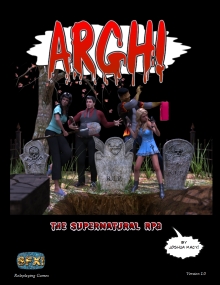
Argh! The Supernatural RPG, free on RPGNow.com

Just in time for Halloween!

Argh! The Supernatural RPG

Do You Dare?


Unlock the power of your imagination? Any kind of monster, any kind of mystery… One Simple, Fast, Exciting system!


Argh! gives you everything you need to play the supernatural thriller of your dreams… or nightmares! Supernatural Powers, magic, aliens, monsters…it’s all there, and you don’t need a degree in accounting to create the Slayer, or the monster, you’ve always wanted to play!


Does your supernatural game sound like a thriller? If you use Argh! it will. Argh! uses the SFX! System, which blends free-form play, with players deciding whether their actions are plausible within the  genre, and dice-driven mechanics where the degree of success–or failure–can come as a surprise to all, and the tension is real.