Death Slaves of Eternity 0-Level Party Generator

Hear ye! Hear ye! Ask and you shall receive! Roll up your Death Slaves of Eternity on Purple Sorcerer 0-Level Party Generator! Last night I gave John Marr  a file with the 0-level Occupations from Marzio Muscedere’s Death Slaves of Eternity module, and today Purple Sorcerer’s 0-Level Party generator has it in the Occupation Source list!

It’s a great list for generating occupations that have a more Sword & Sorcery/classical feel than the late-medieval-ish standard occupations chart from Dungeon Crawl Classics itself, so you don’t really need to be planning to use Death Slaves of Eternity as your funnel, though you should consider it, because it’s a good adventure.

The only thing missing if you’re using Death Slaves is the circumstances of arrest entries, for space reasons, so the GM will have to look up your profession and tell you what the circumstances are, but that’s a pretty minor price to pay.


DCC Alternate Luck & Healing Rules

The 2016 Free RPG Day Goodman Games packet included an adventure for the upcoming DCC Lankhmar, but what I want to talk about is the downloadable packet of pregens for the game, which includes two fascinating new rules to make DCC better fit the setting.

The first is a rule for Fleeting Luck, which adds a sort of free-wheeling easy-come-easy-go luck economy to the game.  Each session every character starts out with one point of Fleeting Luck that they can spend as if it were regular luck (including Thieves getting their Luck Die when they spend a point); every time a player rolls a natural 20 the character gets another point, and the GM is encouraged to hand them out for cool or foolish actions or roleplaying that is evocative of the setting.  There’s no limit to how high the pool can grow, but whenever anybody rolls a fumble at the table (except on rolls where 1 isn’t a failure, such as roll-under luck checks or rolling init) everybody loses all their Fleeting Luck and starts over at 0.

That’s actually a pretty brilliant way of keeping it flowing instead of hoarding it to unleash on the big-bad at the end of the adventure.  Luck as used in DCC is actually one of the only such point economies I can get behind, since it’s really something that you can think about in character.  Even in our world people absolutely do feel lucky or unlucky, or pray for luck when taking a risky action. It’s still a tiny bit meta since you know if you have it or not, but that’s still way better than Fate points or the like.

The other Lankhmar-specific change that would work well in any Sword & Sorcery setting is Luck as Healing.   This is basically a DCC “second wind”: once per battle you take a full round (you can still move, but that’s it) to “examine your wounds” and find out they’re not as bad as they look by spending 1 Luck point and getting back your HP die + Stamina mods (min 1).

After battle, once per day you can spend time recuperating: after 1d3 turns (not rounds) binding up your wounds and resting, you can spend a luck and get your HP die + Stamina mods + level. If you drink a “restorative” (basically a non-magical potion or strong spirits) while recuperating you get some additional HP, depending on the restorative: in the free adventure there’s an example of Eevamarensee Emerald wine, which restores MAX  Hit Die for the class + Stamina Mod + Level.  I presume this is instead of rolling the normal HP die, and is still limited to once per day: that is it’s only effective in conjunction with recuperation.

For some this might smack a little too much of D&D 4e healing surges or the 5e “take a knee” mechanics, but I think it offers significant advantages over both.  For one thing, it doesn’t require tracking a new (and somewhat mysterious) resource: it’s just Luck, a pervasive part of DCC already and something that has significant uses outside of healing. For another, it’s quite limited. If you’re using the Fleeting Luck rules, the only way to get more except at the beginning of a session is to get out there and adventure: holing up and licking your wounds for a couple days isn’t really an option, unless you’ve got a whole lot of luck to spare.  I’d actually suggest limiting it further and saying once you’ve recuperated you can’t spend any Luck on healing until you’ve taken more damage, even if you get in a new battle or wait until the next day.  There’s only so lucky you can be once you’ve examined your wounds and found them not as dangerous as they first seemed, and then taken the time to bind them up.

Since I’m currently running a DCC Swords & Sorcery game on hangouts, I’m thinking of adopting these rules immediately.  My players probably need some help if any of them are going to make it out of the crypts in Death Slaves of Eternity….


A Ready Wit In Their Every Tongue

“I have entertained in all the courts of Europe and speak a ready wit in their every tongue!” – The Court Jester

Let’s talk about languages in D&D-likes.  Generally speaking, languages receive short shrift in D&D.  The core rules, dating back to the days of White Box D&D, default to assuming that there is a “Common Tongue” spoken by all humans and most demi-humans, and then individual racial tongues like Elven, Dwarven, Dragon, and the like, plus the somewhat controversial “alignment tongues” (which apparently Gary Gygax originally conceived of as being like the way Latin was the language of the church, or the Black Tongue was the language of the creatures of Mordor).  While this is easy enough to revamp into languages specific to your setting, whether that’s Spanish, French, and German or Hyrkanian, Aquilonian or Kushite, the other thing that most D&D-likes share is that languages are extremely hard to know and acquire, in most cases with a hard limit based on your Int.  For instance in AD&D, the number of extra languages you could even know ranged from 0, for Ints 8 and below, capping out at 7 for those with a whopping 18 Int.   Other versions limited it even more severely, for instance in Basic D&D and its descendants such as Dungeon Crawl Classics your number of extra languages is the same as your Int bonus: 1 to 3.

That’s all very well for adventures where talking is limited to the occasional parley with creatures in the dungeon or perhaps trying to eavesdrop on their plans, but it seems to be the product of a view of language acquisition heavily influence by the difficulties of learning through formal classroom instruction where you need to be quite clever and diligent to make any headway at all.  Worse, though, is that it’s not very similar to Appendix N fiction at all, where well-traveled characters can rattle off a list of the tongues they speak, or surprise their captors by knowing full well what they’re saying. Granted, pulp fiction may make language acquisition quite easy, and perhaps there’s something to be said for having a common tongue means that there are more opportunities for roleplaying conversations since you don’t have the language barrier stopping you all the time.

One interesting exception to the above is Lamentations of the Flame Princess.  In keeping with its early-modern era default setting, it makes knowing multiple languages a snap.  Or at least the possibility of knowing more languages. In LotFP, whenever the player needs to know if the character speaks a language for the first time in the game, you roll a d6.  If you roll less than or equal to 1 plus the character’s Int modifier (with some extra mods for distant/exotic languages), the character actually knows the language from having learned it some time before play started.  You only get one shot at knowing the language, though, and if there are rules for learning a language once it’s been established it’s not part of your background I couldn’t find them on a quick scan.  I think that’s pretty darn neat, if you don’t mind the slightly Schrodinger aspect of having the skill be indeterminate until needed.

An aspect that few of the D&D-likes deal with, except the 3e-derived ones with ranks for every kind of skill, is fluency with particular languages.  You’re either fluent or you’re not, with possible modifiers based on your Int as far as whether you’re literate (including in your native tongue).

Naturally, I have a proposed rule to address these shortcomings (to the extent you perceive them as such for your particular setting).

Languages

Chance You Already Know the Language.

When you need to determine if you’ve learned a language some time in your past, the base chance is 1 in 6, plus the better of your Int or Cha/Personality modifier (this isn’t book learning so being able to get along with others is a good way to pick up the language from strangers).  Apply the remoteness modifier to the result.

Remoteness Modifier
Local (from the nearby area) 0
Exotic (from a distant land or a non-human race) -2
Dead (few living speakers) -3
Magical (arcane) Can’t already know

If the result is negative, whether because of low Int/Cha or it’s a remote language, for every negative 1 bump up the die-size by one. So a -1 chance on a d6 becomes 1 chance on a d8, a -2 on a d6 becomes a 1 on a d10. This way even the stupid and or shy have some chance of having picked up extra languages in the course of living.

How Well Do You Know the Language?

Language knowledge is rated from 1 to 6 on the following scale:

Level Fluency Learning Period
1 Broken/short phrases Day
2 Halting/sentences Week
3 Fluent (heavily accented)/prose Month
4 Fluent (vaguely foreign)/compose poetry Season
5 Eloquent (native accent)/identify dialects Year
6 Expert/Imitate dialects

Characters always know their native tongue at level 5.  Otherwise roll a d6 when first determining if you already know the language, modified by the better of Int or Cha and modified by remoteness and that’s how well you know the language from prior exposure. Minimum level is 1.

Learning a New Language

When you’re exposed to a language you begin to learn it or improve your understanding. When you’re in a situation where you’re immersed in using the language daily, such as traveling with a caravan, spending time with a foreign city, or adventuring with a native speaker you can see if you improve your skill in that language. I recommend only allowing one roll per calendar period, to avoid bookkeeping hassles1. Roll the same die as when seeing if you already know the language, without any remoteness penalties, once per period: on a 1 you advance to the that level in fluency and the period between rolls changes to the one for the next level you’re trying to learn. We’re not applying remoteness penalties because if you’re currently learning from speakers of the language it doesn’t matter whether it’s really unusual that you’ve met some. For example, if you know nothing about the language you would roll every day you plausibly are practicing until you got a 1 and became able to speak the language, albeit brokenly. To progress to being able to speak haltingly, you would now roll once a week until a 1 came up, then once per month to attempt to become fluent albeit heavily accented, etc. If you have significant down time you can skip steps:  e.g. if the referee says three weeks later, your ship arrives at the port you can make 3 rolls to see if you went from nothing to level 2 at whatever language the sailors are speaking: you don’t have to roll day-by-day to get to level 1 first. If you fail, you get the next level down anyway.  (After a week you’d likely have succeeded in reaching level 1 anyway, even with a penalty, and after three weeks it’s virtually certain.)  Yes, that means with a big chunk of downtime you can get pretty good at one particular language with no risk of failure.  That’s OK, it’s not meant to be a gambling game, just a helpful way of figuring out how long it takes you to learn a language while taking into account some of your attributes, and that doesn’t require that you track anything except whether you’ve made a roll this calendar period.

  1. that is, check each day, and each week, and each calendar month, each time only checking one language that you could plausibly be improving based on your current circumstances, instead of trying to track per language how much time has elapsed since your last check. While  YOU CAN NOT HAVE A MEANINGFUL CAMPAIGN IF STRICT TIME RECORDS ARE NOT KEPT, there is a practical limit.  Looking at a global campaign calendar is way easier than per character per language timesheets. 

Conan and the Ambiguous Text

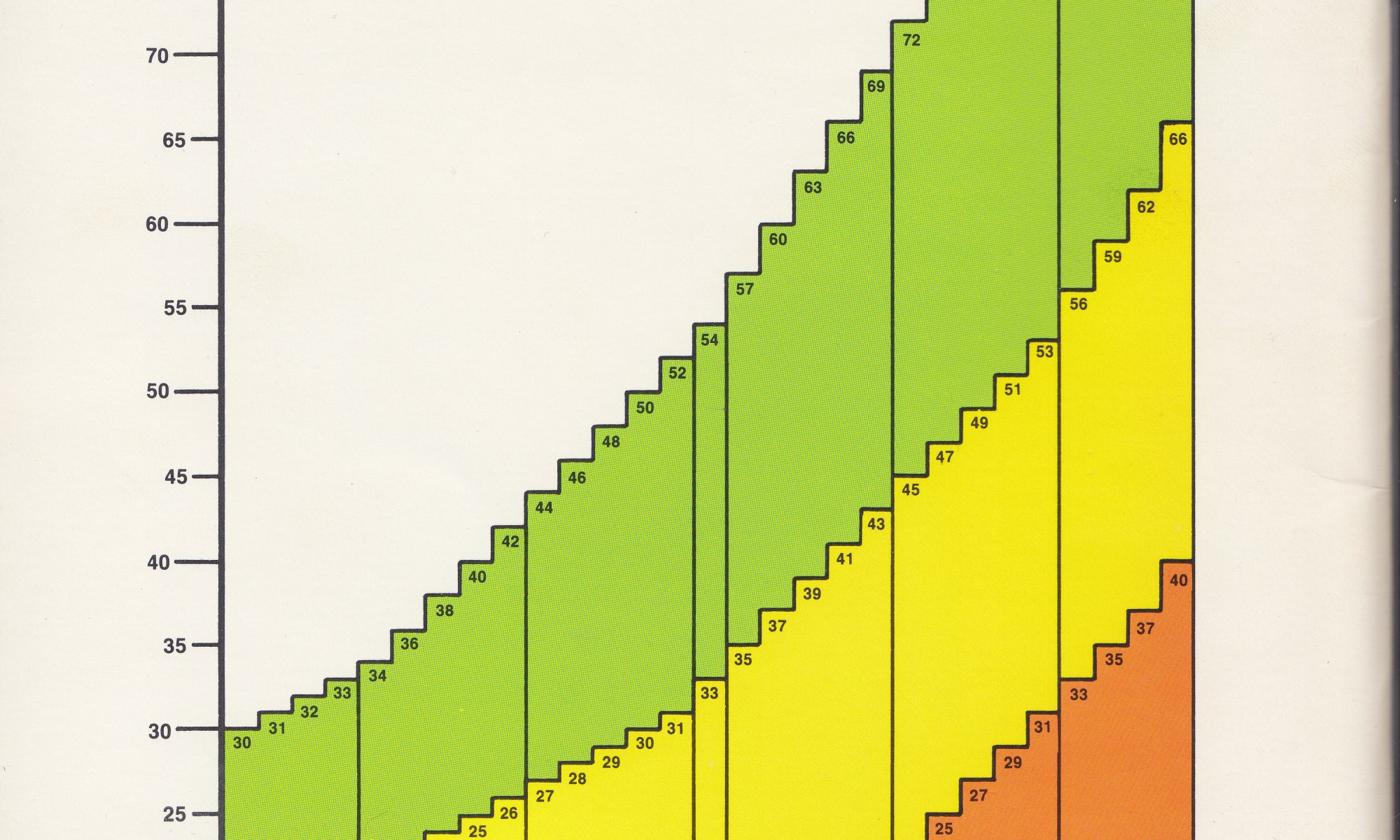
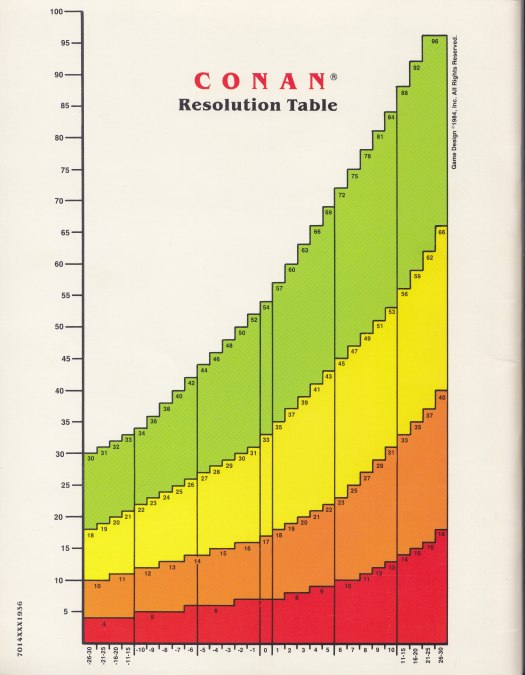
There is a big ambiguity in the Conan Role-playing Game rules mentioned on the ZeFRS site that the referee will have to resolve before trying to play, which is that modifiers to the die rolls call for shifting the columns to the left or right,  but there are two kinds of columns on the resolution chart and apparently no consensus by the fans of the game exactly how they’re used.

conanrpgresolutionchart

Specifically there are small columns corresponding to individual numbers, except at the extreme edges of the chart where they become ranges, and then there are larger groupings of the numbers together into bands of five.  It’s pretty clear that when you roll against a particular talent, or attack by subtracting the defenders Move from your Fighting, you’re looking up a particular number in the column… but when you then shift that right 2 or left 1, do you just go to the next number left or right, or the next big band left or right?  While shifting number by number is simple and seems obvious, it produces really tiny changes in the die rolls needed for success. E.g. even being completely blind is only a -6 shift, which would take marginal success from, say, 72% to 54% and great (red) success from 10% to 7%.  And that’s the largest penalty there is in the reference guide.  More typical penalties and bonuses of 1 or 2 columns barely budge the needle. It would have been simpler and completely unambiguous to describe the modifiers as adding or subtracting from the rating itself, instead of shifting columns. Plus interpreting a shift column as a “band” means the dark vertical lines are there for a purpose more than just a visual aid to keep which column you’re looking in straight.  In addition when using bands for shifting +/- 6 to an action is actually the largest modifier the chart can support, making it quite natural to say that attacking a bound foe (the biggest bonus) is +6 columns and attacking while blind (the biggest penalty) is -6.

Despite that, I suspect the original intent was probably just shifting the rating up or down, firstly because it would have been really sloppy to write up the rules without discussing the difference between the minor and major divisions on the chart if the major divisions were critical to using it. Secondly, having the shifts be by the minor rating columns allows more leeway for stacking modifiers, such as fighting from a lower position and in the darkness. But since tiny modifiers aren’t worth the mental effort, and I think attacking a helpless foe ought to give you a bigger bonus than a paltry 18%, if I were to play I’d probably choose to interpret column shift to mean the big bands.

If you’re doing that, though, you have one more nicety to address, which is when you shift a band where in the band do you roll?  Are you shifting the minimum necessary to fall in the band (closest column to original), the maximum (farthest), smack in the middle, or proportional to your position in the starting band?  Personally I’d go with the last interpretation, so that if, say, your rating is 9 (second highest in the 6-10 band) if you shift left by 1 you’d look on column 4 (second highest in the 1-5 band).  Similarly, shifting right by 1 from 9 would take you to the 21-25 column (second highest in the rightmost band). That way you keep the relative ordering of the characters: If Anna has Dirk 10 and Beryl has Dirk 9 and they both get a -3 shift for fighting with two weapons, Anna is still better than Beryl (rolling on the -1 column instead of the -2 column).

Doing this tends to make stacking modifiers pretty irrelevant: you hit the limit of the chart pretty quickly.  If that bothers you, you could make it so that once you reach the extreme left or right band each additional shift is one column within the band.  Since the columns themselves are in groups of 5 that even makes a certain amount of sense, but it does add extra complication.  As D&D 5e’s advantage/disadvantage rules show, it can be really liberating to not have to care whether you’ve accounted for every conceivable bonus.  In fact, that suggests an alternative way of doing it, which is to ignore the chart of the exact modifiers and count anything that gives you a left shift as one band left, anything that’s a right shift as one band right, and if you have both they cancel regardless of how many are stacked on one side or the other.