Shields Shall Be Splendid!

The following presents a house rule for handling shields that makes sense to me for a more Sword and Sorcery than high medieval setting.

In most D&D-likes, shields are an afterthought.  The bonus for carrying a shield is +1 or maybe +2 on a d20, which seems a little strange considering the prominent place shields have in actual history. There have been some attempts over the years to “fix” that with house rules, such as the nifty “Shields Shall Be Splintered” rule offered by Trollsmyth, giving the player an incentive to carry a shield in order to sacrifice it to avoid damage.

Still, that’s not that much of an incentive, particularly if shields are hard to come by in the middle of an adventure.  There’s also another potential problem if you’re trying to run a campaign set in a period more reminiscent of the ancient world than the late medieval/early renaissance age of heavy plate armor, and particularly if you want the pulp Sword & Sorcery feel of something like a Conan comic.

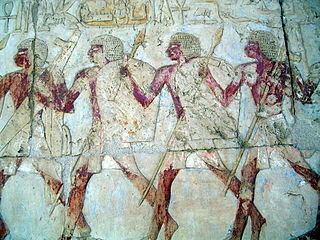
If you want your combatants to look like this

320px-tempio_di_hatshepsut_001

not this
platearmor_leedscastle_1647

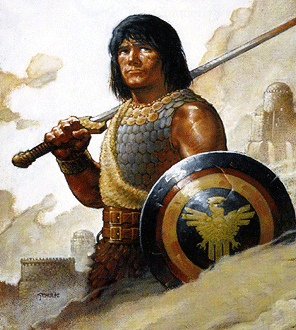
this
conan9

not this

fantasyarmor

this

not this

blackwomanfantasyarmor

then the standard D&D-like rules could stand to be improved.

You can of course make it so the heavier armors just don’t exist in the setting, or are prohibitively expensive, or forbidden by law or custom except to certain social classes and only in certain situations, or lean heavily on encumbrance rules (no pun intended)… but doing so tends to make the characters like front-line fighters that rely on heavy armor in games more fragile…sometimes a lot more fragile.  That’s not always a bullet you want to bite for an aesthetic preference.  Another approach some people use is to either tie AC directly in to level, making armor irrelevant, creating some sort of swashbuckling class or option so certain characters can opt to use less armor without getting chopped to pieces or even provide “chainmail bikini” bonuses based on DEX or even CHA for a particularly Red Sonja comic-book take.

Here’s an alternate take: Make shields provide the bulk of the defensive bonus, with armor only being a secondary bonus unless you’re fighting without any shield.  Here’s a chart of how this would work for an ascending AC game, with values based on Dungeon Crawl Classics.

Shield AC bonus Check Penalty
Off-hand Weapon/improvised 1 0
Buckler 2 0
Targe 3 -1
Roman Scuta 4 -1
Heater 5 -1
Kite 6 -2
Greek Hoplon 7 -2
Tower 8 -3

Using a shield and armor within 3 bonus of each other provides AC equal to the better of the two, plus 1. Using shield and armor more than 3 different, like full plate and a buckler, or leather armor and a tower shield just provides the better of the two bonuses. The Check Penalty is the worse of the two, minus 1, regardless of how close in bonus they are.

Using these rules, all the AC bonuses and check penalties stay the same for existing characters if they like, but there’s the option of shedding a bunch of armor to increase mobility and fit in better with actual historical shield/armor mixes such as Hoplon plus linen linothorax or just greaves and helmet, or targe and leather or hide, or even fantasy comic book targe or buckler and chainmail bikini.  The bonuses are chosen with an eye on providing even min-maxers an incentive to keep to vaguely plausible combinations, even if plausible includes the likes of Frazetta’s Conan or Frank Thorne’s Sonja.

I think doing shield and armor this way allows for a wider variety of Sword & Sorcery or even anime setting tropes with minimal changes to game balance.  If you’re not using DCC, you might have to adjust the bonuses and penalties if you want them to work out to the same as the existing combinations, but the changes should be slight.


Overland Encounters

I just realized I never posted this here, but here are my generic rules for overland travel and encounters for D&D-like games. The overloaded encounter die is pretty similar to the one Gus L uses in HMS Appolyon.

Checking for Events

Each day there are at least two checks for events: one during the day and one at night. Roll 2d6 to see if there are any additional events: if you roll doubles there’s an extra event that day.  If the number on the face of the die is even, it’s an extra daytime event; odd is an extra nighttime event. If there is an extra event roll again… keep doing this, tallying the extra events, until you don’t roll doubles.

Examples

You roll a 9.  No extra events that day, so just the one daytime and one nighttime.

You roll double 3’s, which is an extra nighttime event, and then roll again and get a 7.  So that’s a total of one daytime event and two nighttime events to check for that day’s travel.

You roll double 2’s, then double 1’s, then a 4 (3 and 1).  That’s an extra daytime event, and and extra night time event, for a total of two daytime event checks and two nighttime checks.

Daytime

For the daytime, check the travel speed of the group in hexes and roll a die to indicate in which hex the event will take place.  E.g. if the group can travel 20 hexes a day on the current scale of the map, roll a d20.  If the number of hexes doesn’t neatly fit on a die, use the next higher die and re-roll any that fall outside of the range.  Count off the hexes traveled and when it reaches the number the event die shows, roll a d6 for the type of event.  Note that hexes that are difficult terrain count as multiple hexes.  E.g. if the event is supposed to happen in hex 7 of the day’s travel and after the fifth hex they enter a mountain hex that costs 3, the mountain hex counts as hexes 6, 7, and 8 of the day’s travel, so the event will happen mid-way through the hex.

If more than one event is going to happen in the day, roll as many times as there are events; if you roll a duplicate that means they happen at the same time.

Night Time

At night, roll once for the type of event, ignoring anything except an encounter or environmental.

If the players are setting watches, just roll a die to see which watch the event check occurs in.

Otherwise, or if you need an exact time (e.g. because some pre-planned event is going to happen at midnight) roll 1d12 to see what hour of the night the event occurs, starting at 5 P.M. You can either count, or add 17 to the roll, subtracting 24 if the result is 24 or higher and read that as the hour on a 24 hour clock.  E.g. a roll of 1 indicates the event is at 18:00 (6 P.M.), a roll of 10 indicates the event is at 27 – 24 = 03:00 (3 A.M).

If more than one event is going to happen in the night, roll as many times as there are events; if you roll a duplicate that means they happen at the same time.

Type of Event

  1. Encounter
  2. Environmental/Potential Encounter
  3. Exhaustion/Potential Encounter
  4. Clue
  5. Consume Resources
  6. Setback

Encounter: Encounter some potential hostiles.  See below.

Potential Encounter: Encounter some potential hostiles if the terrain cost is greater than or equal to the die roll. That is, if the hex costs 2 to enter then a 2 is an encounter but a 3 isn’t; if the terrain costs 3 to enter then a 2 or 3 is an encounter.  This is cumulative with any other results on the table: a 3 in a mountain hex means an encounter and Exhaustion.

Environmental: Non-combat event specific to the particular environment. This can include encounters that are unlikely to be hostile even if they get a poor reaction, such as local peasants, travelling merchants, game animals, and so on.

Exhaustion: Take a short rest (1-hour) or suffer one level of Exhaustion.

Clue: Gain some information about something: evidence nearby monsters,  settlements, other travelers, etc.

Consume Resources: Some of your resources are expended (lights, food, rope, etc.)

Setback: Something goes wrong and you lose some time, get lost, suffer an injury, find the way is blocked, etc.

Encounters

Surprise

Both sides roll a d6, on a 1 or 2 that side is surprised and cannot act this turn.

Encounter Distance

Roll a d6 during the day and a d4 at night, subtracting the hex’s terrain cost.  The result is the distance at first sighting.

  1. Bump into each other (can melee this turn)
  2. Close (can charge this turn)
  3. Medium (1d6 turns away, within direct arrow shot)
  4. Long (2d6+6 turns away, within indirect arrow shot)
  5. Extreme (2d6+12 turns away, 6 turns from being within indirect arrow shot)
  6. Barely Visible (10 minutes+ from being within indirect arrow shot)

Evasion

If you want to avoid an encounter, then presuming you’re not surprised and the range is at least Medium, you can attempt to evade.  If you have surprise you can evade automatically. Otherwise, the difficulty of evading the encounter depends on the size of your party and the size of the group you’re encountering.  Roll less than or equal to the Target Number on 2d10.

Size of Party Target Number on 2d10
15
Small (<=4) 13
Medium (5-12) 11
Large (12-24) 9
Huge (25+) 7
5

If the pursuing group is larger than your party, the target number becomes one step easier; if the pursuing group is smaller, it becomes one step harder.  If the terrain isn’t clear, increase the TN by the terrain cost minus one. So, e.g. woods increase the TN (make it easier to evade) by 1, mountains or jungles by 2.

If you don’t like the odds, you can split your party into smaller groups in order to evade; of course the pursuers can do the same, but then at least if they catch up there are fewer of them.

Reactions

When you encounter potentially hostile NPCs or creatures they aren’t necessarily going to attack, depending on their purpose in the area and how your party is conducting itself.  If you’re in enemy territory during wartime and you run into a patrol, a good roll on the reaction table isn’t going to save you from a confrontation, but guardsmen in a city are unlikely to simply attack you even if they’re “Hostile”…though they may look for an excuse to arrest you or run you out of town.

Roll 2d6 Reaction
NPC/monster
Negotiation
2 Hostile/Attacks Refuses & opposes (further rolls on locals -1)
3-5 Unfriendly/may attack Refuses
6-8 Neutral/uncertain Hesitant, may try again with better offer
9-11 Indifferent/Uninterested Accepts
12 Friendly/Enthusiastic friendship Accepts eagerly (+1 morale if hired)

Overland Travel

Another post that I never posted here, with a general way of handling overland travel based on the underlying Outdoor Survival/AD&D terrain and movement rates, simplified for easy use with pretty much any D&D-like.

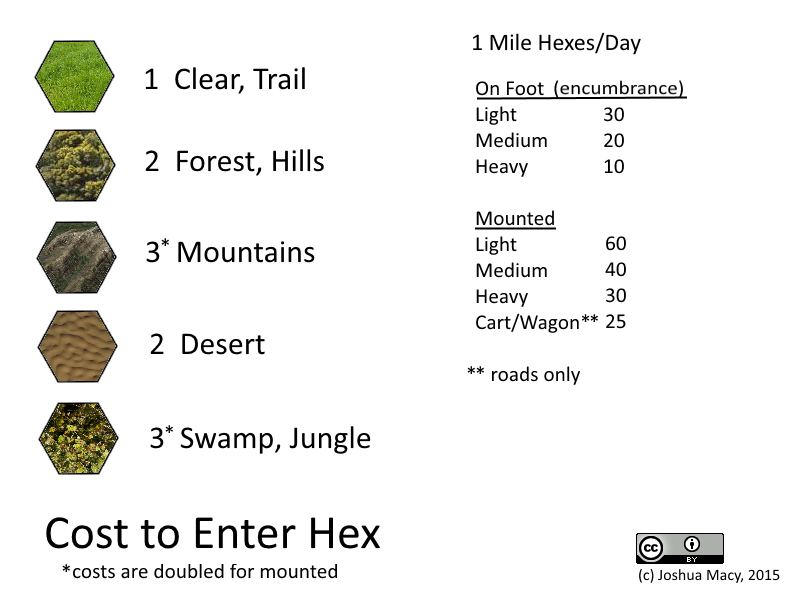
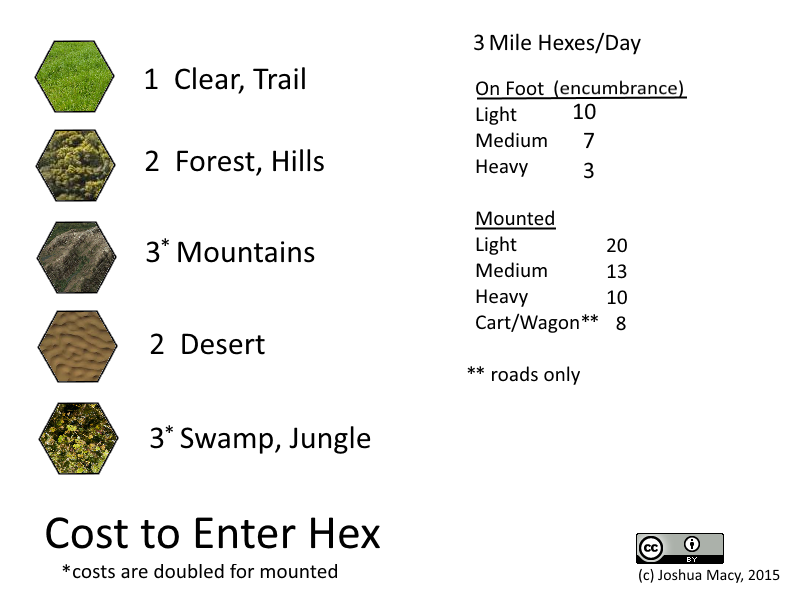
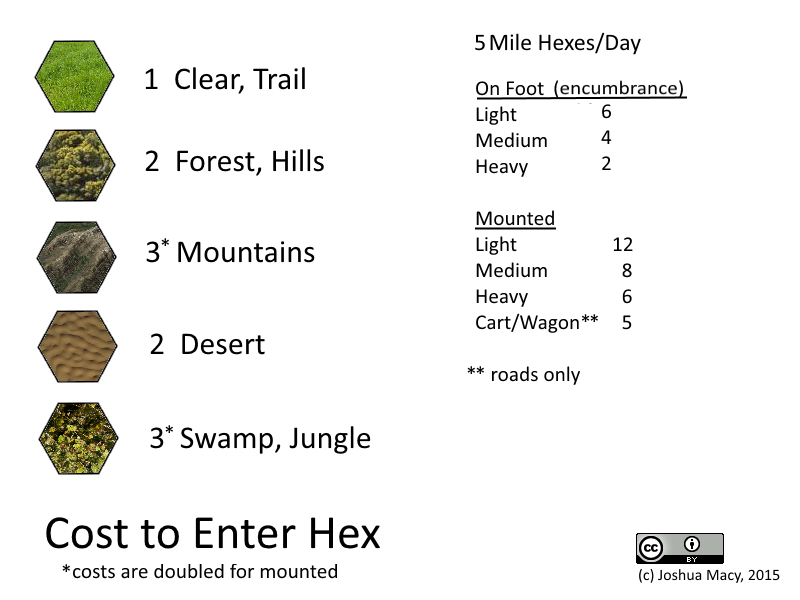
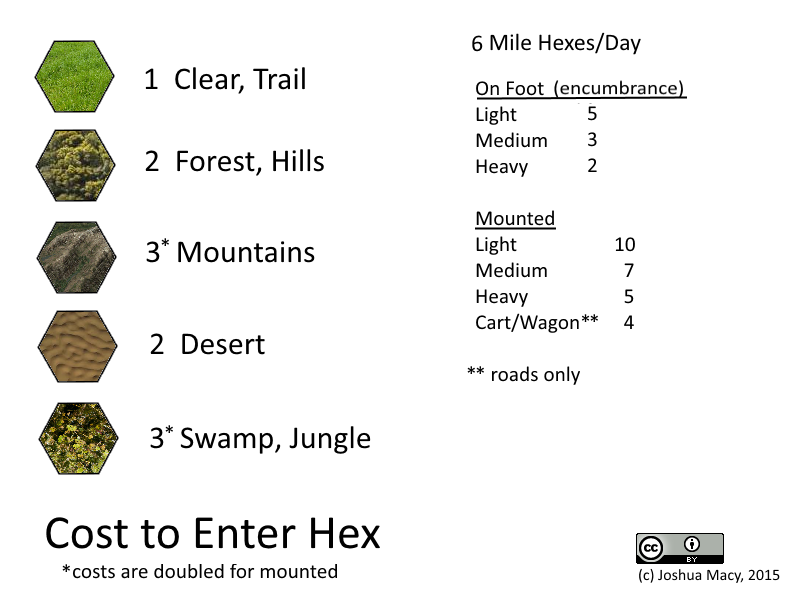
These templates show the cost to enter1 a hex on the overland travel map, with a key to how many hexes a party can move in a day based on the degree of encumbrance (for travelling on foot) or type of mount. The assumption is that roads and trails do not speed your travel enough to track, but they do allow you to pass over worse terrain as if you were on clear terrain. (mostly based on Delta’s discussion of the rates in Advanced Dungeons & Dragons 1e Dungeon Master’s Guide).

If the cost of entering a hex is more than a single day’s allotment (e.g. on heavy horse in a swamp with no road), you can either say it’s impassible, switch to a smaller scale map and have the party slog through taking multiple days, or make the minimum rate of travel 1 hex per day or 1 hex every other day.

1 Mile Hexes

3 Mile Hexes

5 Mile Hexes

6 Mile Hexes


  1. This is by far my preferred approach, since it means no tracking of partial hexes. It also matches the way Outdoor Survival worked, which was the original source of the all the D&D movement rules…and by extension almost everything that came after. 

SF Campaign Quiz

I stumbled across this when going through my old emails, and I thought it might interest some of you.  This was a survey I sent out for a group I was going to run a SF campaign for once a month online; they had agreed they wanted to play some kind of SF campaign, but they weren’t sure what.  Usually I’d start with an idea for the kind of campaign I felt like running, but since I was play-testing Zap! at the time, I was open to almost anything they wanted to try.

Tone

How serious do you want the tone of the campaign to be
  • Played for Laughs (Galaxy Quest)
  • Campy but played straight (Flash Gordon)
  • Straight, with leavening of humor (Star Trek Original Series)
  • Straight, with little or no humor (later season DS9)
  • Grim (Battlestar: Galactica remake)
  • Other:

Hardness of SF

How hard do you want the SF to be?
  • Sufficiently advanced science is indistinguishable from magic
  • Anything goes as long as you wave your hands sufficiently vigorously and invoke nano, quantum, or tachyons.
  • Stick to standard SF tropes like FTL travel and cloning, please.
  • At least make a stab at plausibility, don’t include anything known to be impossible without flagging it
  • Stick to actual speculative science
  • Everything has to be vetted by Scott (one of our two resident physicists)
  • Other:
Which of the following elements would you like to see? *
if there’s a conflict, these choices will override the previous answer in specific areas
  • Space ships
  • FTL Travel
  • Psionic powers
  • Alien life forms
  • PC alien races
  • Artificial intelligence
  • Teleportation/Matter transmission
  • Near Future
  • Alternate Present
  • Farther future, but Earth still known/relevant (3-400 years)
  • Far future, Earth history known but Earth lost
  • Earth? What’s that?
  • Terra-forming
  • Interstellar civilizations
  • Time travel
  • Extra-dimensional travel
  • Virtual worlds
  • Resurrection/Restore from Backup
  • Increased Longevity
  • Robot PCs
  • Interstellar War
  • “Uplifted” animals
  • Genetically engineered humans
  • Allegory and social commentary
  • Universal translators
  • Matter replicators
  • I’m good with any or none of the above
  • Other:

Campaign Structure

Episodic or Epic
  • Episodic: I want the stories to have discrete beginning, middle and end
  • Seasonal Arcs: I want the individual episodes to eventually add up to a larger arc, but that arc might be only one of several with these characters
  • Epic: I want one overarching story, with the bulk of what happens being driving that story forward
  • Non-dramatic: I want to explore and do stuff, and if I see any dramatic structure happening, I’ll zap it with my blast pistol.
  • Other:

Lethality

Should PCs die?
  • Never.
  • Only by player choice.
  • If they do something everybody agrees is lethally stupid
  • If they do something that the GM thinks is lethally stupid
  • If the dice say so
  • If the dice say so, but with player veto
  • Inevitably
  • Multiple times per session, thank goodness for backups
  • Multiple times per session, thank goodness characters are easy to create
  • Other:

Are the PCs special?

ordinary schmoes or heroes?
  • Some are born great, some achieve greatness, some have greatness thrust upon them. And then there’s the PCs
  • Ordinary folks thrown into extraordinary circumstances, trying to get by
  • Competent professionals, doing their jobs
  • Elite, the special squad within the ranks of the pros
  • We’re the A-Team, we get called in when the elite have failed
  • Legends, the ones that taught the A-Team everything they know
  • Mary Sue Squad
  • Other:

Scope

How far and wide do the PCs roam?
  • Based in a particular city-sized locale
  • Globe trotters
  • Interplanetary is an adventure
  • Interplanetary is a commute, Interstellar is an adventure
  • Interstellar commuters, Intergalactic adventurers
  • Time travelers
  • Dimension hoppers
  • Other:

Homebrewery – a tool for easy 5e formatting

Just ran across this tool for easily making pdfs and web pages in the style of the D&D 5e Player’s Handbook. Very useful if you’re writing D&D 5e home-brew material, or really any home-brew stuff that you want neatly formatted and don’t mind the D&D house style

For instance, here’s a link to one of my blog posts, basically just plopped into the Homebrewery with some minor fixup of the markup:

http://homebrewery.naturalcrit.com/share/SysX_IV3/


Check it out.

Tracking Individual Initiative

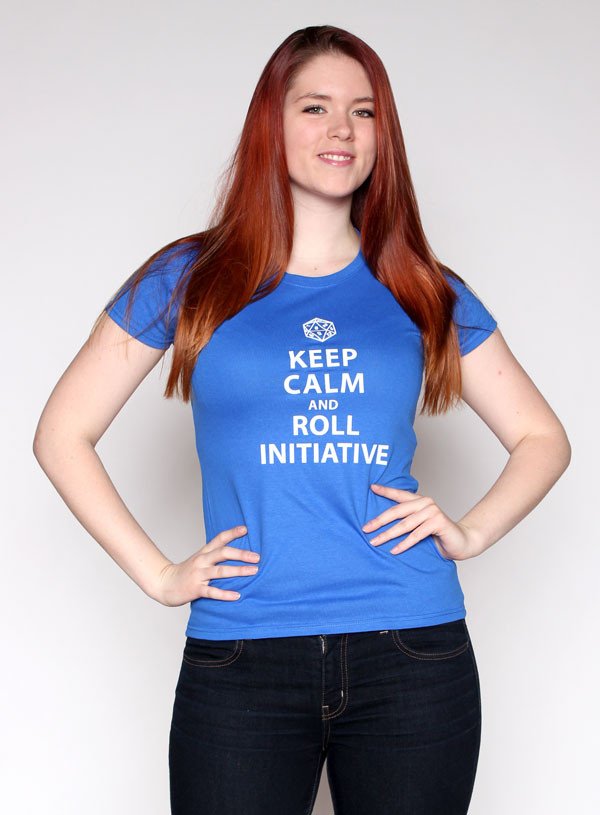
http://www.armorclass10.com/products/keep-calm-and-roll-initiative

Despite what I said a while back about group initiative (was it really almost a year ago?), in our DCC game we’ve been using individual initiative, both ’cause that’s how DCC is written and ’cause it has some little flavorful fillips to it that make it more interesting.  In DCC only Warriors increase Init bonus as they level, and two-handed weapon wielders use a d16 for Init instead of d20, both of which I quite like.  But that means that I need to track individual initiative, so I came up with the following.  Instead of using the traditional count-down (Does anybody go on 20?  19?  etc.) I’ve made up a 3×5 card for each character with vital stats like AC, saves, etc. and I go through the count-down once, putting the cards in order of Init.  I make one more card for the monster init, and an extra card representing the end of the round just to remind me if I need to check things like spell effects wearing off or random encounters.

I’m ashamed it took me so long to come up with something like this, because it works perfectly.   Nobody ever gets missed, and there’s never any hesitation about what comes next.   It’s fully as fast as my old stand-by just go around the table I use when I just can’t be bothered with init. I’m sure I’m not the first person to come up with this, but all of the discussions I recall and printed GM aids I’ve seen involve writing the character names on a list and either updating the init numbers and skipping around the list or redoing the list when init is rolled…which unless you’re using a computer at the table isn’t so slick.  The one drawback I can see, besides the need for index cards or scraps of paper, is that if you roll for init every round putting the cards in order could be a drag…you’d essentially do one pass to order the cards and one pass through the cards to carry out the turn.  I still think it might be worth it, but for a system like DCC where the init is rolled only at the start of combat, there’s no such problem.

Searching it Old School

Here’s how I do it:  only roll when you’re testing the character’s skill, not the player’s; roll when the player says they’re searching; only roll once per character; give the players the benefits of their own skill at coming up with ideas without rolling;  and no pixel-bitching.

  1. The Judge describes the scene to the player, including anything the character would automatically notice, whether it’s because it’s completely obvious or because it falls within the range of the character’s “Passive Perception” threshold (for games that use it, e.g. an Elf’s 2 in 6 ability to spot any hidden door they pass in OD&D was the very first passive perception check).“It’s an empty 20 by 20 room, with a chest in the middle of the floor.  There are no obvious exits (because either there are none or the Judge secretly checked the passive perception and the character failed)”.
  2. The player announces the character is searching, and optionally specific things to look for or methods of searching being tried.“I search the chest for traps, paying particular attention to whether there’s any kind of tripwire or pressure plate.”
  3. If the player has said she’s looking for something that’s there, just give it to her, no roll.  In addition roll as appropriate to see if the character’s knowledge and skill is enough to reveal any secrets.“There’s no tripwire or pressure plate, but you do notice there are some tiny holes in the floor right in front of the chest (rolled a success on the character’s ability to spot traps; if the trap was triggered by a tripwire or pressure plate the roll would have been irrelevant, but is included in case there were other things to notice that weren’t specifically mentioned).”

Why make the players announce it?

Searching beyond what’s apparent during a passive perception check involves actively moving about, touching things, looking closely at them, etc.  The search roll covers everything generic the character has learned to do: the standard operating procedure as it were. But searching is likely to set off traps, depending on how they’re triggered, so it’s up to the player to announce whether they’re going to take that chance or they want to limit their activities to certain specific things until they decide it’s safe for a general search.  As long as they’re not yet turning things over to the character’s training and experience to carry out, they don’t get the character’s skill roll to discover things.

Note that if they want to use the character’s skill to detect whether there are traps, they can go ahead and do that, but that itself requires an announcement, for the same reason: the activities necessary to look for traps might have consequences such as getting surprised by the spiders on the ceiling (assuming they failed their passive perception/surprise roll), and it’s not fair to spring that on the players unless they’ve made a choice.

What if the player wants to search again?

Originally this was handled by allowing re-rolls as long as the players were willing to spend the extra time, one ten-minute turn for every 10′ searched.  While that’s legitimately old-school, it has the drawback that if there’s no time-pressure (e.g. there are no wandering monsters in the area or they’re not racing against a deadline) then the players are guaranteed to be able to find every secret they come across eventually, but it’s boring as all get-out to play it out.  In actual play much of the time the resource being tested is the player’s patience.  If you hand-wave it and just let them spend as long as it takes (maybe rolling to see how long that is), while you don’t waste as much table time you get this big and to my mind boring disconnect with the game world: “seven hours later you’ve finished searching the first room and found ten copper pieces that had fallen in the back of the garderobe”.  Plus as anybody who has looked for something they’ve lost knows, even searching ’til you’re exhausted won’t necessarily uncover all the secrets.

On the other hand, if you only allow character skill to have one bite at the apple, the players are free to keep searching, but only if they can come up with specific, concrete plans. This allows for interesting brain-storming at the table, and if the players get bored they stop: they know there’s no further chance of uncovering anything if they’re out of ideas, so no temptation to try a few more rolls just in case.  If they get a sudden idea later, they can come back to it (circumstances permitting) and try it out.

Why are player ideas a gimme?

If they announce they’re looking for something specific that’s really there, maybe they should still have to roll, perhaps with a bonus? No, if you do that and they fail they can’t know whether it’s a bad idea or a bad roll… which means they’d have to repeatedly search and that is tedious. When the rule is that if they are looking for the correct thing they automatically find it, they never have to repeat an idea just in case they got unlucky on the roll.  If the thing is supposed to be really well hidden you can make them be more specific about exactly what they’re looking for or how they’re searching.  Maybe an ordinary secret door can be found just by banging on the wall until you find where it sounds hollow (assuming that your spot hidden roll failed), while a well-hidden door that’s been padded to muffle the sound requires something more clever like you dust it with fine powder to see if you can find hand-prints where somebody has pressed a hidden catch.  But you shouldn’t put the players in the position of having to guess whether they just need to repeat an action until it works.

Note that you should require they be specific: “I search the wall really carefully for a secret door” is covered by the roll their character gets for ten minutes of searching a 10 foot stretch of wall (using OD&D as an example).  It needs to be something more concrete than that, something such that if somebody really was trying what they suggest it would be strange if they didn’t find it.  If there’s a book that when lifted opens the secret door behind the bookcase and they say they take out and examine all the books, that ought to open the bookcase.  This puts the onus on the Judge to make sure that for every secret door and hidden thing, there really is a specific way that it works and the Judge either knows it in advance or makes it up when the player starts searching.  No fair having a door that’s generically secret, and opens when you “figure out its secret”.  Make up whether it’s opened by sliding, or pushing a particular stone on the wall, or lifting a torch out of a sconce, or whatever, but know what it is so you can rule whether what the player is doing will work.

Ok, let them find the specific thing they’re looking for as a gimme, but what about applying a penalty to the roll for finding anything else?

No, that’s even worse.  Conceptually it might make some sense that focusing on one thing makes it less likely to spot other things, but that means a priori the player is making an uninformed choice between having a flat roll for everything or a roll with a penalty for everything but one thing.  It just doesn’t make sense to take that bargain, so it discourages players from getting specific about what they’re looking for.  The goal is to encourage players to go beyond “I roll my Search skill” and put some real thought into it: the way to do that is make sure they’re never worse off for having tried.

What do you mean by no pixel-bitching?

Pixel-bitching is when in a video game it’s not just enough to click on a wall, you have to click on the exact right pixel out of hundreds on the wall, so you just have to keep moving the pointer tiny increments and trying again.  In tabletop RPGs that means making the players guess the exact right thing instead of just anything that would work if it were a physical problem.  For instance, if the chest is guarded by a trap that’s set off by a trip-wire right in front of the chest and the player says “I look for a pressure plate in front of the chest” it’s pixel-bitching to tell them “You don’t see a pressure plate” without mentioning the trip-wire that’s right there.  Obviously if the character’s getting right down there and looking at the floor trying to spot a pressure plate or switch  then they’re going to see the trip-wire in front of their face.

When  they say they’re looking in a particular place or via a particular method, and the Judge should reveal to them whatever they would discover in that place by that method. It’s legitimate to ask for some more details if you’re not completely sure what they’re doing and what it would reveal (“Are you getting down with your face close to the flagstone to take a look?  Or are you poking at it with your pole? Or something else?”)  If there’s some ambiguity, give them the benefit of the doubt. If they’re pushing on the flagstone with their ten-foot pole to try to set off any pressure-plate traps, and it’s not clear whether the pole would necessarily touch the trip-wire that the Judge knows is there… just rule the pole does touch the trip-wire.  They were looking in the right place for something that was there with a method that could plausibly reveal it, so reward their skill. Otherwise you risk teaching them that adding specificity in how they’re searching is an often fruitless game of “what number am I thinking of?” when it should be an opportunity to interact with the world to gain success where the straight dice-roll failed them.

The Tomb of Horrors and Player Mindset

https://plus.google.com/111524822183500809557/posts/Zyjv6epapwJ

https://plus.google.com/111524822183500809557/posts/Zyjv6epapwJ

Stuart Robertson talks about his group’s experience with the infamous Tomb of Horrors back in 1987 over on G+.  Spoilers abound, so don’t read that or this if you care.  The gist of it is that after the players lost a bunch of PCs in the initial false entrances, and the party got down to about half the original PCs they gave it up as a bad job.  Stuart then goes on to complain about The Tomb of Horrors being badly designed by the lights of this (perfectly reasonable) Gamasutra article.  The following is my reaction, which got a little long for a comment.

Honestly, if you lose any PCs to the fake entrances, your group isn’t nearly paranoid or prepared enough to have any chance with the Tomb of Horrors. I mean, in one case the group marches into a corridor with cobwebs thick enough to obscure the ceiling without a care in the world as to what might be lurking above, in the other not only don’t they send anything ahead capable of triggering the trap nor react quickly by retreating during the slow count to 10, but despite being 10th-14th level nobody has Rock to Mud, Disintegrate, or Stone to Flesh prepared or the equivalent in items.

A lot of the traps in the Tomb aren’t particularly lethal for a character of that high level (e.g. 1d4+1 d6 of damage), especially since the party should always be pretty close to full health: the Tomb has no wandering monsters, even in the area around it, or any time pressure from plot events, and characters of that level typically have access to a lot of healing. There are some nasty exceptions, but a 10th level Cleric can Raise Dead twice a day, so it’s not like most of the deaths in the Tomb need be irrevocable.

I have some quibbles about specifics of the Tomb (like I think preventing Passwall from being one of the spells that can get you out of the sealed fake corridor is kinda cheap), but I think if you see it as a series of uninformed choices you’re just not used to the style of play. Players have lots and lots of ways, mundane and magical, of gaining information to turn blind choices into informed choices…which is why some but by no means all of the tricks and traps specify certain divination/magic tricks that won’t work.  That’s not random: I think the clear presumption is that the players are going to be moving carefully through the tomb, casting various detect spells on anything that seems suspicious and poking and prodding everything from a safe distance. I dare say most of the decisions in the Tomb are actually dilemmas: how many resources to expend to turn it into an informed decision. Relatively few are “weighted” (in the Gamasutra sense of being balanced between pros and cons): if you can figure out a safe path, there’s usually no reason not to take it.

Obviously it’s not a style of play suitable for everyone, but that doesn’t make it badly designed. One of my favorite memories of dungeoneering when I was a lad was finally beating my step-brother’s death-trap dungeon (not Tomb of Horrors, but same basic idea, heavily inspired by Raiders of the Lost Ark)… The character I had that finally beat it was pretty powerful and equipped with a ring of regeneration, but I was soloing it, so those kind of balanced out.   In role-playing terms there was a reason the forces of good needed the treasure the dungeon guarded, but at this date I can’t recall at all what the treasure was or its significance, while I clearly recall the feeling of getting it and getting out again and even the details of some of the ingenious traps. I’m not ordinarily a challenge-based player, and it’s not something I’d want to do every day, but the satisfaction of completing it and being the first of the various players who’d attempted it to succeed was a thrill like no other

Running Sailors on the Starless Sea

So I’ve run my holiday-themed re-skinning of Sailors on the Starless Sea twice so far… the most recent time, last Friday, ended in a TPK. Everybody had fun, and wanted to play some more DCC, but I think it pointed out a gotcha in the scenario that I’d want to address before I ran it again for some other group.  Spoilers ahead if you haven’t played it.

Specifically, if the players skip the Charnel Ruins… and both my groups wanted to because of how foreboding it was, though the first reconsidered after a bit… then when it comes time to meet the Leviathan, they’re screwed. Unless they’re willing to make a human sacrifice (fat chance, at least with my typical players), even if they chum the waters to distract it, they need to spend at least 2 rounds in the water (if they can even swim) both coming and going from the ship with the Leviathan getting 6 attacks per round… what actually happened Friday is they ended up fighting the Leviathan on the deck of the ship and losing. Which is fine: fighting the Leviathan straight up should be a losing proposition. But that means that there need to be either more ways around it or the single way that’s there needs to be on the main path.

Sailors on the Starless Sea is a very linear adventure: after the choice of the initial approach there are a couple of side areas, but no real branches.  That’s not necessarily bad for something that’s supposed to be a short adventure, but it means sticking the key to completing the adventure in one of the few skippable side areas is a problem.  That’s compounded because once they meet the Leviathan there’s no retreating and regrouping or exploring what they might have missed: it’s deliberately set up so if they don’t have the censer they’re stuck either halfway across or 50′ from the far shore if they come up with the chum-the-waters trick.  IMO, that’s pretty mean, and not really in keeping with the best Old School principles of letting the players pick their fights and routes.  I also think the set up gives perhaps unfortunate psychological pressure on the players to hurry along to rescue the villagers instead of poking their noses into everything the way a more “let’s loot the ruins” party would.

Having said all this, I think there’s a pretty simple fix: since the Leviathan basically acts like a gate that requires a key, make it so you can’t open the gate without the key.  Take away the candle at the top of the menhir, and make it so that lighting the censer (or sacrificing a victim) both summons the ship and placates the Leviathan.  That way if they make it that far without getting the censer, they can figure out they’re missing something… and if they don’t immediately, then if they swim out to the ship the Leviathan can attack the swimmers while they still have a chance of retreating.  It also makes the mosaic a better clue, since the action depicted in the mosaic of using the censer while standing on the menhir now matches how you’re supposed to deal with the Leviathan.

A more radical fix would be to have the Leviathan’s blood-lust be sated as soon as each tentacle seized and dragged somebody off; then even if the party just bulls through they won’t lose more than 7 characters.  It’ll hurt, but at least it might be enough to finish the module, particularly if you have a lot of players.

Weirder Fantasy

So, my Monday group has been talking a bit about a post by Ken on running a low-magic, restricted race and class (Human only, Fighter and Thief only) setting. A bunch of my thoughts on “low magic” and what feels magical have appeared on my blog (e.g. Niven’s Law and Low Magic) but I want to offer some further comments.

  1. I’m in favor of streamlined, quick systems in general, though you can take it too far. E.g. Systems which boil down to one roll for everything are usually too bland; it often ends up feeling like it makes no real difference whether you do something clever or stupid, expected or unexpected, genre-plausible or not: you end up rolling pretty much the same either way.
  2. Rare != weird or wonderful. It doesn’t matter if it’s the only one in the world, a +1 sword is still dull. Even if something is ubiquitous in the setting, it can still give the players a thrill (e.g. space-ships in an SF game).
  3. Whether something counts as wonderful or prosaic is entirely based on the players’ experiences, not the typical inhabitants of the setting.  A peasant in a no-magic setting might be completely freaked out if somebody actually casts a spell like Levitate; the player of that peasant won’t be.  Even if the player roleplays it well, experience with other fantasy outside the campaign is going to color whether the player feels awe.
  4. Finally, to Ken’s specific idea about a fantastic dungeon in a decidedly non-fantastic world, unless the characters spend a lot of time outside the dungeon, contrast makes little practical difference.  I’ve only played a few sessions in Monteporte, but all of them were so far down in the megadungeon the outside world might as well not have existed except as a source of back-story.

This isn’t to say that I’m against the idea of low-magic settings or stripped down character options, but I think to accomplish Ken’s stated goals, it’s best to concentrate on achieving them directly.  The bullet  points are Ken’s goals, followed by my commentary.

  • Focus play on exploration, rather than tactical combat.

Players are goal oriented. E.g. in D&D if you stick closely to OD&D xp (award XP for gold, minimal XP for killing things), or you directly award XP for exploring new areas, players will naturally shift their focus to exploration.  Of course, you have to make the exploration itself interesting, with new and startling alien vistas, things to interact with and decisions to make.  Resource management can be a big part of this, if you can do it in a non-boring way.

  • Focus the players to find different and creative solutions to challenges poised by having such limited options.

I find this to be more a matter of the GM’s openness to out-of-the-box thinking than limiting the mechanical options available to the players.  At worst having lots of mechanical options acts as friction, where play slows down for the players to review their options and make sure they haven’t missed any application of mechanics before they start poking at the problem space with off-the-wall thinking.  Limiting mechanics can help there, but it doesn’t actually spur the players to creative solutions unless the GM is willing to consider them. I’ve seen plenty of minimalist games bog down with the GM shooting down all the options until the players come up with the solution the GM is looking for.

  • Highlight the sense of danger and weirdness with regards to the dungeon.

This is best done by making the dungeon dangerous and weird in comparison to the things the players are familiar with, ignoring whether it would seem weird simply in comparison to the rest of the world or the characters’ expectations.  Eliminating PC MUs and Clerics helps establish a certain Conan-esque baseline for the world, but they won’t automatically ooh and ahh if they finally encounter an NPC capable of casting Magic Missile or even Sticks to Snakes.  A related point is that in order to establish a contrasting baseline it’s more important how the NPCs behave than what the PC options are.   Even if you have a stereotypical anything-goes group of oddball PCs (lizardman, elf, gnome, ninja), as long as the rest of the world treats them like a freakshow you get much the same effect.  In Rob’s game playing an elf feels special because the NPCs treat elves like they’re special, even though it sometimes seems like half of all PCs are elves.

  • Magic items become highly prized.

Useful and bizarre magic items are highly prized even in high-magic settings; worthless or dull ones aren’t, even if they’re unique.  Even if you can buy a +1 sword or a healing potion in Ye Olde Magick Shoppe, a collar that you can wear around your neck that lets you detach your head and fly it around is something the players will covet, (Not a random example, this was something that turned up in my Friday night GM’s game a bunch of years ago, and that particular bit of foolishness is still remembered fondly.)  Boots of elven kind that just add 5′ to your speed, not so much.

One last thought.   Consider a world (like our own in olden times), where superstition is rife.  People will leave milk out for brownies, put horseshoes over their doors for luck, even burn people alive for witchcraft.  Is there anything actually to be gained by having it be a no-magic world and telling the players that while their characters probably believe it, it’s all a bunch of hooey?  Or is it better to leave it open whether things like charms against the evil eye work, or they need to be careful when travelling through the forest at night lest they meet a Will o’ th’ Wisp or troll? Or even better to have a world where such things are absolutely possible?

My own preferences for a setting that emphasized the weird and dangerous would be to make magic and supernatural creatures real, and potentially lurking around any corner, but have most magic be dangerous and mistrusted, while certain types of superstitions be well-known and effective.  I think it’s weirder and scarier when, say, the players feel the need to seek a church-yard when they fear they’re pursued by fey creatures than when they know for a fact that since they’re not in the dungeon those sounds were at worst bandits.  Dungeons can be a higher concentration of weirdness and danger, making them strange and spooky places. but leeching that stuff from the world at large in hopes of increasing the impact by contrast doesn’t really pay off  But that’s me.