Or at least that’s what I intend to use it for: Doll Divine


Tales of the Rambling Bumblers
an RPG blog
Or at least that’s what I intend to use it for: Doll Divine

Alexander, Lloyd – The Prydain Chronicles
Baum, L. Frank – The Oz Books
Bellairs, John – The Face in the Frost; The House with a Clock in its Wall; The Figure in the Shadows, etc.
Burroughs, Edgar Rice – John Carter Series, Tarzan series, etc.
Carroll, Lewis – Alice’s Adventures in Wonderland; Through the Looking Glass
Garner, Alan – Elidor, The Weirdstone of Brisingamen; The Moon Of Gomrath, etc.
Le Guin, Ursula K. – The Earthsea Trilogy, etc.
Lewis, C.S. – Narnia series, et al.
Barber, Richard – A Companion to World Mythology
Buehr, Walter – Chivalry and the Mailed Knight
Coolidge, Olivia – Greek Myths; The Trojan War; Legends of the North
d’Aulaire, Ingri and Edgar Parin – Norse Gods and Giants; Trolls
Hazeltine, Alice – Hero Tales from Many Lands
Hillyer, Virgil – Young People’s Story of the Ancient World: Prehistory – 500 B.C.
Jacobs, Joseph – English Folk and Fairy Tales
Macauley, David – Castles
McHargue, Georgess – The Beasts of Never: A History of Natural and Unnatural Monsters, Mythical and Magical; The Impossible People
Renault, Mary – The Lion in the Gateway
Sellow, Catherine F. – Adventures with the Giants
Sutcliff, Rosemary – Tristram and Iseult
Williams, Jay – Life in the Middle Ages
Winer, Bart – Life in the Ancient World
Anderson, Poul – Three Hearts and Three Lions; The Broken Sword; The Merman’s Children, etc.
Anthony, Piers – the Xanth series
Brackett, Leigh – The Coming of the Terrans; The Secret of Sinharat; People of the Talisman, etc.
Campbell, J. Ramsey – Demons by Daylight
Davidson, Avram – The Island Under the earth; Ursus of Ultima Thule; The Phoenix in the Mirror, etc.
de Camp, L. Sprague – The Fallible Fiend; The Goblin Tower, etc.
de Camp, L. Sprague and Pratt, Fletcher – The Incomplete Enchanter; Land of Unreason, etc.
Lord Dunsany – Over the Hills and Far Away; Book of Wonder; The King of Elfland’s Daughter, etc.
Eddison, E.R. – The Worm Ouroboros
Eisenstein, Phyllis – Born to Exile; Sorcerer’s Son
Farmer, Phillip Jose – The Gates of Creation; The Maker of Universes; A Private Cosmos, etc.
Finney, Charles G. – The Unholy City; The Circus of Dr. Lao
Heinlein, Robert A. – Glory Road
Howard, Robert E. – Conan; Red Nails; Pigeons from Hell
Lee, Tanith – Night’s Master; The Storm Lord; The Birthgrave, etc.
Leiber, Fritz – Fafhrd and the Grey Mouser series
Lovecraft, H.P. – The Doom that Cam to Sarnath; The Dream Quest of Unknown Kadath; The Dunwich Horror
Merritt, A.E. – The Moon Pool; Dwellers in the Mirage; The Ship of Ishtar, etc.
Moorcock, Michael – The Stealer of Souls; The Knight of the Swords; Gloriana, etc.
Mundy, Talbot – Tros of Samothrace
Niven, Larry – The Flight of the Horse; The Magic Goes Away
Norton, Andre – Witch World; The Year of the Unicorn; The Crystal Gryphon, etc.
Offut, Andrew – The Iron Lords; Shadows Out of Hell
Pratt, Fletcher – The Blue Star; The Well of the Unicorn
Smith, Clark Ashton – Xiccarph; Lost Worlds; Genius Loci
Stewart, Mary – The Crystal Cave; The Hollow Hills; The Last Enchantment
Stoker, Bram – Dracula
Swann, Thomas Burnett – Cry Silver Bells; The Tournament of the Thorns; Moondust, etc.
Tolkien, J.R.R. – The Hobbit; The Lord of the Rings
Vance, Jack – The Eyes of the Overworld; Dying Earth; The Dragon Masters, etc.
Wagner, Karl Edward – the Kane series
White, T.H. – The Once and Future King
Zelazny, Roger – Jack of Shadows; Lord of Light; the Chronicles of Amber, etc.
Beagle, Peter S.; Bok, Hannes; Cabell, James Branch; Carter, Lin; Cherryh, C.J.; Delany, Samuel R.; Fox, Gardner; Gaskell, Jane; Green, Roland; Haggard, H. Rider; Jakes, John; Kurtz, Katherine; Lanier, Sterling; McCaffrey, Anne; McKillip, Patricia A.; Moore, C.L.; Myers, John Myers; Peake, Mervyn; Saberhagen, Fred; Walton, Evangeline; Wellman, Manley Wade; Williamson, Jack
Carter, Lin (ed.) – The Year’s Best Fantasy Stories; Flashing Swords
Offut, Andrew (ed.) – Swords Against Darkness
Borges, Jorge Luis – The Book of Imaginary Beings
Bullfinch, Thomas – Bullfinch’s Mythology: The Age of Fable, The Age of Chivalry
Funk and Wagnalls Standard Dictionary of Folklore, Mythology, and Legend>
Kyrinn Eis, who’s currently playing in my Skyships of Atlantis! setting as part of play-testing Zorch! the Fantasy RPG, was asking last night about how you’d run a grittier setting. The default in the SFX! games tends toward a fairly light-hearted tone where the protagonists are never in much actual danger. For example, there are no explicit rules for character death, even for NPCs, just suggestions. The reason for that is that SFX! explicitly asks the GM and players to consider the tone of the game they’re aiming for, instead of letting it be dictated by the rules. In some campaigns you might want it to be impossible for somebody to die “accidentally”, that is just because of an unlucky roll, while in others you might aim to have life be cheap and death or career-ending injury be a genuine risk every time you go into combat. There’s no one right answer.
If you want a grittier tone, or as I believe Kyrinn put it “Success [to be] lubricated by the blood of heroes” there are a number of ways you can approach that with SFX!
The first is to treat Overkill as dead. Or, if you want to be a little less harsh towards PC, as dead for NPCs and Down for the Count for PCs, with a permanent injury Complication if they’re revived by their companions after the battle. That alone will up the casualty count and put a real caution about battle in the hearts of the players.
Next, you can adjust the interpretation of Tired. Tired is largely a condition that characters impose upon themselves by overexerting themselves in taking heroic measures, by using the cliches Supreme Effort or Failure is Not an Option! In Kapow! and Argh! Tired generally represents being physically exhausted, but in a grittier campaign it could easily represent being injured, perhaps seriously, since Tired usually lasts until you’ve had significant down-time or gotten some kind of medical attention (which might mean somebody’s healing magic or a stim-pack from their med-kit). For even grittier, less cinematic play, you could rule out the ability to invoke your character’s Drive to remove the Tired condition; while a staple of comic books and action-oriented movies, being able to use sheer guts and determination to basically ignore a serious injury can run counter to the feeling that the sacrifice that you make in pushing yourself to become “Tired” was a serious one.
Hindered is also open to interpretation in a grittier fashion. Hindered represents any of a myriad of things that can happen to the character that limits her effectiveness until she or an ally takes the effort to counteract it. Most of the time that wouldn’t be an injury, but would represent something like slipping, being off-balance, partially blinded by dirt or blood in your eyes, temporarily trapped under a tapestry or having your ankle grabbed by a clutching hand, being momentarily dazed or disoriented… but it could easily be treated and narrated as the kind of superficial wound that requires being bound with a makeshift bandage or temporary sling. An example might be when John McClane in Die Hard has to run over broken glass in his bare feet; once he’s bound them up, they don’t really degrade his performance for the rest of the movie–certainly not by enough to cause him to mess up any of the spectacular stunts he attempts.
In addition to adjusting the interpretation of the various conditions in the game mechanics, which carries over via the Primary Rule into narration of the types of things that can cause and cure them, Zorch! has a new rule about injury: when you recover from being Out, you have a chance of having suffered a long-term injury. If you were injured, you are Tired and you get a new Complication (in addition to your existing ones) that describes the nature of your injury. You can recover from Tired in the usual ways, but the Complication can only be removed by taking positive steps, such as replacing a crippled limb with a prosthetic (which may itself be a Complication).
These guidelines still won’t make the game full of random insta-death, but SFX! was never intended to be Rolemaster. They do, I think, lead to injury and death that fit in with somewhat grittier genre fiction: death can happen unexpectedly, but injury tends to occur as a result of dramatic do-or-die choices or when the character had a narrow scrape with death.
Just in time for Halloween!
Unlock the power of your imagination? Any kind of monster, any kind of mystery… One Simple, Fast, Exciting system!
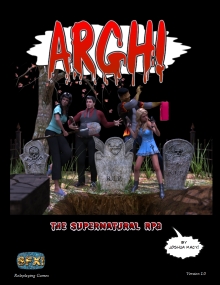
Argh! gives you everything you need to play the supernatural thriller of your dreams… or nightmares! Supernatural Powers, magic, aliens, monsters…it’s all there, and you don’t need a degree in accounting to create the Slayer, or the monster, you’ve always wanted to play!
Does your supernatural game sound like a thriller? If you use Argh! it will. Argh! uses the SFX! System, which blends free-form play, with players deciding whether their actions are plausible within the genre, and dice-driven mechanics where the degree of success–or failure–can come as a surprise to all, and the tension is real.
Nowadays I mostly use SFX! and its variants (a system of my own devising), though I do use Stars Without Number for a science fiction game with the kids, and a homebrewed version of D&D when they want to go dungeon delving. I also recently ran a one-shot of Old School Hack.
As a player I play in my friend Mac’s homebrewed D&D game, and in Russell’s homebrew he calls brew 20, as well as the SFX!-based campaigns my friends are running: Russell’s Surf City campaign using Argh!, and Dan’s Warhammer 40K campaign that recently converted to Zap!
In the past we did a bunch of Savage Worlds, D&D third edition, FUDGE, and others too numerous to mention.
When it comes to sitting on the player side of the table,
Following Greyhawk Grognard and Big Ball of No Fun, here’s a post of my preferences in RPGs:
We started playing Stars Without Number, a D&D meets Traveller retro-style game last Friday night. It’s free for the PDF version, or you can buy it in softcover or hardcover from the link. The mechanics are simple old-school D&D with a simple skill package system. It was dead easy to teach the kids, and my friends, since rolling up a character and choosing a class is the same as what they’re used to from D&D. That’s pretty much the reason I chose this, instead of trying to teach them Zap!, my own take on SF RPGs. One thing that would make generating a character quicker would be for me to print off multiple copies of the skills section and equipment… and possibly even make a set of starter equipment “kits” so they don’t have to comb the lists looking for what they might want to buy. One thing that would be nice would be a comprehensive equipment list, instead of it being divided into a number of tables by type, one table for primitive weapons, one table for energy weapons, one table for exploration gear, etc.
All in all, it went pretty smoothly for what was their first non-D&D game ever. They all seemed to like the Stars Without Number setting, and found it easy to get the hang of. I don’t think we’re going to be running it in a particularly sand-box style, even though that’s probably SWN’s biggest strength; the players had already told me they’d really prefer to be given discrete missions, so they know what they have to accomplish and there’s a definite goal for the evening’s play. So I just began the session with them all stuck on a backwater world, trying to scrape enough creds together to book passage out, and get approached as a group by a Xenoarchaeologist who was worried that he wasn’t able to establish contact with the base camp that his daughter and the workers she hired had gone ahead to set up near some of the ancient alien ruins that dotted the planet.
This is all from one planet, and all from the same time period. See if you can make your star systems feel half as varied.