Group Initiative

Lately I’ve had a strong preference for group initiative. Despite individual initiative giving a more fluid and chaotic battlefield, as well as scope for per-character bonuses and penalties, it seems more trouble than it’s worth. Tracking who goes when is a hassle,particularly if you’re tracking each NPC separately, and players seem to get more bummed out when they consistently roll crappily than they are pleased to roll well.

But because I like to tinker, I’m considering the following house rule:

In order of preference each turn initiative goes to:
1. The side that ran away last turn, as long as they’re still running.
2. The side that downed the most foes last turn.
3. The side that hit the most foes last turn (failed saves count as being hit).
4. The side that rolls highest on a d6 plus any CHA bonus for the designated leader.

I Don’t Know, Does That Look Like 11 Hit Dice To You?

I don't know, does that look like 11 hit dice to you?
I don’t know, does that look like 11 hit dice to you?

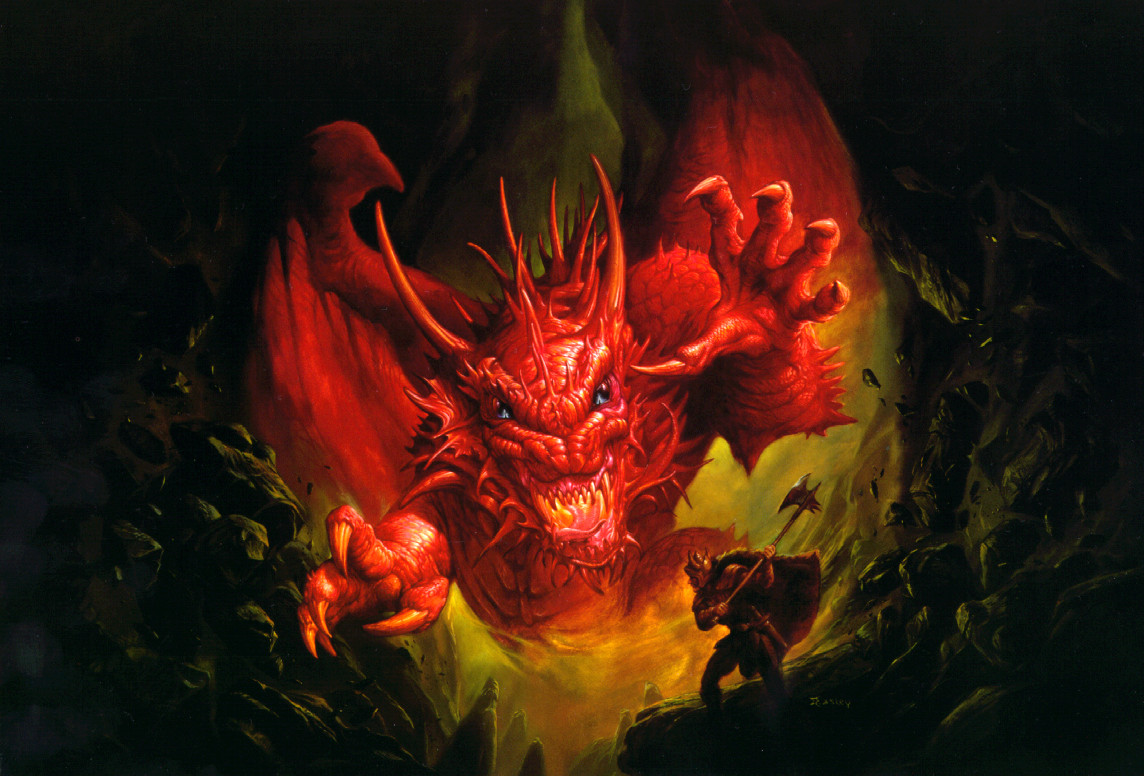
Apropos of Delta’s discussion of big cats in D&D,  I suddenly realized after all these years that a saber-tooth tiger was nearly as many HD as a red dragon.

Weirder Fantasy

So, my Monday group has been talking a bit about a post by Ken on running a low-magic, restricted race and class (Human only, Fighter and Thief only) setting. A bunch of my thoughts on “low magic” and what feels magical have appeared on my blog (e.g. Niven’s Law and Low Magic) but I want to offer some further comments.

  1. I’m in favor of streamlined, quick systems in general, though you can take it too far. E.g. Systems which boil down to one roll for everything are usually too bland; it often ends up feeling like it makes no real difference whether you do something clever or stupid, expected or unexpected, genre-plausible or not: you end up rolling pretty much the same either way.
  2. Rare != weird or wonderful. It doesn’t matter if it’s the only one in the world, a +1 sword is still dull. Even if something is ubiquitous in the setting, it can still give the players a thrill (e.g. space-ships in an SF game).
  3. Whether something counts as wonderful or prosaic is entirely based on the players’ experiences, not the typical inhabitants of the setting.  A peasant in a no-magic setting might be completely freaked out if somebody actually casts a spell like Levitate; the player of that peasant won’t be.  Even if the player roleplays it well, experience with other fantasy outside the campaign is going to color whether the player feels awe.
  4. Finally, to Ken’s specific idea about a fantastic dungeon in a decidedly non-fantastic world, unless the characters spend a lot of time outside the dungeon, contrast makes little practical difference.  I’ve only played a few sessions in Monteporte, but all of them were so far down in the megadungeon the outside world might as well not have existed except as a source of back-story.

This isn’t to say that I’m against the idea of low-magic settings or stripped down character options, but I think to accomplish Ken’s stated goals, it’s best to concentrate on achieving them directly.  The bullet  points are Ken’s goals, followed by my commentary.

  • Focus play on exploration, rather than tactical combat.

Players are goal oriented. E.g. in D&D if you stick closely to OD&D xp (award XP for gold, minimal XP for killing things), or you directly award XP for exploring new areas, players will naturally shift their focus to exploration.  Of course, you have to make the exploration itself interesting, with new and startling alien vistas, things to interact with and decisions to make.  Resource management can be a big part of this, if you can do it in a non-boring way.

  • Focus the players to find different and creative solutions to challenges poised by having such limited options.

I find this to be more a matter of the GM’s openness to out-of-the-box thinking than limiting the mechanical options available to the players.  At worst having lots of mechanical options acts as friction, where play slows down for the players to review their options and make sure they haven’t missed any application of mechanics before they start poking at the problem space with off-the-wall thinking.  Limiting mechanics can help there, but it doesn’t actually spur the players to creative solutions unless the GM is willing to consider them. I’ve seen plenty of minimalist games bog down with the GM shooting down all the options until the players come up with the solution the GM is looking for.

  • Highlight the sense of danger and weirdness with regards to the dungeon.

This is best done by making the dungeon dangerous and weird in comparison to the things the players are familiar with, ignoring whether it would seem weird simply in comparison to the rest of the world or the characters’ expectations.  Eliminating PC MUs and Clerics helps establish a certain Conan-esque baseline for the world, but they won’t automatically ooh and ahh if they finally encounter an NPC capable of casting Magic Missile or even Sticks to Snakes.  A related point is that in order to establish a contrasting baseline it’s more important how the NPCs behave than what the PC options are.   Even if you have a stereotypical anything-goes group of oddball PCs (lizardman, elf, gnome, ninja), as long as the rest of the world treats them like a freakshow you get much the same effect.  In Rob’s game playing an elf feels special because the NPCs treat elves like they’re special, even though it sometimes seems like half of all PCs are elves.

  • Magic items become highly prized.

Useful and bizarre magic items are highly prized even in high-magic settings; worthless or dull ones aren’t, even if they’re unique.  Even if you can buy a +1 sword or a healing potion in Ye Olde Magick Shoppe, a collar that you can wear around your neck that lets you detach your head and fly it around is something the players will covet, (Not a random example, this was something that turned up in my Friday night GM’s game a bunch of years ago, and that particular bit of foolishness is still remembered fondly.)  Boots of elven kind that just add 5′ to your speed, not so much.

One last thought.   Consider a world (like our own in olden times), where superstition is rife.  People will leave milk out for brownies, put horseshoes over their doors for luck, even burn people alive for witchcraft.  Is there anything actually to be gained by having it be a no-magic world and telling the players that while their characters probably believe it, it’s all a bunch of hooey?  Or is it better to leave it open whether things like charms against the evil eye work, or they need to be careful when travelling through the forest at night lest they meet a Will o’ th’ Wisp or troll? Or even better to have a world where such things are absolutely possible?

My own preferences for a setting that emphasized the weird and dangerous would be to make magic and supernatural creatures real, and potentially lurking around any corner, but have most magic be dangerous and mistrusted, while certain types of superstitions be well-known and effective.  I think it’s weirder and scarier when, say, the players feel the need to seek a church-yard when they fear they’re pursued by fey creatures than when they know for a fact that since they’re not in the dungeon those sounds were at worst bandits.  Dungeons can be a higher concentration of weirdness and danger, making them strange and spooky places. but leeching that stuff from the world at large in hopes of increasing the impact by contrast doesn’t really pay off  But that’s me.

D&D To HOW Stat Translation

This is just a quick recap of translating D&D attributes into their Heroes & Other Worlds equivalents, if what you care about is how much the attribute adds to the chances of success on a roll.  See my previous post on Bell Curve vs. Linear for a deeper explanation of the probabilities involved.   It seems to me that chance of success is probably the best way to look at it, since that’s most often what you’re going to be directly testing, at least in HOW.  There are other things the attributes are good for (e.g. carrying capacity for STR in D&D), but they seem to me to be relatively minor compared to adjustments to your chance to hit, say.  In D&D, particularly old D&D, attributes are much less important than in HOW: the difference between a 12 and a 9 in Basic D&D is almost purely cosmetic, and even the difference between a 3 and an 18 is no more than the difference between a 10 and a 13 in HOW when it comes to applying the bonuses to a d20 roll.

old D&D New D&D HOW
2-3 8
4-5 8-9
3 6-7 9
4-5 8-9 9-10
6-8 9
9-12 10-11 10
13-15 12-13 10-11
16-17 14-15 11
18 16-17 11
18-19 11-12

If the HOW column shows a range, use the lower number if you’re at the lower end of the D&D range, or the higher number if at the higher end.  Flip a coin if the number is exactly in the middle.

Update: Since Tim Knight asked, I’m including a little more of the reasoning behind having the D&D stats represent such a tight range of HOW stats… is a stat over 12 in HOW really superhuman?

D&D stats add comparatively little to your abilities.  Even in the more generous editions, an 18 is only a +4 bonus… which is +20% on a d20 roll. Starting from a base to-hit of 50% vs. unarmored foes, that gives you a 70% chance of landing a blow.  In HOW a score of 12 gives you a 75% chance of landing that same blow.

There are other ways you could look at it.  For instance, as a straight roll under stat to see if you succeed, an 18 is 90%, which is equivalent to a HOW score of 14.  But by-the-book D&D never employs rolls like that. Instead, where stats matter at all, it’s almost always as the tiny (+/- 20%) bonus.

The systems have pretty different underlying assumptions of competence, but it seems to me that matching bonuses as I did tends to minimize “system shock” where translating a character from one to the other makes it vastly more or less likely to succeed at tasks than in its home system.   A beginning HOW character is much more likely to succeed than a beginning D&D character; they’re much closer in competency to a mid-level D&D character, even though HOW being a much more deadly system overall tends to make them feel comparatively fragile.  E.g. a beginning thief in D&D has only 15% chance of picking locks or 20% of picking pockets compared to the 50% a 10 DX thief has in HOW. The one thing that D&D characters get a lot better at over time is taking multiple blows, though I haven’t yet tried to factor in the difference between armor as DR and armor as deflection

Bell Curve vs. Linear

Here’s a handy little chart showing the difference between a linear distribution like rolling a d20 and a bell curve distribution like 3d6 when it comes to rolling versus a target.  The first column is the d20 roll, the second is the approximate percent chance of rolling that or less on d20. That’s pretty obvious, but the next column is what the target number would be on 3d6 to have that chance to succeed (i.e. roll target or under).  So a 50% chance is right in the middle of the curve at 10… but by the time the target is 12 you’ve got a 75% chance of succeeding.  Next we have columns for a d20 skill roll/Basic Attack Bonus (as in 3e or 5e).  The final four columns show THAC0 (to hit AC 0) and what level you would have to be to have that chance of hitting an unarmored person, using the D&D Rules Cyclopedia as a reference point.  Hitting an unarmored person is the standard we’re using because that directly translates to scoring a hit in Heroes & Other Worlds/TFT (and similar games like Runequest) where armor reduces damage from a successful hit but does nothing to make success less likely.

From this you can see that, for instance, having a 13 DX in HOW is like being a 10th level Fighter, at least in terms of being able to land a blow.  (On the other hand, a 10th level Fighter in D&D can sustain multiple times the damage a HOW fighter could, so you can’t just translate back and forth quite that easily.) Another thing to pay attention to is the s20 skill column, where you can see that in terms of stat bonus, a D&D score of 18 is equivalent to DX 11 (if 18 is +3 as in original D&D), or maybe DX 12 (if 18 is +4 as in later editions).  Using the stat bonus in D&D is much more common than a straight roll-under against the stat.

Still, I find thinking of things this way as instructive.

Roll Under Rules Cyclopedia
d20 Approximate % 3d6 d20 skill/BaB THAC0 Fighter Cl/Th/D MU/Normal
0 0.00% 3,4 -11
1 5.00% 5 -10
2 10.00% 6 -9
3 15.00% 7 -8
4 20.00% -7
5 25.00% 8 -6
5 25.00% -5
6 30.00% -4
7 35.00% 9 -3
8 40.00% -2
9 45.00% -1
10 50.00% 10 0 10 1 1 1
11 55.00% 1 9
12 60.00% 11 2 8 4 5 6
13 65.00% 3 7
14 70.00% 4 6 7 9 11
15 75.00% 12 5 5
16 80.00% 13 6 4 10 13 16
17 85.00% 7 3
18 90.00% 14 8 2 13 17 21
19 95.00% 15 9 1
20 100.00% 16,17,18 10 0 16 21 26

Here’s an Anydice page with the 3d6 info, and just for the heck of it, the 1d20

Link to

Chaotic Caves Hexmap

This is a hexmap version J.D. Neal’s Chaotic Caves map from his The Chaotic Caves supplement for Basic Fantasy, released under the OGL, which is basically a nice, simple, hexcrawl retroclone of The Keep on the Borderlands.  C.R. Brandon released a version reskinned for Heroes & Other Worlds.  Since I was kind of irritated by the square grid in the map, I ripped it out and replaced it with a hex grid to approximately the same scale (1 hex = 1 mile, instead of 1 square = 1 mile). If I have energy I might even go as far a coloring it, though even doing this much took way more time than I had hoped.  (If there’s a truly easy way to just lay down a hex grid in GIMP, I couldn’t find it.  The otherwise nice hexGIMP plugin I found assumed that you wanted to hand-place all the hexes… and Hexographer has pretty much the same assumption: you can import an image to trace over it, but just imposing a simple hex grid of a particular size?  Forget about it.  I ended up just creating custom graph paper at the right scale and combining the images in Paint.NET, having had my fill of GIMP for the evening.)

You can get the free PDF version of the Basic Fantasy edition of The Chaotic Caves here.  The HOW pdf version is available from C.R. Brandon’s Lulu store (and is somewhat inexplicably more expensive than the print version of the BF edition on Amazon, but it does save you any headaches converting from D&D to HOW).

Anyway, enjoy!  Naturally, this version of the map is also released as OGL-licensed, but if you think I’m going to add the complete text of the OGL itself to the image, fuggedaboutit.

Chaotic Caves map by J.D. Neal, with hex grid added

How To Hexcrawl

+Joe Johnston released How to Hexcrawl: a nice little pay-what-you-want primer on running a hex crawl in Labyrinth Lord, or any other D&D-like, gathering together the rules and charts you might use as well as some advice.

What I want to talk about, though is how to handle checking for encounters. Joe correctly points out (p 20) there’s a contradiction in the rules, or at least some confusion, about the step-by-step procedure of rolling once per day’s travel vs what happens when you travel over multiple terrain types and the admonition against checking more than 3-4 Times per day.  He suggests 3 possibilities: roll based on the start hex, the last hex, or each time the terrain changes. Unfortunately those all skew the encounters one way or another.

I’d like to offer a fourth option:

4) Secretly roll 1d12 for the hour and 1 die  of any type (or flip a coin) for day/night.  At the appointed hour in the game day, roll for an encounter based on the current hex’s chance of encounter.   This prorates the chances exactly.  The only minor drawback, if it is a drawback, is you do need to pay slightly closer attention to what the in-game time is, though that shouldn’t be at all difficult since you already are dealing with the travel speed to traverse the hex.

N.B. How to Hexcrawl doesn’t mention it, but the assumed overland travel rate for most D&D editions is about 3 m.p.h. for unencumbered travelers, with an 8-hour effective travel day, which gets you the list 24 miles/day.  With 6-mile hexes, each hex of travel is 2 hours.  If you get in the habit of announcing the time of day as the party enters the hex (“it’s about 10 am when you get to the mountains”) it’s dead easy to tell if it’s time to roll for an encounter, and helps give the players a better sense of the passage of time anyway.   This suggests a nice variation, if you want to roll for travel encounters and then separately for night encounters while camped: roll a d8 to see which hour of travel the encounter gets checked and then again at night based on the terrain where they are camped.  Ideally you want to have a separate table, or at least adjust the results, for night encounters, since a caravan or troop of men are not at all likely to be traipsing through the woods in the dark.

Chess isn’t an RPG, but D&D sure as Hell is

John Wick’s post Chess is not an RPG: The Illusion of Game Balance is making the rounds of the RPG blogosphere (I stumbled across it when Michael “Stargazer” Wolf wrote about it here) .  I started to write a comment, but it blew up into an entire post.

I was suspicious when I saw Wick start talking about telling stories, since that’s not really what I think RPGs are about, but it’s a common-enough starting point for discussing them.  Where Wick completely lost me, though, is when he proclaimed “The first four editions of D&D are not roleplaying games.”  Sorry, but if that’s where your argument ends up, it’s obvious you need to reexamine your premises.

Riddick and the teacup is a terrible example of why weapon stats shouldn’t matter: the thing that makes the scene stand out is that we all know that a teacup is a lousy weapon.  In a game without weapon stats, players will be completely unimpressed if you manage to kill somebody with a teacup because they’re aware that the rules make that no harder than killing with a gun or sword.  They might give you points for style if it’s the first time anybody’s done that, but nobody’s going to conclude your character is a bad-ass because of it.  Even having it built into your character “Can kill a man with a teacup” is less impressive than accomplishing it when according to the rules you need to roll two 20’s and then max damage to have a chance.  And I say that as the designer of a game that indeed doesn’t have weapon stats precisely so that characters with the right kind of abilities can accomplish feats like that.

My take on balance is the only important form of balance is whether the players are all getting satisfactory amounts of time to do their things.  It comes up in combat more frequently only because a lot of systems make resolving combat take a lot of time even in encounters that aren’t very important or interesting so the combat-oriented characters get a bunch of spot-light time simply because there is a combat.  This leads to people feeling that everybody needs to be balanced in the sense of having a substantial role in combat when really what needs to be balanced is the amount of table time devoted to combat vs. other activities.
As for player skill vs. character skill in social tasks, I’m pretty firmly against the model where accomplishing a task is defined as entertaining/persuading the GM. The problem isn’t just that naturally some people are better at reading the GM and describing or acting out what they do in such a way to please the GM and get rewarded with a success, or that games of charming the GM into getting your way often narrows the scope of characters you can successfully play, it’s that games like that are almost always too predictable and cliched.  Once you’ve grasped the GM’s sense of plot and pacing, everybody knows what’s going to happen most of the time.  Games are much more exciting for everybody involved, IMO, when the outcome isn’t known before the die stops rolling. You may make the most brilliant rallying speech since St. Crispin’s say… but do the troops buy it?  That moment when everybody at the table, GM included, are hanging on whether the universe is going to pop up a Yea or Nay result, is *the* moment in an RPG where it goes from being a form of clumsy collaborative fiction to an “it’s almost like you’re there” experience.  That may actually be the crux of it: fiction you create, games you experience.  Substituting the former for the latter every time there’s an important social interaction robs RPGs of their most compelling feature: the ability to experience fictive worlds.

Unofficial Large Creature Template for D&D 5e

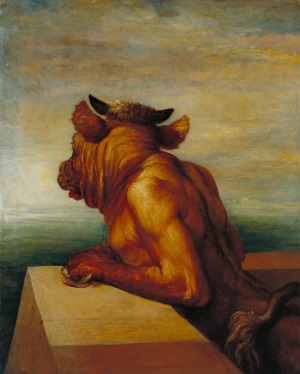
Minotaur_SmallSince Joshua Burnett and some folks on G+ were talking about statting up Minotaurs as a Large playable race, this is my take for a Template that could be applied to a creature to make a Large version of a creature.  This is based on the Ogre from the Starter Set, since that’s the only example of a Large humanoid we’ve got so far.

Large Creature

Movement: +10 feet

Reach: +5 feet

Ability Scores: if you want to stick to the Basic pattern of playable races not having any penalties, I’d stick with the ranges of bonuses they have (+2 to +4, no more than +2 in any single ability); if you’re willing to impose penalties, then I’d suggest another up to +3 on STR or CON, with a matching penalty to DEX, for a maximum of +5 increase and a cap of 21.  So a Minotaur might have straight +3 STR (within the “normal” increase range for a non-human, so no penalty, but all applied to the one stat), while an Ogre might be STR +4, CON +2,  DEX -2 (another +2 above the normal, matched by a -2 penalty, and again with more in the one stat than “normal”).

Points to bear in Mind

While most rules and spells in Basic affect creatures up to Large the same way as Small and Medium, so there’s nothing special you have to do, there are a couple rules that are triggered by a creature being Large:

Maximum # of Large enemies that can surround a Medium creature: 5 (page 71)

Large creatures can’t squeeze through a space smaller than would fit a Medium creature, and treat spaces that are Medium size as difficult terrain.  So, e.g. a 5′ wide corridor would be difficult terrain and take 2′ of movement for every 1′ of passage.  This is really the same rule as for other creatures (Medium vs. Small), it’s just liable to come up much more often. (p.71)

Carrying/lifting/dragging capacity is doubled compared to a Medium creature of the same STR. (p. 60)

Armor should have to be custom made (p. 44 suggests armor size as an optional rule, but it probably ought to be mandatory for Large humanoids even if optional for Medium and Small).


Beast-kin of Salamagundi

A new #DnD5e racedog-kin

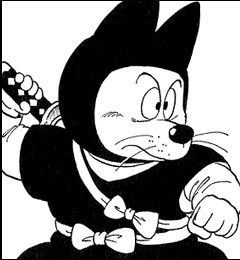
Beast-kin have the appearance of bipedal beasts (cats, dogs, pigs, cows, etc). They usually wear clothes, and are roughly human-sized. They can also transform to full-on beast form, in which case they use that stats for that type of beast, as well as an almost completely human form. Beast-kin typically end their utterances with an sound appropriate to their nature. E.g. “What’ll you folks have for dinner, moo?” or “Catch them before they get away! Oink!”

In their hybrid form they can move around and breath on land as humans do even if their full beast form could not, but have the special abilities of their subrace according to the table below.

In their fully human-looking form they retain only slight traces of their beast ancestry (generally ears, tail, and eyes): this form grants an extra +2 Cha but lacks any of the special abilities of the hybrid form except Animal Senses.

In their fully beast form, they have the stats and abilities of their beast, though they are size Medium unless otherwise noted.

Size Medium
Speed 35 feet

Stats +1Dex +1 Con

Animal senses: choose one since that acts as tool (grants proficiency in tasks that use it)

Proficiency: Survival

Languages: Common, specific species (e.g. Wolf-kin can talk to wolves)

Beast-kin Type Tablecat-kin

Roll d20 (Type and Examples)

  1. Fish:
    Bass, Clownfish, Dolphin, Eel, Lionfish, Marlin, Puffer, Shark
  2. Bird:
    Crow, Dove, Egret, Hummingbird, Ostrich, Parrot, Raven, Robin
  3. Insect
    Ant, Bee, Beetle, Butterfly, Centipede, Cricket, Flea, Fly, Moth, Wasp
  4. Arachnid
    Mite, Scorpion, Spider, Tick 
  5. Rodent
    Bat, Capybara, Gopher, Mole Mouse, Rat, Squirrel
  6. Canine
    Dingo, Dog, Fox, Hyena, Jackal, Wolf
  7. Feline
    Cat, Cougar, Leopard, Lion, Lynx, Ocelot, Puma, Tiger
  8. Bovine
    Antelope, Auroch, Bison, Bull, Buffalo, Gnu, Ox, Yak
  9. Marsupial
    Bandicoot, Kangaroo, Koala, Platypus, Possum, Tasmanian Devil
  10. Pachyderm
    Elephant, Hippo, Rhino
  11. Raptor
    Eagle, Falcon, Hawk, Owl, Osprey, Peregrine
  12. Amphibian
    Frog, Newt, Salamander, Toad, Turtle
  13. Aquatic Mammal
    Beaver, Manatee, Orca, Otter, Porpoise, Whale
  14. Reptile
    Alligator, Crocodile, Gecko, Gila Monster, Iguana, Komodo
    Dragon
  15. Snake
    Anaconda, Boa, Cobra, Coral Snake, Mamba, Viper
  16. Dinosaur
    T Rex, Ankylosaur, Triceratops, Allosaur, Pteranodon, Velociraptor
  17. Extinct Giant Mammal
    Giant Sloth, Mammoth, Mastodon, Saber-tooth Tiger
  18. Primate
    Ape, Baboon, Chimp, Gibbon, Gorilla, Lemur, Monkey, Orangutan
  19. Equine
    Camel, Deer, Donkey, Horse, Reindeer, Zebra
  20. Invertebrate
    Jellyfish, Octopus, Sea Anemone, Sea Urchin, Squid, Starfish

Hybrid Special Abilitiesbear-kin

The GM and players are strongly encouraged to tweak the special abilities to better fit the exact beast type since the listed special abilities are quite general.

Fish

Breath under water, +10′ movement in water

One of Camouflage  (hide as bonus action in appropriate terrain), Natural attack 1d6 Bite, Natural Attack 2d4 Poison spines

Bird

Flight or +10′ running (for flightless).

Two of Proficiency: Singing; Absolute Direction Sense; Natural Attack 1d4 Peck or Scratch, Long-distance vision

Insect

Walk on walls and ceiling

One of Poison Bite/Sting (1d6), Fly +10′,  Blood sucking (recover 1d4 HP on successful attack after grapple), Can eat anything organic

Arachnid

Walk on walls and ceiling.

One of Poison Bite/Sting (1d6), Web Spinning (cast Web spell once/short rest), Blood sucking (recover 1d4 HP on successful attack after grapple)

Rodent

+1 Dex. Treat as 1 size smaller when moving through tight areas (so no penalty for small, tiny is difficult terrain).  Low Light Vision. Proficiency: Climbing. +5 Move.

Canine

Proficiency: Tracking. Natural Attack 1d6 bite. Pack Tactics (gain advantage on foe if ally who isn’t incapacitated is within 5 feet of foe), Additional Keen sense.

Feline

+2 Dex.  Low light vision.  Proficiency: Jumping, Climbing.  Natural Attack: 1d4 claws. +5 Move.

Bovine

+2 STR, Double carrying capacity. +10 Move.

Marsupial

+2 Cha.  Either Proficiency Climbing or Proficiency: Jumping.

Pachyderm

+2 Str, +2 Con.  Double carrying capacity.  Either Trunk (extra limb), or Natural attack 1d6 (teeth/horn)

Raptor

+1 Wis. Fly +10 Move, Long-distance vision, Natural Weapon 1d6 claw.

Amphibian

+1 Wis, +1 Con. Can breathe under water, Full movement under water, Camouflage (hide as bonus action in appropriate environment). One of climb walls/ceiling freely or Proficiency: Jump +10′ jump

Aquatic Mammal

+1 Dex, +2 Dex under water, +10 movement under water.  Can hold breath for 10 minutes per +1 con bonus.

Reptile

+2 AC. Additional Keen sense (one of heat detection, vibration detection, smell).  Hard to Kill (advantage on Death saves)

Snake

+2 AC. Additional Keen sense (one of heat detection, vibration detection, smell).  Hard to Kill (advantage on Death saves)

Dinosaur

+2 AC, +2 STR, Natural Weapon 1d8 Bite.  Note that Dino beast Kin are still Medium sized humanoids, and their beast forms are only Large, even if the natural form would be Huge or bigger

Extinct Giant Mammal

Size Large (+10 Move, 5 ft reach, double carrying capacity). +2 Con.  Natural Weapon 1d6 Bite or claw or tusk.  Advantage on saves vs. cold.

Primate

+2 Str.  Proficiency: Climbing, Jumping.  One of +1 Con; Size Small; Size Tiny + Prehensile Tail.

Equine

+10 Move, Double Carrying Capacity.

Invertebrate

Advantage on saves vs. crushing; Damage Resistance vs. bludgeoning.

pig-kin