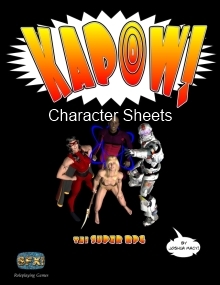
New Alternate Kapow! Character sheet

Contributed by Jason D. Smith.  You can grab it from RPGNow by clicking on the picture.

I particularly like the use of the balloons and caption boxes to make it look more comic-book-y

This is How I Rule

Nowadays I mostly use SFX! and its variants (a system of my own devising), though I do use Stars Without Number for a science fiction game with the kids, and a homebrewed version of D&D when they want to go dungeon delving. I also recently ran a one-shot of Old School Hack.

As a player I play in my friend Mac’s homebrewed D&D game, and in Russell’s homebrew he calls brew 20, as well as the SFX!-based campaigns my friends are running: Russell’s Surf City campaign using Argh!, and Dan’s Warhammer 40K campaign that recently converted to Zap!

In the past we did a bunch of Savage Worlds, D&D third edition, FUDGE, and others too numerous to mention.

This is How I Role

When it comes to sitting on the player side of the table,

  • I prefer games with a lot of scope for player initiative and planning.  I don’t insist on Sandbox worlds, but I really dislike railroading.
  • I tend towards playing Mad Thinker types; even my brutes tend to have flashes of So Stupid It’s Brilliant insights.  My favorite parts of the game are when the brilliant flashes of insight pan out, followed by PC interaction, then PC-NPC interaction.
  • The mere process of grinding through combat until a foe runs out of HP is fairly boring; adding fiddly bits to make the combat “more interesting” mostly makes it more tedious.  I prefer combat to be made more interesting by giving the players scope to do stuff that doesn’t involve invoking obscure rules or counting hexes, and by making the stakes more interesting.
  • Adding fiddly bits that directly let the players push the story around usually annoys me as a player, though I don’t object to it as a GM, and as a player I don’t object to having input into the direction of the story as long as it happens outside of the game.  It’s having story-manipulation resources that I have to track that gives me the pip.

This is How I Roll

Following Greyhawk Grognard and Big Ball of No Fun, here’s a post of my preferences in RPGs:

  • The rules as you play should all fit in your head, with maybe a cheat sheet or a character sheet to remind you.  Having to stop and look something up in the middle of a combat is a failure; having to try to remember which book to look in for the rule is beyond the pale.  I’ll make allowances for things like character generation or leveling up that are done in the downtime, but even then I’d rather not have the players passing around books, or waiting until somebody’s done with the book that has the part they need.
  • It is not the GM’s job to prevent the players from having too much fun.  If things are going the players’ way and they’re enjoying themselves, the GM doesn’t have to suddenly throw something at them to rob them of their victory or teach them the game-world is a harsh place.
  • The only thing that’s important to balance is spotlight time. It simply doesn’t matter if one character can slay a dragon in a single blow while another can be taken down by an angry toddler as long as the time spent in play and importance for the character goals is balanced between dragon fighting and diplomacy or whatever the other character is good at.
  • Game mechanics should get out of the way as much as possible, they’re there to support role-playing.  RP shouldn’t suddenly stop so you can play a miniatures skirmish game, or a card game, or a game of jenga.  Play those when you’re in the mood for them, not as resolution mechanisms for the action in an RPG.
  • If you want to write a novel, write a novel. RPGs are games, and they have to satisfy everybody at the table.  That means the GM doesn’t get to say this is my world, and your role is to admire it and provide bits of improv color while my grand narrative unfolds.  By the same token, players don’t get to try to turn it into collaborative fanfic about their Mary-Sue character.  If everybody has agreed that it’s a game set in a relatively realistic version of medieval Wessex, don’t try to wheedle the GM into allowing you to play a ninja, even if it would be cool.
  • Use dice, and let the dice fall where they may.  It’s the best, most reliable way to have events happen in the game that surprise everybody; unexpected triumphs and setbacks are much more interesting than ones the GM has planned out even before the players sit down at the table.  Corollary: don’t roll for anything if you’re not willing to accept a random result. If the adventure can’t proceed if they don’t find the hidden door, and having the adventure end right there isn’t acceptable, just have them find the door.
  • Talk about what you want.  Don’t try to handle out-of-game problems and clashes of preference by tweaking in-game rules and events in the game-world.
There’s a bunch more I could say, and have in other posts, but those are pretty much the core of how I approach RPGs.  They are my preferences, and I don’t expect everybody to share them. If you don’t, you’re not playing wrong, though there’s a good chance I won’t really enjoy playing the games that you like the way you like them.

Easiest Gary Gygax Quiz in the World

Since the Hardest Gary Gygax quiz in the World was too hard for me, I decided to make one of my own (update: do the other one first,  if you’re going to; I just looked at it again and this lets slip some of the answers for that):

  1. The first letter of E Gary Gygax’s real first name is?
  2. Along with Dave Arneson, he co-created Dungeons & Dragons. Who is he?
  3. The first D in D&D stands for?
  4. The “mad Arch-Mage’, Zagig Yragerne’s name was inspired by reversing the name of which famous game designer?
  5. Which of the following was not one of the original three D&D classes created by Gygax and Arneson: Fighting Men, Magic Users, Clerics, or Nightsong Infiltrator?
  6. Which of the following games was not created by Gary Gygax: Dungeons & Dragons, Advanced Dungeons & Dragons, Chainmail, Cyborg Commando, Lejendary Adventure, Checkers.
  7. Which famous game designer appeared as himself in an episode of Futurama, along with Nichelle Nichols, and Al Gore?
  8. Gary Gygax was born on which of the following dates: July 27, 1938; February 12, 1809; November 23, 1992.
  9. In 1973, Gygax and Don Kaye co-founded the company that would become TSR Hobbies. TSR originally stood for which of the following? Tactical Studies Rules, The Sims Resource, or Texas Ski Ranch?
  10. Identify at least one of Gary Gygax’s hobbies from the following list: Hunting, target shooting, war games, gun collecting.

Magical Traditions

A quick list of magical traditions that might be used to differentiate the magic of various cultures in an RPG setting. I originally posted these as a comment on a friend’s Google+ query, but I thought it might be of interest outside that circle.
Necromantic (needn’t be all evil zombies & ghouls, could be magic is always done with the help of ancestral spirits and a lot of it is talking to the dead)
Animistic (magic done by dealings with the spirits of natural things)
Alchemic (magic is brewing potions and the like)
Demonologic (magic is dealings with higher powers and extradimensional entities)
Calligraphic (magic is done by drawing talismans and sutras)
Sacrificial (magic is done by sacrificing living things, animals, people, your own blood)
Bardic (magic is done through poetry and song)
Hermetic – magic through the study of the fundamental principles of the cosmos
Hermeneutic – magic through the interpretation of foundational texts
Yogic – magic through meditation and physical practice
Naturalistic – magic through the application of the innate magical properties of natural substances obtained from plants and animals
Shamanistic – magic through communication with the spirit world
Supercalifragilistic – magic through words of power

Stars Without Number Session 1

We started playing Stars Without Number, a D&D meets Traveller retro-style game last Friday night.  It’s free for the PDF version, or you can buy it in softcover or hardcover from the link.  The mechanics are simple old-school D&D with a simple skill package system.  It was dead easy to teach the kids, and my friends, since rolling up a character and choosing a class is the same as what they’re used to from D&D.  That’s pretty much the reason I chose this, instead of trying to teach them Zap!, my own take on SF RPGs.  One thing that would make generating a character quicker would be for me to print off multiple copies of the skills section and equipment… and possibly even make a set of starter equipment “kits” so they don’t have to comb the lists looking for what they might want to buy.  One thing that would be nice would be a comprehensive equipment list, instead of it being divided into a number of tables by type, one table for primitive weapons, one table for energy weapons, one table for exploration gear, etc.

All in all, it went pretty smoothly for what was their first non-D&D game ever. They all seemed to like the Stars Without Number setting, and found it easy to get the hang of.  I don’t think we’re going to be running it in a particularly sand-box style, even though that’s probably SWN’s biggest strength; the players had already told me they’d really prefer to be given discrete missions, so they know what they have to accomplish and there’s a definite goal for the evening’s play.  So I just began the session with them all stuck on a backwater world, trying to scrape enough creds together to book passage out, and get approached as a group by a Xenoarchaeologist who was worried that he wasn’t able to establish contact with the base camp that his daughter and the workers she hired had gone ahead to set up near some of the ancient alien ruins that dotted the planet.

Recommended Viewing for Imagining Extra-solar Environments

This is all from one planet, and all from the same time period.  See if you can make your star systems feel half as varied.