As part two of “The Macy Conventions”, I want to look at Spell Resistance.
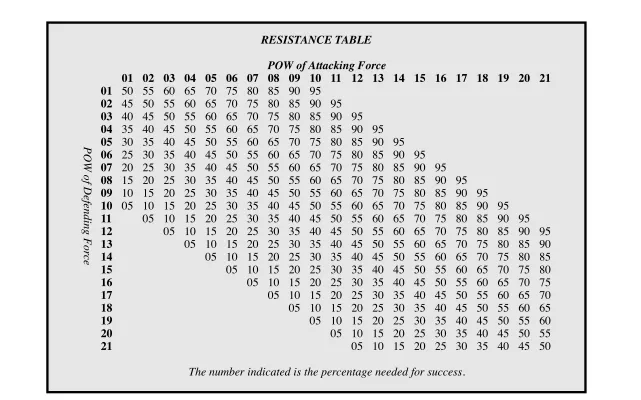
Spell resistance is another thing that’s needlessly complicated in RuneQuest 2e, or at least expressed in a needlessly complicated way. The rule is that to cast a spell on a resisting target, you need to roll 50%, plus 5% for every point your POW is higher than theirs, -5% for every point lower. 96-00 always fails. They even gave you a handy chart to cross index the POWs and see what you need to roll
That strikes me as an ugly way to achieve this result. My house rule is:
Spell Resistance
Roll d20 and add (Your POW – 10)
If result exceeds (not equals) target’s POW, spell succeeds
If result is less than or equal to target’s POW, spell fails
A 1 always fails.
That’s mathematically identical, but seems to me much easier at the table. Most people are very fast at subtracting 10 from a number, even when it results in a negative number, compared to subtracting arbitrary numbers between 1 and 21 and then adding 50.
POW Gain Rolls
If you qualify for a POW gain roll after an adventure (cast a spell that could fail other than the auto fail on a 1 in a stressful situation during an adventure), roll strictly higher than your current POW on a d20 and you can increase your POW according to the regular rule (10% chance of +3 POW, 30% chance of +2, otherwise +1).
This is mathematically equivalent to the original subtract POW from racial max, multiply by 5 and roll less than the result on %.
As is my wont, I’ve been noodling on some older games that have come up in conversation recently, and in particular RuneQuest 2e. I ran a RuneQuest campaign, back in the day, and I’m pretty sure we started with 1st edition, and later switched to 2e (or maybe I just did a different campaign of 2e… wouldn’t be the first time my memory of those long ago events was a little blurry). There were a lot of things I liked about RQ, and later the whole BRP line, particularly Call of Cthulhu, and its percentile dice system was one of the easiest things ever for players to grok. Your skill at driving was 32%, cool, roll under 32 on the percentile dice and you’re golden. Now, what exactly it meant to fail that roll when it was something as mundane as driving was a matter of interpretation and sometimes heated debate, but the basic principle couldn’t be simpler.
But I was never quite happy with the way things like criticals and fumbles were worked into the roll, or in RuneQuest things like impaling with your pointy weapon. The basic rule, with many variations on the exact numbers, was always something like compute 5% of your skill, if you roll that or less you’ve scored a critical hit. For instance if your skill was 100, then 01-05 was a crit; if your skill was 50, then only 01-02 (or maybe 03 depending on rounding). An impale would be similarly 01-20 with skill 100, while proportionally less the lower your skill. Fumbles were the reverse, though explained rather confusingly as starting at 5% (96-00) for skills less than or equal to 20 and being reduced by 1% for every full 20% in your skill (97-00 for skill 40, 98-00 for skill 60, etc.) This meant that unless you were great at mental arithmetic, you had to write down your critical, impale, and fumble range for each and every skill on your character sheet, updating it whenever the skill improved. And if you reached the point with skills at 100+ where you could split your skill into two actions with any division you liked as long as both were at least 50, recalculating with what you chose at the moment (or sticking to a split that you precalculated). Bleh, and double-bleh.
So, I’ve come up with a dice-rolling method for RuneQuest, BRP, and really any other percentile system that I really quite like. As far as I know this is original, though my memory being what it is and with all the time people have spent fiddling with things like this some pieces of it may have been published elsewhere and I’ve just forgotten running across it. As far as I can tell glancing through my Chaosium books, though, none of them have used this, sticking to variations on what I’ve laid out above. I think RoleMaster had a special convention for 66, maybe for all doubles, but I’m hazy on the details. Here it is, though, for your entertainment, with a tip of the hat to the famed Perrin Conventions that started the whole RuneQuest thing, the Macy Conventions:
The basic idea is to read the percentile roll cleverly, to simulate (more or less) the odds that calculating it the old way would have given you, and incidentally incorporating the 1d20 Hit Location roll into the same roll through more shenanigans in how you read off the result. Moreover, we want the whole thing be so simple and easy to remember that you wouldn’t have to keep looking it up once you understood it. Basically all doubles are special, either a crit or or fumble based on whether the roll qualifies as a hit or miss.
Special Results
Critical Hit: Any doubles (11, 22, etc.) that would normally hit
Fumble: Any doubles that would normally miss
Special Effect (Impale/Slash/Crush): Any roll that would normally hit with a 0 in either digit
Always Hit: 05 or less
Always Miss: 96 or higher
Hit Locations
Read the ones digit of your roll:
If tens digit is even: Use ones digit as location (0 = 10)
If tens digit is odd: Add 10 to ones digit
For reference the following is the hit location table from RQ 2. I haven’t really given much thought yet to whether there’s a way to simplify it to reduce the need to look it up, but the one look-up doesn’t strike me as that burdensome compared to the original. And of course if anybody finds the process of checking the tens digit this way a pain, they can just roll a separate d20. You probably should roll the separate d20 when you crit anyway, so crits don’t cluster in a couple locations. But for Ernalda’s sake, roll it at the same time as you roll your damage!
Humanoid Hit Location Table
D20
Area
Description
01-04
Right Leg
Right leg from hip joint to foot
05-08
Left Leg
Left leg from hip joint to foot
09-11
Abdomen
Hip joint to just under the floating ribs
12
Chest
Floating ribs to neck and shoulders
13-15
Right Arm
Entire right arm
16-18
Left Arm
Entire left arm
19-20
Head
Neck and head
Example: if you hit with a 27, that’s location 7, so left leg; if you hit with a 37 that would be 17, so left arm.
Examples
You have a skill of 39.
You roll 33! It’s a crit, and strikes the right arm (13)!
You roll a 55! It’s a fumble, roll on the fumble table.
You roll a 19! It’s a hit.
You roll a 20! It’s a hit to the abdomen (10), and the attack impales/crushes/slashes depending on your weapon!
You roll an 07! It’s a hit to the left leg (7), and again the attack impales/crushes/slashes.
You roll a 70! It’s a miss.
You have a skill of 65.
You roll a 34, it’s a hit to the right arm (14)!
You roll a 44, it’s a critical hit to the right leg (4)!
You roll a 66, it’s a fumble!
You roll a 100, it’s a fumble!
You roll a 01, it’s an impaling/slashing/crushing hit to the right leg!
Stuck Weapons
Addendum: I had forgotten that a successful impale left the weapon stuck in the target unless you rolled again immediately looking for double the chance of an impale, i.e. if you had 4% chance of impale, you had 8% chance of freeing the weapon that same turn. On subsequent turns you just had to roll an ordinary hit. So:
Freeing stuck weapon: roll again, looking for a hit with either 0s or 1s on either die.
Later turns it’s still just looking for an ordinary successful hit. Automatically successful after 5 turns trying, just as in the original rules.
A Look at the Odds
So, how close is this method to the original? The answer is pretty close. Crits are about twice as common, but ranging from 0% if your skill is <11 to 9% if your skill is 99+. For instance if your have skill 25 you have 2 chances in 100 of scoring a crit (11 and 22 instead of just on an 01); if you have skill 99 you have 9 chances in 100 (11, 22, 33, 44, 55, 66, 77, 88, 99), while a 91 score it would be only 8. Fumbles are the same but in reverse, just being more common at lower skills and less common at higher ones. Double sounds like a lot, but twice a small number is still pretty small, and at least some later editions of RQ switched to 10% of the skill anyway, to make the calculation easier and the combat more spicy.
Chance of impalement (or crushing/slashing if you use that option) is a bit closer to the original. Once you get past 10% skill, you have 9 chances to impale (01-09) + 1 chance for every 10% more skill. So at 50% skill that would be 14% (01-09, 10, 20, 30, 40, 50) instead of the original 10%, while at 100% it would be 18% instead of 20%. My experience is that differences that small are very hard for the players to even perceive, though your mileage may vary, and it’s not like the original was arrived at by any rigorous examination of the odds in real combat.
The always hit/always miss odds are straight from the original, while the hit locations are nearly identical: there are exactly 10 digits on the ones die, and exactly half of the the digits on the tens die represent adding 10 to get the upper half of the d20. The nearly part comes from the fact that since 00 is always a miss, you only get 4 out of 100 ways of rolling a 10 (20, 40, 60, 80). All the others are spot-on. There’s also the slightly odd fact that the always hit numbers are always going to be blows to the legs, but I’m not sure I’m that worried about it; if I were I could say that if you roll an automatic hit then you roll a d20 for hit location instead of just reading it off the dice. Is the one special case better or worse than people’s legs being slightly more vulnerable than the rest of them?
Characteristic Checks
Don’t multiply by 5 and roll under the stat, just roll a d20 directly against the stat. Unless you plan on using the crits and fumbles rules on the stat checks, it’s mathematically identical.
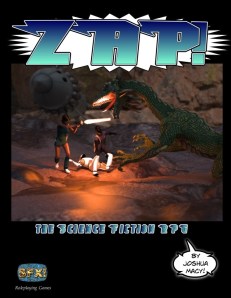
There’s a new version of Zap! on RPGNow. Â A lot of work went into this one. Â There are some rules clarifications, and significant new optional rules for things like speeding ship-to-ship combat, adding hit locations to regular combat, and pages and pages of new example equipment. Â Many of the most useful tables have been added to a new Appendix for easy printing, and there’s a whole bunch of new art, mostly from public domain SF comics of yore. Â Plus I’ve included a 5 page Quickstart PDF with just enough rules to generate a character and go.
Also, I’ve been running a lot of G+ Hangout games using Zap! Â If you want to join in the fun, follow me or the SFX! RPGs community on G+. Â We’re trying to set up an every-Tuesday-night SF RPG hangout, where I’ll be one of the rotating GMs, and I have pick-up games several other nights of the week. Â If I can get interest, I’d love to run a longer term campaign instead of pick-up one-shots. Â Drop on by!
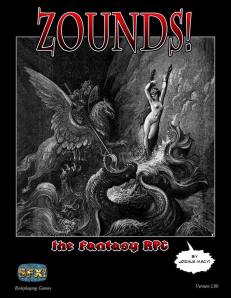
I’m thrilled to announce that Zounds! the Fantasy RPG is now available from RPGNow! Â I feel like this is the best SFX! game yet. Â It’s certainly the biggest in terms of content.
It’s also the first to have illustrations other than the computer graphics ones that I do… swiped from dead people the world over! (All public domain, that is.)