D&D To HOW Stat Translation

This is just a quick recap of translating D&D attributes into their Heroes & Other Worlds equivalents, if what you care about is how much the attribute adds to the chances of success on a roll.  See my previous post on Bell Curve vs. Linear for a deeper explanation of the probabilities involved.   It seems to me that chance of success is probably the best way to look at it, since that’s most often what you’re going to be directly testing, at least in HOW.  There are other things the attributes are good for (e.g. carrying capacity for STR in D&D), but they seem to me to be relatively minor compared to adjustments to your chance to hit, say.  In D&D, particularly old D&D, attributes are much less important than in HOW: the difference between a 12 and a 9 in Basic D&D is almost purely cosmetic, and even the difference between a 3 and an 18 is no more than the difference between a 10 and a 13 in HOW when it comes to applying the bonuses to a d20 roll.

old D&D New D&D HOW
2-3 8
4-5 8-9
3 6-7 9
4-5 8-9 9-10
6-8 9
9-12 10-11 10
13-15 12-13 10-11
16-17 14-15 11
18 16-17 11
18-19 11-12

If the HOW column shows a range, use the lower number if you’re at the lower end of the D&D range, or the higher number if at the higher end.  Flip a coin if the number is exactly in the middle.

Update: Since Tim Knight asked, I’m including a little more of the reasoning behind having the D&D stats represent such a tight range of HOW stats… is a stat over 12 in HOW really superhuman?

D&D stats add comparatively little to your abilities.  Even in the more generous editions, an 18 is only a +4 bonus… which is +20% on a d20 roll. Starting from a base to-hit of 50% vs. unarmored foes, that gives you a 70% chance of landing a blow.  In HOW a score of 12 gives you a 75% chance of landing that same blow.

There are other ways you could look at it.  For instance, as a straight roll under stat to see if you succeed, an 18 is 90%, which is equivalent to a HOW score of 14.  But by-the-book D&D never employs rolls like that. Instead, where stats matter at all, it’s almost always as the tiny (+/- 20%) bonus.

The systems have pretty different underlying assumptions of competence, but it seems to me that matching bonuses as I did tends to minimize “system shock” where translating a character from one to the other makes it vastly more or less likely to succeed at tasks than in its home system.   A beginning HOW character is much more likely to succeed than a beginning D&D character; they’re much closer in competency to a mid-level D&D character, even though HOW being a much more deadly system overall tends to make them feel comparatively fragile.  E.g. a beginning thief in D&D has only 15% chance of picking locks or 20% of picking pockets compared to the 50% a 10 DX thief has in HOW. The one thing that D&D characters get a lot better at over time is taking multiple blows, though I haven’t yet tried to factor in the difference between armor as DR and armor as deflection

Bell Curve vs. Linear

Here’s a handy little chart showing the difference between a linear distribution like rolling a d20 and a bell curve distribution like 3d6 when it comes to rolling versus a target.  The first column is the d20 roll, the second is the approximate percent chance of rolling that or less on d20. That’s pretty obvious, but the next column is what the target number would be on 3d6 to have that chance to succeed (i.e. roll target or under).  So a 50% chance is right in the middle of the curve at 10… but by the time the target is 12 you’ve got a 75% chance of succeeding.  Next we have columns for a d20 skill roll/Basic Attack Bonus (as in 3e or 5e).  The final four columns show THAC0 (to hit AC 0) and what level you would have to be to have that chance of hitting an unarmored person, using the D&D Rules Cyclopedia as a reference point.  Hitting an unarmored person is the standard we’re using because that directly translates to scoring a hit in Heroes & Other Worlds/TFT (and similar games like Runequest) where armor reduces damage from a successful hit but does nothing to make success less likely.

From this you can see that, for instance, having a 13 DX in HOW is like being a 10th level Fighter, at least in terms of being able to land a blow.  (On the other hand, a 10th level Fighter in D&D can sustain multiple times the damage a HOW fighter could, so you can’t just translate back and forth quite that easily.) Another thing to pay attention to is the s20 skill column, where you can see that in terms of stat bonus, a D&D score of 18 is equivalent to DX 11 (if 18 is +3 as in original D&D), or maybe DX 12 (if 18 is +4 as in later editions).  Using the stat bonus in D&D is much more common than a straight roll-under against the stat.

Still, I find thinking of things this way as instructive.

Roll Under Rules Cyclopedia
d20 Approximate % 3d6 d20 skill/BaB THAC0 Fighter Cl/Th/D MU/Normal
0 0.00% 3,4 -11
1 5.00% 5 -10
2 10.00% 6 -9
3 15.00% 7 -8
4 20.00% -7
5 25.00% 8 -6
5 25.00% -5
6 30.00% -4
7 35.00% 9 -3
8 40.00% -2
9 45.00% -1
10 50.00% 10 0 10 1 1 1
11 55.00% 1 9
12 60.00% 11 2 8 4 5 6
13 65.00% 3 7
14 70.00% 4 6 7 9 11
15 75.00% 12 5 5
16 80.00% 13 6 4 10 13 16
17 85.00% 7 3
18 90.00% 14 8 2 13 17 21
19 95.00% 15 9 1
20 100.00% 16,17,18 10 0 16 21 26

Here’s an Anydice page with the 3d6 info, and just for the heck of it, the 1d20

Link to

Overland Travel Rates

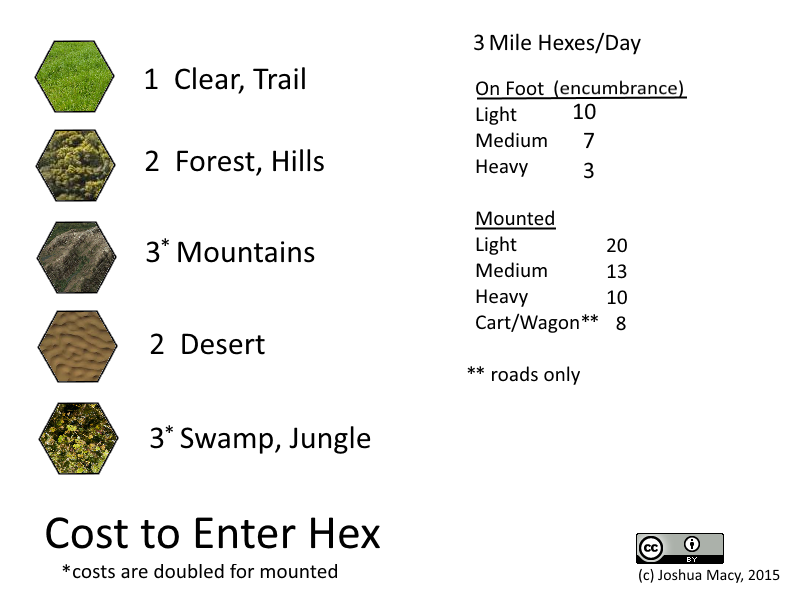
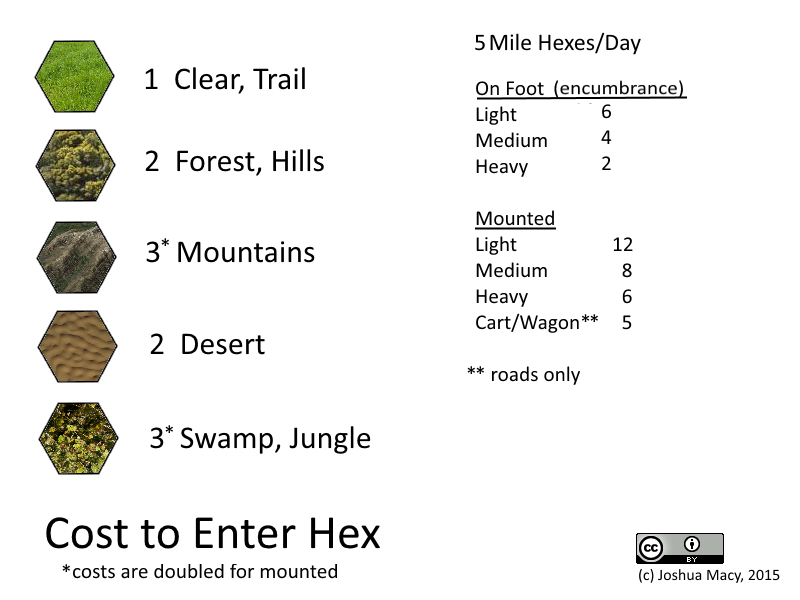
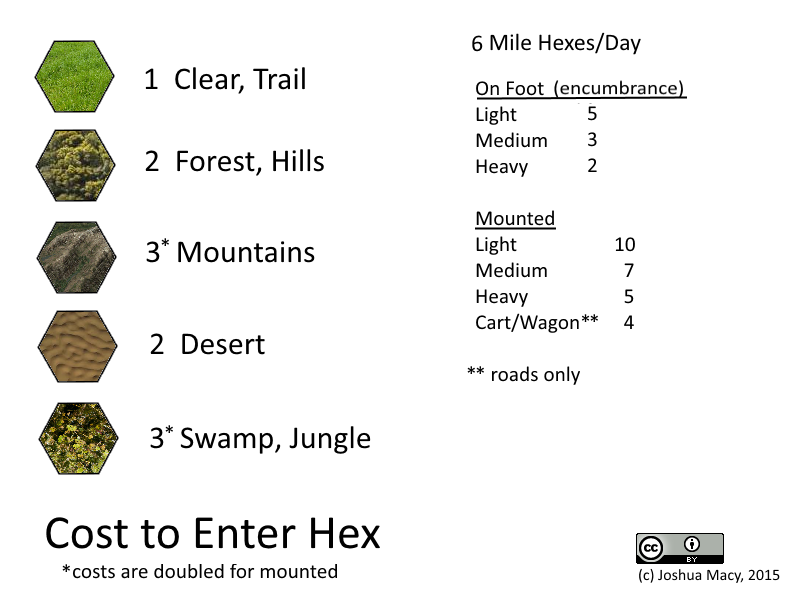
The following are some hopefully useful templates (mostly based on Delta’s discussion of the rates in Advanced Dungeons & Dragons 1e Dungeon Master’s Guide).  They show the cost to enter1 a hex on the overland travel map, with a key to how many hexes a party can move in a day based on the degree of encumbrance (for travelling on foot) or type of mount.  The assumption (following the DMG) is that roads and trails do not speed your travel enough to track, but they do allow you to pass over worse terrain as if you were on clear terrain.  That doesn’t completely match up with the way, say, the Cook Basic D&D works, but it’s easy enough to increase the rates on roads if you’re really inclined.

If the cost of entering a hex is more than a single day’s allotment (e.g. on heavy horse in a swamp with no road), you can either say it’s impassible, switch to a smaller scale map and have the party slog through taking multiple days, or make the minimum rate of travel 1 hex per day or 1 hex every other day.

While these have been derived from D&D, they are non-system specific, and are released under a CC-BY license (that is you can use them any way you want, but you should credit me somewhere)/ Enjoy.

1milehexes

3mile_hexes

5mile_hexes

6mile_hexes


  1. This is by far my preferred approach, since it means no tracking of partial hexes. It also matches the way Outdoor Survival worked, which was the original source of the all the D&D movement rules…and by extension almost everything that came after. 

Awesoming up Numenera

Having played Numenera again, I’d have to say that the two biggest fun-sucks are deciding whether to save XP for improvements or spend it to reroll or avoid GM Intrusion, and the decision as to whether to spend the XP to avoid GM intrusion and if you accept it having to decide who to give the extra XP to.  These are terrible, terrible things to force the player to do in the middle of every exciting situation, wrenching the players out of any immediate visceral reaction to the what’s happening in the fiction and forcing them to consider long-term character goals and emphasizing the fact that its fiction at the worst possible moment by making potentially exciting twists and developments provisional upon the players’ decision about whether to spend resources to prevent it.  It is in a word, bletcherous, and it doesn’t need to be.

In order to dial up the awesomeness in Numenera, you only need to make two house rules:

First Make GM Intrusions compulsory, but allow the players to mitigate them instead of retconning them.  Instead of saying “This happens, unless you choose to spend now to make it unhappen” say “This happens, what do you do?” Then allow the players to either spend XP to automatically succeed at some attempt to cope, or proceed normally with the usual rolls.  Thus instead of “GM Intrusion: You drop your weapon!”  “Spend an XP.  I refuse.” it becomes “GM Intrusion: You drop your weapon!”  “But I manage to catch it with my other hand! Spend an XP!”  or “They grab you from behind!”  “Just as they do I catch a glimpse of them reflected in the shop window and manage to wrench myself out of their grasp!”  Or if the player doesn’t feel like spending the XP, “I try to wrench myself free. (Rolls)”  It may seem trivial, but keeping it so the fiction always moves forward with no “taps back” is, imo, really important for maintaining a high level of engagement.

Second Reward players for spending XP on immediate and short-term benefits by making it required.  In fact, instead of calling what you get awarded for accepting GM Intrusion and discovery XP, let’s call it Numenera Points, or NP.  NP can be spent on anything except Long Term Benefits and Character Advancement.   XP are gained by spending NP.  XP can only be spent on Long Term Benefits and Character advancement.  If you keep the ratio of spent NP to XP earned at 1:1 characters will advance a bit faster, so if you like you can adjust this for your campaign so that, e.g. you spend 2 NP to gain 1 XP.  This automatically solves the problem of hoarding NP… there’s no real reason to, and if players do, they gain no particular benefit; it’s not like they are trying to save to improve the character at the same time as keeping a bank to use during play.  Those functions are now handled separately by XP and NP, and you can adjust the conversion ratio for any desired pace of advancement.  Most importantly, players are now rewarded instead of punished for engaging with the mechanics of the game when they spend NP.

To a lot of people these differences are too subtle to care about; they’re perfectly happy to stop playing their character and ponder how to manage their resources or discuss tactics and rules minutia with other players mid-sword-swing, and rewinding what’s going on in the game is no more distressing than playing an interrupt card on an opponent in Magic the Gathering.  On the other hand, there are people like me who are really bugged by “dissociated mechanics” to the point where it can be really hard to care much about what happens to the character, who becomes a token to push around on the board.  The thing is, people who don’t mind dissociated mechanics aren’t bugged by associated mechanics; in fact many of them seem to be completely blind to the difference between them… so tweaking things to make the mechanics associated with what’s going on in the game world is a win-win.  Engagement with the mechanics is still perfectly satisfactory for those that don’t care how its connected to the fiction, and those that do care can now use the mechanics without the pain of having to step back from the fictional world to make OOC decisions.

Low-Magic Fantasy Settings Seem Strange

The idea of a low-magic fantasy setting seems a bit odd to me, in that the idea that the world we live in is low-magic strikes me as a very modern one.  As far as I can tell at most times and places in our world, which has no magic at all, people nonetheless believed that the world was chock full of magic.  It might have been hard to make use of reliably, though most superstitions seem to me to be every bit as formulaic as D&D wizard spells, but it lurked everywhere and you needed lots of protection against it.

I can kind of see wanting a setting where objective proof of the existence of magic is hard or impossible to come by if you want something that feels like our world.  And I certainly get not wanting the solution to every problem to be just magic it away.  But many (most?) low-magic settings I’ve seen in games take it much farther than that, to where hardly anybody even claims to do magic or have never encountered anything they regarded as supernatural, and that doesn’t quite feel right to me.  To the modern mind the difference between natural and supernatural is obvious and complete: your cattle catching a disease vs. somebody levitating  in front of your eyes are completely distinct kinds of phenomena.  In a setting based on the pre-modern world I’m pretty sure that shouldn’t be true.


Discussion on G+

Random Good Fortune

And to balance out the bad luck, a table of random fortunate occurrences.

  1. Ha! Ha! Opponent rolls on Mishap table
  2. That was Quick! whatever you were attempting happens so fast you take another action immediately
  3. Serendipity! your failure succeeds at something else entirely (e.g. attempt to find secret passage harmlessly triggers a trap you missed)
  4. Good Job! you achieve max normal success, whatever that is (e.g. maximum non-critical damage, highest value on a sale)
  5. Inspirational! +1 morale to allies
  6. Educational! allies get XP as if they too had accomplished the task
  7. Lucky! add 1 to your Luck score (if not using Luck, get one free reroll to use later)
  8. Insight! GM reveals one hidden fact about the situation (e.g. the exact number of HP the enemy has left, or which way the quarry went)
  9. Look! Somebody dropped something valuable or interesting
  10. Premonition! Next time you would be surprised, you aren’t
  11. Not as bad as it looks: the most recent bad thing that happened to you is only half as bad as it first appeared or is mitigated by half (e.g. if you took 4 points damage, it was only two; if you lost 10 gp gambling, you discover you were carrying 5 g.p. more than you thought or find a purse with 5 g.p.).
  12. Aha! If you failed, reroll; if you succeeded get double the XP for the task
  13. I meant to do that! failure becomes success in an unexpected way (e.g. opponent blocking a door dodges your blow so violently he hits his head on the lintel)
  14. In the Zone! Win next initiative roll if in combat, complete the task in one less time period otherwise (e.g. if searching the room takes 5 turns, complete it in 4)
  15. Focused! Ignore situational penalties (such as bad lighting, or fatigue) on your current action, if that would change failure to success, otherwise ignore them on your next action.
  16. Make Failure Your Teacher! However much you failed the roll by becomes a bonus to your next attempt at the same action.
  17. Combo! However much you succeeded by becomes a bonus to succeed on your next action (if you failed there’s no bonus, but no penalty).
  18. KO! Treat as critical success, for non-combat tasks treat as most favorable outcome your character could ordinarily roll (e.g. if crits do double damage, double the damage you roll)
  19. Perfect! Maximum possible success, including best possible critical if applicable, for non-combat tasks treat as the most favorable outcome the game allows regardless of whether your character could ordinarily achieve it (e.g. if crits do double damage, do max damage  x2, if crits roll on a table, pick the result you want)
  20. You Win! You prevail in the current situation.

Random Mishaps

Fumble tables can be fun, but are often very combat specific.  Here’s a d20 table for random mishaps suitable for fumbling on other rolls:

  1. Lose something
  2. Break something
  3. Make a mistake
  4. Slip and fall
  5. Bang into something
  6. Drop something
  7. Brain fart (lose an action/accomplish nothing this time period)
  8. Sneeze/belch/fart (make unwanted/embarrassing noise)
  9. Interrupted
  10. Chills/foreboding
  11. Misspeak
  12. Mishear
  13. Misremember
  14. Misstep
  15. Misunderstand
  16. Lose control (by personality type, e.g. rage, cry, vomit, panic attack, faint)
  17. Lose track of time (lose 1d4 time units appropriate to current task)
  18. Lose focus (Fail at current task, but roll accomplish some other task instead)
  19. Hurt self
  20. Hurt other

The Traps of the Santicore

Being a set of tables for generating concepts for traps for any system, with examples and discussion.

Tables

Purpose of Trap (d8)

  1. Capture
  2. Impede
  3. Injure/Kill
  4. Resource Sink
  5. Hazard
  6. Practical Joke
  7. Lock/Barrier
  8. Alarm

Trigger Type (d12)

  1. Pressure Plate
  2. Trip-wire
  3. Opening a container/door
  4. Removing pressure
  5. Occlusion
  6. Heat/Light
  7. Magnetism
  8. Guard-activated
  9. Permanent
  10. Sound
  11. Unusual Sense
  12. Timed

Location (roll separately for trigger and trap, d6)

  1. Floor
  2. Wall
  3. Ceiling
  4. Container
  5. Entrance
  6. Other


Obviously, some effort needs to be spent to make the trap coherent; if the trigger is a pressure-plate on the ceiling for a trap on the floor, it should be something like a place the door will brush as it’s opening, or be part of a feature on the ceiling like a mosaic or chandelier that the players will be tempted to explore.

Mechanism (d10)

  1. Gravity (pit trap, falling block, tilting floor, sharpened pendulum)
  2. Spring-loaded (arrow or spear)
  3. Clockwork (crushing walls, retracting catwalk, portcullis releasing beast)
  4. Hydraulic (liquid filling area, rising floor)
  5. Chemical (gunpowder, chemicals combining to form noxious fumes, acid)
  6. Physical Properties (flammable material, radioactive, poisonous)
  7. Magical (known magical effects and spells, such as magic mouth, or fireball)
  8. Electronic (electrifying areas, as well as hi-tech substitutes for clockwork)
  9. Biological (spores, parasites, released critters)
  10. Arbitrary (magic not using known/documented spells)

Notes

Purpose of Trap

Capture

A Capture trap attempts to hold victims until they can be dealt with later; in some cases the trap is meant to hold them until they expire from natural causes or injuries suffered.

A pit trap is the classic capture trap, though others might throw a net or sticky substance, or simply lock adventurers in a room with no way out.

Impede

Impedance traps are meant to slow down victims, either to make them easier to catch or increase the likelihood of patrols running into them.

Classic impedance traps include mazes, caltrops, sticky or slippery floors, magically darkened areas, or cryptic messages that adventurer’s may waste time trying to decipher.

Injure/Kill

Injury traps are intended to harm the victim, perhaps killing them outright.

Classic injury traps are pit traps (if deep enough or with spikes), spear or arrow traps, swinging blades, falling blocks, crushing walls, poison darts, and the like. Some can be dodged or defended against (particularly ones that poke or slice with a regular weapon), or depending on damage rolled might not injure you that much. Others, such as being dumped into lava or having cockatrice feathers poured down over you, are meant to be lethal so they have to be avoided, whether through noticing the trigger or making a saving throw.

Resource Sink

Traps that cost resources are meant to deplete the intruder’s stock of available resources, softening them up for later, or perhaps stranding them if they turn out not to be carrying enough torches or rope to get through the area.

Resource traps might be stretches that require a lot of technical climbing (with spikes and ropes, or use of fly spells), or passage through long underwater sections, or strong magnets that make the party abandon iron gear (a rust monster is the animate version of this), or contain things like slimes or oozes that eat away at wooden or leather gear.

Hazard

Some “traps” aren’t designed as such at all (or at least not designed by any creatures in the gameworld), but are simply hazardous areas. Narrow mountain passes prone to avalanches, or areas with volcanic fumaroles, or treacherous ice don’t have a specific design goal, they are simply there and dangerous if you try to traverse them.

Practical Joke

Some traps are designed to amuse the placer of the trap, and often do no more than inconvenience or embarrass the victim. These may also serve as alarms or to discourage intrusion in places where it would be unwise to put a trap that can actually injure or kill. E.g. a wealthy merchant probably won’t have a pit-trap with poison spikes in his town-home to keep his servants out of the liquor, but might put lampblack on the knobs of the cabinet to stain their hands.

The real-world version is a bucket over the door or a whoopee cushion. Magical traps of this sort planted by a whimsical wizard or fairy might curse somebody with an animal’s head, or change their sex.

Lock/Barrier

Some “Traps” are just meant to prevent access to unauthorized people. The simplest is just a locked door or gate. Elaborate or magical ones may involve puzzles, perhaps an entire room that forms a puzzle. There might be consequences, including lethal ones, for making a wrong move in the puzzle, the essence is to actually to provide a means of ingress to somebody who knows the secret, not to keep everybody out permanently (as might a rolling boulder or falling block trap in a tomb).
Note that some locks or barriers aren’t there to prevent adventurers from getting in, but to keep something dangerous from getting out….

Alarm

Alarms aren’t intended to directly harm those triggering them, but to alert others to the fact they’ve been triggered.  They might respond by arranging an ambush, or by running away with the treasure.

Trigger Type

Pressure Plate

A Pressure Plate is any sort of pressure sensitive mechanical trigger. It is usually activated by stepping on it, and typically has some threshold weight that is too small to trigger it (whether that’s a coin, a mouse, or a hobbit).

It can typically be detected by careful examination of the area for a mismatch in the height of the material, seams where the plate meets the rest of the area, a slight wobbliness or give if manipulated; because of the presence of a mechanism beneath the plate, sand or water may be able to flow through the seams where it wouldn’t in ordinary crevices.

Pressure plates can often be jammed by wedges in the seams or levered beneath the plate, or can by bypassed by not stepping on them.

High tech or magical pressure plates may be nearly impossible to detect, save by detecting the presence of magic or electricity itself, though a fair trap will still usually a least be triggerable by dropping a sufficient weight on it.

Trip-wire

Trip-wires are any sort of physical wire, rope, or cord that triggers a trap by pulling on something when somebody steps on or through it.

They can often be spotted by visual inspection, though if they are camouflaged, very fine or in bad lighting conditions they can be extremely hard to spot without unusual senses; adventurers of unusual size (small enough to pass beneath) or means of locomotion (always flying) may bypass them without even noticing.  They may also be detected, or at least triggered, by poking ahead with a pole.

They can be bypassed by stepping over or under them, or jammed by preventing the wire from moving or breaking.

Opening a container/door

Opening a container or door can trigger a trap by the mechanical action of the hinges, by the lid or door pushing or pulling something as it changes position, or releasing pressure on a spring, by the twisting or pulling of a knob or handle attached to the catch that holds it closed, by poison on the handle or on something sharp that someone manipulating the handle is likely to cut himself on  or simply because the container or room has something dangerous in it.

Spotting such traps can be difficult unless you have unusual senses allowing you to see inside the container, since all the mechanical parts of the trap may be on the inside.  It might be possible to detect the trap by an slightly higher resistance to opening than expected (particularly if the hinges are well-oiled first) or the sound/feel of something scraping or being pulled.

Such traps can be bypassed by creating a new opening in the container, by breaking a wire or flange that would be pulled out of position by opening the lid, by applying pressure to a spring that would otherwise release, by manipulating the knob or handle remotely or through protective gear.

Removing pressure

Pressure triggers can be set off when something is removed from where it should be, such as when a heavy gold idol is taken off an altar, allowing a spring to uncoil, the other end of a counter-weighted lever to descend, or weight that was held in place by a cord beneath the idol to fall…

Spotting such triggers can sometimes be done by seeing the cord or noticing the seams where the trigger mechanism will move once the weight is gone.

Disarming the trap can be done by swapping the weight for a similar one (be careful that the replacement weight is close enough… particularly if the builders took extra care so that if too much extra pressure was applied to the balance the trap would trigger anyway), or by jamming the balance platform so that it can’t move even if the pressure is removed.

Occlusion

Occlusion triggers are set off when something blocks the sensor, as with an “electric eye.”  These usually require magic or high technology, though a goblin with a peephole would do in a pinch.

They can be spotted by noticing the opening for the sensor, or if the sensor requires a visible beam of light (or one that can be made visible, say with smoke) the beam.

They can be bypassed by avoiding breaking the beam or passing in front of the sensor, or by arranging mirrors to divert the light in a path that reaches the sensor but leaves space to pass.

Heat/Light

Heat/Light triggers are set off by the presence of extra heat or light, such as generated by torches or just by warm-blooded creatures.  The trigger might be an exotic material that melts easily, releasing a spring or a weighted cord, or perhaps the material itself is poisonous once it’s heated enough to form a vapor, or perhaps phototropic plant that pulls or pushes the trigger as it turns toward the light.  Or it could just be magic or tech.

Spotting such traps will be very difficult without some way to observe the trapped area remotely or in perfect darkness.

Bypassing the trap might involve nothing more than being able to pass through the area in darkness, or by interfering with whatever mechanical part is connected to the sensor.

Magnetism

Magnetic triggers will usually have some catch that is pulled out of place by magnetic attraction, generally to the armor to the adventurers wear… though if the magnet is powerful enough it might itself be the trap, pulling the adventurers off a ledge or just immobilizing them unless they abandon their armor.

If it’s not obvious, a magnetic trigger might be detected by its effect on compasses, or by the very subtle pressure it exerts (a realistic magnet would have to be quite powerful if the metal isn’t going to come within a few inches of it, unless it was suspended in something to reduce friction. Otherwise the trap might as well be magical for all the adventurers can do to detect it).

Magnetic triggers can usually be bypassed by being careful not to bring metal near them, or by the usual mechanical jamming methods depending on what they’re attached to.

Guard-activated

Some traps are simply activated manually by a guard from an observation post.

Spotting the trap usually means spotting the guard, or at least the peephole or camera (or magical equivalent) the guard is using to observe the area.

Such traps can be bypassed by avoiding the field of vision of the guard, presenting the guard with a fake or illusory view of the area, taking out the guard, distracting or tricking the guard, or waiting for the guard’s attention to lapse (e.g. fall asleep, or leave the observation post to make rounds or relieve himself).

Permanent

Permanent traps don’t have a trigger, the area is simply dangerous (or dangerous to unprotected/unprepared people) all the time.  A room might be full of poison gas, so the only safe way to enter it would be if you were immune to the poison, took an antidote, or wore protective gear.

Depending on the nature of the danger it might be obvious to any observer, or it might only be revealed if you see somebody aware of the danger taking precautions.

Bypassing the trap usually requires ascertaining what precautions are necessary and taking them, since by definition there’s no way to avoid the trigger.

Sound

Sound triggers are set off by sounds or vibrations; they might be carefully balanced stones or snow (as in an avalanche), or a cavern or other structure that amplifies sound until it’s sufficient to dislodge a lever or weight.

Sound traps might be spotted by the area being unusually quiet or having peculiar echoes, or by observation of whatever pile of rocks or lever/pulley structure that’s the mechanical part of the trap before you get close enough for the sound to dislodge it.

Bypassing the trap could be done by being unusually quiet, by somehow stabilizing the delicately balanced trigger, or by jamming the mechanics if there is an accessible mechanical part of the trap and not just tons of stone that will fall from the ceiling if disturbed by loud sounds.

Unusual Sense

When magic or high tech is involved, many bizarre or nearly arbitrary phenomena might serve as a trigger.  (e.g. the presence of “good alignment”)  These usually can’t be spotted or bypassed unless you have appropriate magic or tech of your own, though you might still be able to infer the presence of the trap by observing the behavior of those “in the know” about it.

Timed

No actual trigger, rather the trap activates periodically, regardless of what’s going on.  A simple example would be a cavern that filled with water at high tide, but more complex ones might be something like pendulums that constantly swing, or walls that crash inward every few minutes.

Detecting timed traps can be done by noticing the remains of previous victims of the traps (since such traps are often unattended and automatically reset, so nobody ever takes the bodies away) or by observing the trap going off (since it will activate whether or not there’s reason to do so).

Bypassing the trap usually consists of figuring out the timing of the activation and passing through the area during the quiescent period.

Complications

Nastier traps often involve traps with precautions, fail-safe mechanisms, extra concealment or misdirection.

Precautions

Extra care might be taken to build the mechanism in such a way that it’s hard to interfere with.  For instance a trap where opening the lid of a box pulls a cord that activates a poison blade on a spring might make the cord out of wire so that it’s hard to cut even if spotted, or include extra metal baffles that extend downward from the lid so that you can’t poke a knife in until the lid is lifted enough for the cord to do its work.

Failsafes

Traps may have extra mechanisms to thwart attempts to disarm them; this can be an entirely separate trap that guards the mechanism of the original trap, or just extra precautions so that obvious ways of trying to disarm the trap trigger it anyway. For instance, using the example of a box and cord again, the trap could have an additional spring mechanism that puts tension on the cord so that if it’s cut the spring contracts and releases the poison blade regardless.  Or a trap that is triggered by a balance arm might be rigged so that it goes off if the balance goes in either direction (the idol is removed from the altar or the idol is replaced by something heavier).

Extra Concealment

Any trap can be made more dangerous by spending extra effort on concealing its mechanism.  This can range from the completely simple (painting the tripwire black, removing the debris from when the trap was activated previously) to the cunning (trompe l’oeil painting to deceive the eye as to the actual dimensions of the room or make the exposed parts of the trap completely blend in) to making the trap magically undetectable to all intents and purposes (illusions and invisibility fall into this category unless the characters have magic to deploy against it).

Misdirection

Some traps are concealed by the presence of obvious other traps or suspicious things.  E.g. an obvious pit-trap with an illusory floor trap just beyond it so that if the characters vault the first they land right in the second.  These are usually more amusing for the GM to contemplate than for the players to encounter, unless they are explicitly attempting to beat a “deathtrap” dungeon and are prepared to spend hours trying to out-paranoid a mad wizard with arbitrary resources in order to cross a 30’ corridor.

Still, in the real world there are such things as fake safes and dummy security cameras, so a certain amount of misdirection is probably allowable without being a complete bastard.

Super Simple Martial Artist Class for D&D (early editions)

The Monk is a Fighter, with the following special rules:

  • AC is 3, unarmored.
  • Attack is 1d6, unarmed.
  • May use any object that she can lift as an improvised buckler, for AC 2.
  • May attack with any object she can lift (1d6 damage); the only advantage to this is not actually having to touch the target (in case it’s on fire or is an ooze or something) and she gets the reach of the object (if you’re using rules for reach).  The Martial Artist isn’t subject to the penalties for the size of the object (if you’re using those) as long as she’s not using the extra reach, since she can just change her grip to not use it at full extension.
  • May not use missile weapons, or ordinary weapons except as improvised bucklers/ways of extending reach (i.e. doesn’t get additional damage if using variable weapon damage rules, doesn’t get bonuses for magic weapons).

That’s it.  You’re encouraged to also use “Super Simple Combat Maneuvers“, to give the Martial Artist more variety and the chance to do take-downs, holds, and the like.

If you want a Martial Artist with Esoteric Chi powers, you could base it on an Elf instead, and adapt the spells to chi powers, but that’s for another day.

50 Ways to Save that Party!

There must be 50 ways to save that party!
Let them slip out the back, Jack,
Make a new plan, Stan,
no need to destroy, Roy,
just listen to me…

In event of an immanent unacceptable TPK roll 1d8 on each table.
Foes
1. capture them
2. flee
3. parley
4. turn on each other
5. become distracted
6. change sides
7. surrender
8. are defeated by a miracle. (Stop. Do not roll on because.)

because
1. somebody the party once helped arrives*
2. an old enemy of the party arrives*
3. an enemy of the foes arrives
4. a powerful supernatural entity intervenes
5. an unforeseen disaster occurs
6. they mistake one of the party for somebody else
7. they have a change of plans
8. reroll.

* substitute a mysterious stranger if the party has no plausible old enemies or allies.

Note that in many games TPKs are entirely acceptable, or acceptable under certain circumstances. This is just for the times when a GM wants to stop a TPK in progress without fudging the dice.