The Macy Conventions: A RuneQuest house rule

As is my wont, I’ve been noodling on some older games that have come up in conversation recently, and in particular RuneQuest 2e. I ran a RuneQuest campaign, back in the day, and I’m pretty sure we started with 1st edition, and later switched to 2e (or maybe I just did a different campaign of 2e… wouldn’t be the first time my memory of those long ago events was a little blurry). There were a lot of things I liked about RQ, and later the whole BRP line, particularly Call of Cthulhu, and its percentile dice system was one of the easiest things ever for players to grok. Your skill at driving was 32%, cool, roll under 32 on the percentile dice and you’re golden. Now, what exactly it meant to fail that roll when it was something as mundane as driving was a matter of interpretation and sometimes heated debate, but the basic principle couldn’t be simpler.

But I was never quite happy with the way things like criticals and fumbles were worked into the roll, or in RuneQuest things like impaling with your pointy weapon. The basic rule, with many variations on the exact numbers, was always something like compute 5% of your skill, if you roll that or less you’ve scored a critical hit. For instance if your skill was 100, then 01-05 was a crit; if your skill was 50, then only 01-02 (or maybe 03 depending on rounding). An impale would be similarly 01-20 with skill 100, while proportionally less the lower your skill. Fumbles were the reverse, though explained rather confusingly as starting at 5% (96-00) for skills less than or equal to 20 and being reduced by 1% for every full 20% in your skill (97-00 for skill 40, 98-00 for skill 60, etc.) This meant that unless you were great at mental arithmetic, you had to write down your critical, impale, and fumble range for each and every skill on your character sheet, updating it whenever the skill improved. And if you reached the point with skills at 100+ where you could split your skill into two actions with any division you liked as long as both were at least 50, recalculating with what you chose at the moment (or sticking to a split that you precalculated). Bleh, and double-bleh.

So, I’ve come up with a dice-rolling method for RuneQuest, BRP, and really any other percentile system that I really quite like. As far as I know this is original, though my memory being what it is and with all the time people have spent fiddling with things like this some pieces of it may have been published elsewhere and I’ve just forgotten running across it. As far as I can tell glancing through my Chaosium books, though, none of them have used this, sticking to variations on what I’ve laid out above. I think RoleMaster had a special convention for 66, maybe for all doubles, but I’m hazy on the details. Here it is, though, for your entertainment, with a tip of the hat to the famed Perrin Conventions that started the whole RuneQuest thing, the Macy Conventions:

The basic idea is to read the percentile roll cleverly, to simulate (more or less) the odds that calculating it the old way would have given you, and incidentally incorporating the 1d20 Hit Location roll into the same roll through more shenanigans in how you read off the result. Moreover, we want the whole thing be so simple and easy to remember that you wouldn’t have to keep looking it up once you understood it. Basically all doubles are special, either a crit or or fumble based on whether the roll qualifies as a hit or miss.

Special Results

  • Critical Hit: Any doubles (11, 22, etc.) that would normally hit
  • Fumble: Any doubles that would normally miss
  • Special Effect (Impale/Slash/Crush): Any roll that would normally hit with a 0 in either digit
  • Always Hit: 05 or less
  • Always Miss: 96 or higher

Hit Locations

Read the ones digit of your roll:

  • If tens digit is even: Use ones digit as location (0 = 10)
  • If tens digit is odd: Add 10 to ones digit

For reference the following is the hit location table from RQ 2. I haven’t really given much thought yet to whether there’s a way to simplify it to reduce the need to look it up, but the one look-up doesn’t strike me as that burdensome compared to the original. And of course if anybody finds the process of checking the tens digit this way a pain, they can just roll a separate d20. You probably should roll the separate d20 when you crit anyway, so crits don’t cluster in a couple locations. But for Ernalda’s sake, roll it at the same time as you roll your damage!

Humanoid Hit Location Table

D20AreaDescription
01-04Right LegRight leg from hip joint to foot
05-08Left LegLeft leg from hip joint to foot
09-11AbdomenHip joint to just under the floating ribs
12ChestFloating ribs to neck and shoulders
13-15Right ArmEntire right arm
16-18Left ArmEntire left arm
19-20HeadNeck and head

Example: if you hit with a 27, that’s location 7, so left leg; if you hit with a 37 that would be 17, so left arm.

Examples

  • You have a skill of 39.
    • You roll 33! It’s a crit, and strikes the right arm (13)!
    • You roll a 55! It’s a fumble, roll on the fumble table.
    • You roll a 19! It’s a hit.
    • You roll a 20! It’s a hit to the abdomen (10), and the attack impales/crushes/slashes depending on your weapon!
    • You roll an 07! It’s a hit to the left leg (7), and again the attack impales/crushes/slashes.
    • You roll a 70! It’s a miss.
  • You have a skill of 65.
    • You roll a 34, it’s a hit to the right arm (14)!
    • You roll a 44, it’s a critical hit to the right leg (4)!
    • You roll a 66, it’s a fumble!
    • You roll a 100, it’s a fumble!
    • You roll a 01, it’s an impaling/slashing/crushing hit to the right leg!

Stuck Weapons

Addendum: I had forgotten that a successful impale left the weapon stuck in the target unless you rolled again immediately looking for double the chance of an impale, i.e. if you had 4% chance of impale, you had 8% chance of freeing the weapon that same turn. On subsequent turns you just had to roll an ordinary hit. So:

Freeing stuck weapon: roll again, looking for a hit with either 0s or 1s on either die.

Later turns it’s still just looking for an ordinary successful hit. Automatically successful after 5 turns trying, just as in the original rules.

A Look at the Odds

So, how close is this method to the original? The answer is pretty close. Crits are about twice as common, but ranging from 0% if your skill is <11 to 9% if your skill is 99+. For instance if your have skill 25 you have 2 chances in 100 of scoring a crit (11 and 22 instead of just on an 01); if you have skill 99 you have 9 chances in 100 (11, 22, 33, 44, 55, 66, 77, 88, 99), while a 91 score it would be only 8. Fumbles are the same but in reverse, just being more common at lower skills and less common at higher ones. Double sounds like a lot, but twice a small number is still pretty small, and at least some later editions of RQ switched to 10% of the skill anyway, to make the calculation easier and the combat more spicy.

Chance of impalement (or crushing/slashing if you use that option) is a bit closer to the original. Once you get past 10% skill, you have 9 chances to impale (01-09) + 1 chance for every 10% more skill. So at 50% skill that would be 14% (01-09, 10, 20, 30, 40, 50) instead of the original 10%, while at 100% it would be 18% instead of 20%. My experience is that differences that small are very hard for the players to even perceive, though your mileage may vary, and it’s not like the original was arrived at by any rigorous examination of the odds in real combat.

The always hit/always miss odds are straight from the original, while the hit locations are nearly identical: there are exactly 10 digits on the ones die, and exactly half of the the digits on the tens die represent adding 10 to get the upper half of the d20. The nearly part comes from the fact that since 00 is always a miss, you only get 4 out of 100 ways of rolling a 10 (20, 40, 60, 80). All the others are spot-on. There’s also the slightly odd fact that the always hit numbers are always going to be blows to the legs, but I’m not sure I’m that worried about it; if I were I could say that if you roll an automatic hit then you roll a d20 for hit location instead of just reading it off the dice. Is the one special case better or worse than people’s legs being slightly more vulnerable than the rest of them?

Characteristic Checks

Don’t multiply by 5 and roll under the stat, just roll a d20 directly against the stat. Unless you plan on using the crits and fumbles rules on the stat checks, it’s mathematically identical.

Player Agency vs. Narrative Control

Player Agency is when as a player, your decisions matter… they have weight and consequences, and play out into the future in the game.  Narrative Control is when the player can control what goes on in the world, including what the consequences are or whether to accept them.

As I view them, they are incompatible despite the fact that at first glance they’re both about allowing the players to have input.  The problem is that the kinds of input cancel each other out. Weighing the decision whether the character should do X or Y in the game hoping for consequence A or B becomes pointless as soon as you can control whether it’s A, B, or something else.  And if you’re controlling the consequences, whether creating it from whole cloth or picking from a list, any time spent on the decision that led to that point is a waste…you’re just slowing the game down by pretending to consider probabilities and chains of causation which in the end will actually be decided by you choosing the one you like (understanding that like might mean what you feel is dramatically satisfying and not necessarily what the character would choose).

Now, if you’re very careful and aware of the distinction it may be possible to have a game where you shift back and forth…only having narrative control over things that aren’t the consequences of the decisions you’re making, and only pondering and planning out your decisions in areas that have been placed beyond your narrative control.  That’s actually kind of how SFX! games work: players have a lot of narrative control over details of the environment, but only as long as they don’t really matter.  If you’re in a bar and want to hit somebody with a bar stool, that’s mechanically the same as hitting with your fists, or a chair, or a bottle so you  have narrative control over whether there are suitable bar stools in the place.   It matters only insofar as hitting them with a stool might insulate you from their electric shock power, say.  On the other hand, whether hitting them is actually going to hurt them is completely out of your control and in the hands of the GM and the dice, so the decision you are making to try to hit them instead of any of the other things you might attempt (grab them, knock the gun out of their hand, distract them by throwing a drink in their face, run away, etc) is an important one that bears assessing and reasoning about the probable consequences.

This is why as a player I have very little interest in games that emphasize giving the players a lot of narrative control: it’s something that actively interferes with my favorite part of RPGs.  I want a lot of player agency, but only narrative control in very limited circumstances, such as when creating a character, or perhaps between sessions deciding what’s been going on in the character’s life off-screen.

Numenera Quick Hits

Some quick impressions of Numenera from Monday’s game:

  • I like the mad-lib character generation. I might even steal it.
  • The names Glaive, Jack, and Nano for the character types aren’t particularly evocative for me.  Nanotech is the new phlebotinum and it already feels worn out.
  • Cyphers is a bad name for the one-use devices. The one thing they’re not is mysterious, since to make them worthwhile you know exactly what they do (I guess they come clearly labelled).
  • The hard limit of two Cyphers (or three if you’re a Nano with Expert Cypher use), while clearly a good idea to prevent characters from accumulating a huge pile of them and spending too much time staring at their character sheets looking for the right device to solve a problem, seems pretty contrived.  I’d prefer some kind of sliding scale of increased chance of mishap and wilder catastrophic failure.
  • Multiplying by 3 all the time is kind of a nuisance.  Not sure why it’s better to have everything ranked in difficulty 1-10 with bonuses and penalties applied to that number, but have to multiply by 3 to derive the d20 target.
  • Having the player roll both attack and defense vs. target numbers is fun, though our GM made a minor goof and had us rolling low for defense as if we were rolling the opponent’s to-hit against us.
  • The GM Intrusion mechanic is immersion breaking.  Personally I’d get rid of the choice to accept or spend an XP to reject _and_ the compelled give XP to another player; both those decisions can’t be made from an In Character POV, and the latter can’t even usually be attached to the fiction.
  • The game is an odd mix of broad strokes and fiddly details.  I’d prefer to stick to the broad strokes.
  • I think it would be nice to encourage more colorful character descriptions and abilities; the characters depicted in the game art seem much more exotic than what the character generation process turns out, though that might just be a failure of imagination on my part.
  • I’m not sure what I think of spending your stats (which are also your hp) for extra effort or to power your abilities; I am sure I don’t like spending XP for temporary bonuses.

I’m planning on playing in Jonathan Henry’s Numenera campaign once he gets that up and running, but what playing this did for me was make me want to work on a far-future science fantasy setting for Zap! more than run a game of Numenera myself.

Fate Accelerated Non-Review

Not a review, just an impression

I was flipping through Fate Accelerated at the game store yesterday, and it seemed like the mirror-universe version of my own SFX!  There are strong similarities (maybe because I played and hacked so much FUDGE back in the day), but almost every concrete difference I noticed was the exact opposite of how I like things to be.  Starting from the very beginning with the description of the purpose of this tabletop RPG being to gather around with your friends to take turns telling little parts of stories, through the FUDGE special dice, the use of names that need to be continually converted to numbers and back, and the damnable economy of points that need to be spent to actually have the fiction of the world have any bite, the meta decision whether to have a failure or a success at cost, negotiating back and forth over “compels”… I can practically feel the game staring at me, stroking its goatee and toying with its agonizer.

Anyway, you can currently get the pdf (or epub or mobi) version as Pay What You Want over on RPGNow.  If you ever wanted a game that has many of the elements I like (rules light, freeform chargen, resolution driven by genre-logic, shared responsibility for the details of the world) delivered in a way that makes me cringe, check it out.

http://www.evilhat.com/home/fae/

Fate Accelerated
Fate Accelerated

Basic Roleplaying d20 Hack

Since I can’t look at a system without wanting to hack it, here’s how I would hack BRP:

Replace d100 with d20.  That means Characteristic Rolls would be straight d20 vs. Characteristic, instead of d100 vs. Char x 5.  You’d have 1/5 as many points to divide among your skills (50 instead of 250, e.g.).

Rolls would all be “blackjack style”: roll as high as possible without going over (BRP used to work that way, at least for opposed rolls, and it’s still listed as an optional rule).  Hitting your number exactly would be a crit, a 1 would be a fumble, “Special” would be figured on getting close to your number (within X, where X ranges from 0 to 4 depending on your skill).

Why would I do this?  Well, basically because I don’t really believe variations of less than 5% add anything to the game, but the math with all the double-digits and multiplication and division is fricking annoying. d100 is really intuitive: a 51 is 51% chance… but that’s its only advantage. My experience is that players just don’t roll enough to discern the difference between 49%, 50% and 51%.  That means deciding whether to put 49, 50, or 51 points into a skill at character creation is a waste of effort, and tracking whether experience raises that by 1, 2, 3, etc is a further waste.  Call it 10 on a scale of 20 and be done with it.

Meanwhile rolling low is less intuitive than rolling high, but if you don’t use roll low w/d100 then checking for crit or special gets really ugly: you basically have to look at a cheat-sheet next to your skill every time.  d20 lets you say a 5% chance is the same as rolling your to-hit number exactly; that’s a little more generous than straight BRP, but it’s super-easy.

Zounds! is here!

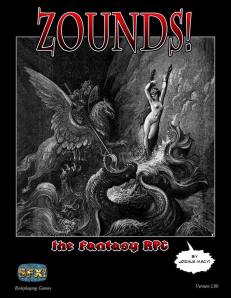
Zounds! Cover

I’m thrilled to announce that Zounds! the Fantasy RPG is now available from RPGNow!  I feel like this is the best SFX! game yet.  It’s certainly the biggest in terms of content.

It’s also the first to have illustrations other than the computer graphics ones that I do… swiped from dead people the world over! (All public domain, that is.)

Check it out!

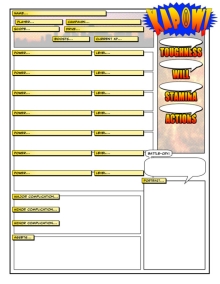
New Alternate Kapow! Character sheet

Contributed by Jason D. Smith.  You can grab it from RPGNow by clicking on the picture.

I particularly like the use of the balloons and caption boxes to make it look more comic-book-y

Kapow! The Super RPG Free on RPGNow.com

Kapow! the Super RPG is now available, free, gratis, and for nothing on RPGNow.com.  Download it and spread the word!

Kapow! Playtesting Continues

We’ve been playing Kapow! and overall I’d say it’s going well: the players seem to be engaged and having fun.  At the end of one session, in which as a result of one of his character’s Complications it was revealed that unbeknown to him, his character had a 20-year old daughter, Doug gave it a big thumbs up and said “This is a great comic!” And Wendy has praised the clarity and concision of the combat cheat-sheet.

One thing that hasn’t gone quite as well, or at least has caused me to rethink one of the basic rules, is what happens to a character’s defenses when they are Hindered.  Where other games like Champions have status conditions like Stunned, Knocked Down or Blinded, Kapow! has the more generic Hindered.  It’s simpler, in the sense that it’s one status condition to cover everything instead of separate rules for each kind of thing that can interfere with the character’s ability to act effectively, and it’s less debilitating than some in that you can still act while Hindered.  Losing a turn due to a status condition gets boring pretty quickly, particularly if as in most games it can happen over and over so you end up spending all your turns standing back up or recovering, only to be stunned again on the villain’s turn (sometimes called “chain-stun”).

I wanted to avoid that, and to avoid the “Death Spiral” effect where getting stunned or damaged makes you more likely to get stunned or damaged in the next round, so that once you start to lose you’ll probably be defeated if you don’t run away.  So in Kapow! not only can you can still act while Hindered, albeit at a penalty,  being Hindered doesn’t reduce your defenses.  For many, if not all, superhero defenses that makes a lot of sense: if you’re  invulnerable, even if you’ve been temporarily blinded or glued to the spot with webbing you’re still just as hard to knock out.  And in play it means that just because you’ve gotten hit and are suffering from a penalty to your attack, you’re not on the verge of losing.  For some defenses, such as acrobatics where if you’re tied down or dazed you really ought to be easier to clobber completely, it makes less sense, but sometimes playability trumps what passes for realism in comic books.

The problem that play-test revealed is that the players really expect to be able to soften up the villain’s defenses by Hindering them so that follow-up attacks by their companions stand a better chance…but that’s not how the rules work.  One of my design principles is that if players keep misremembering a specific rule, that probably means you should change the rule to match their mental model of how things ought to work instead of trying to beat it into them that they’re playing it “wrong.”  Fixing it to match the way the players think it works, though, could cause a ripple effect through the rest of the rules in order to balance things out (for instance, I don’t want to make Powerhouse characters, who are designed to have fewer but more powerful actions weaker than fast, nimble Jack of All Trades characters…but if they had to keep spending their limited actions on shoring up their defenses they could be).

What Doug suggested, and we’ll probably go with at least to test next session is that we make what the players are attempting one of the combat maneuvers.  So the rules for defense would stay as they are, but the players would have the option of deliberately trying to weaken a target’s defenses just as they were (repeatedly) trying in our play-test sessions… but there would be a built-in penalty for doing so since trying to weaken the target’s defenses would preclude trying to KO the target with the same attack.   In addition, Weakening the target’s defenses would only last for the next attack (or maybe the next round, we’ll have to experiment); that way Powerhouses wouldn’t have to spend all their time undoing the weakened defenses.  The characters could act deliberately to set them up for a more devastating attack, but they would have to keep doing it to continue to get the benefit, and the slower characters wouldn’t be unduly penalized by forcing them to spend their time recovering from being weakened.

I may also emphasize that certain defensive powers (like acrobatics, or heightened senses, or super-speed) really ought to be taking the Disadvantage “Can Be Hindered” to represent the fact that they’re much easier to interfere with than, say, being invulnerable, or being able to become intangible.  It’s possible I should swap it so that by default defenses are affected by being Hindered, but you could take an Advantage “Can’t Be Hindered” for characters with defenses that don’t really involve being maneuverable or having heightened awareness of attacks…my gut is that being really tough and able to withstand a beating is a bit more common as a defensive superpower, particularly when you include villains, than being really nimble or having great reflexes, but I could be wrong.  Comments are welcome.