Numenera Quick Hits

Some quick impressions of Numenera from Monday’s game:

  • I like the mad-lib character generation. I might even steal it.
  • The names Glaive, Jack, and Nano for the character types aren’t particularly evocative for me.  Nanotech is the new phlebotinum and it already feels worn out.
  • Cyphers is a bad name for the one-use devices. The one thing they’re not is mysterious, since to make them worthwhile you know exactly what they do (I guess they come clearly labelled).
  • The hard limit of two Cyphers (or three if you’re a Nano with Expert Cypher use), while clearly a good idea to prevent characters from accumulating a huge pile of them and spending too much time staring at their character sheets looking for the right device to solve a problem, seems pretty contrived.  I’d prefer some kind of sliding scale of increased chance of mishap and wilder catastrophic failure.
  • Multiplying by 3 all the time is kind of a nuisance.  Not sure why it’s better to have everything ranked in difficulty 1-10 with bonuses and penalties applied to that number, but have to multiply by 3 to derive the d20 target.
  • Having the player roll both attack and defense vs. target numbers is fun, though our GM made a minor goof and had us rolling low for defense as if we were rolling the opponent’s to-hit against us.
  • The GM Intrusion mechanic is immersion breaking.  Personally I’d get rid of the choice to accept or spend an XP to reject _and_ the compelled give XP to another player; both those decisions can’t be made from an In Character POV, and the latter can’t even usually be attached to the fiction.
  • The game is an odd mix of broad strokes and fiddly details.  I’d prefer to stick to the broad strokes.
  • I think it would be nice to encourage more colorful character descriptions and abilities; the characters depicted in the game art seem much more exotic than what the character generation process turns out, though that might just be a failure of imagination on my part.
  • I’m not sure what I think of spending your stats (which are also your hp) for extra effort or to power your abilities; I am sure I don’t like spending XP for temporary bonuses.

I’m planning on playing in Jonathan Henry’s Numenera campaign once he gets that up and running, but what playing this did for me was make me want to work on a far-future science fantasy setting for Zap! more than run a game of Numenera myself.

Low-Magic Fantasy Settings Seem Strange

The idea of a low-magic fantasy setting seems a bit odd to me, in that the idea that the world we live in is low-magic strikes me as a very modern one.  As far as I can tell at most times and places in our world, which has no magic at all, people nonetheless believed that the world was chock full of magic.  It might have been hard to make use of reliably, though most superstitions seem to me to be every bit as formulaic as D&D wizard spells, but it lurked everywhere and you needed lots of protection against it.

I can kind of see wanting a setting where objective proof of the existence of magic is hard or impossible to come by if you want something that feels like our world.  And I certainly get not wanting the solution to every problem to be just magic it away.  But many (most?) low-magic settings I’ve seen in games take it much farther than that, to where hardly anybody even claims to do magic or have never encountered anything they regarded as supernatural, and that doesn’t quite feel right to me.  To the modern mind the difference between natural and supernatural is obvious and complete: your cattle catching a disease vs. somebody levitating  in front of your eyes are completely distinct kinds of phenomena.  In a setting based on the pre-modern world I’m pretty sure that shouldn’t be true.


Discussion on G+

Fate Accelerated Non-Review

Not a review, just an impression

I was flipping through Fate Accelerated at the game store yesterday, and it seemed like the mirror-universe version of my own SFX!  There are strong similarities (maybe because I played and hacked so much FUDGE back in the day), but almost every concrete difference I noticed was the exact opposite of how I like things to be.  Starting from the very beginning with the description of the purpose of this tabletop RPG being to gather around with your friends to take turns telling little parts of stories, through the FUDGE special dice, the use of names that need to be continually converted to numbers and back, and the damnable economy of points that need to be spent to actually have the fiction of the world have any bite, the meta decision whether to have a failure or a success at cost, negotiating back and forth over “compels”… I can practically feel the game staring at me, stroking its goatee and toying with its agonizer.

Anyway, you can currently get the pdf (or epub or mobi) version as Pay What You Want over on RPGNow.  If you ever wanted a game that has many of the elements I like (rules light, freeform chargen, resolution driven by genre-logic, shared responsibility for the details of the world) delivered in a way that makes me cringe, check it out.

http://www.evilhat.com/home/fae/

Fate Accelerated
Fate Accelerated

Basic Roleplaying d20 Hack

Since I can’t look at a system without wanting to hack it, here’s how I would hack BRP:

Replace d100 with d20.  That means Characteristic Rolls would be straight d20 vs. Characteristic, instead of d100 vs. Char x 5.  You’d have 1/5 as many points to divide among your skills (50 instead of 250, e.g.).

Rolls would all be “blackjack style”: roll as high as possible without going over (BRP used to work that way, at least for opposed rolls, and it’s still listed as an optional rule).  Hitting your number exactly would be a crit, a 1 would be a fumble, “Special” would be figured on getting close to your number (within X, where X ranges from 0 to 4 depending on your skill).

Why would I do this?  Well, basically because I don’t really believe variations of less than 5% add anything to the game, but the math with all the double-digits and multiplication and division is fricking annoying. d100 is really intuitive: a 51 is 51% chance… but that’s its only advantage. My experience is that players just don’t roll enough to discern the difference between 49%, 50% and 51%.  That means deciding whether to put 49, 50, or 51 points into a skill at character creation is a waste of effort, and tracking whether experience raises that by 1, 2, 3, etc is a further waste.  Call it 10 on a scale of 20 and be done with it.

Meanwhile rolling low is less intuitive than rolling high, but if you don’t use roll low w/d100 then checking for crit or special gets really ugly: you basically have to look at a cheat-sheet next to your skill every time.  d20 lets you say a 5% chance is the same as rolling your to-hit number exactly; that’s a little more generous than straight BRP, but it’s super-easy.

Random Good Fortune

And to balance out the bad luck, a table of random fortunate occurrences.

  1. Ha! Ha! Opponent rolls on Mishap table
  2. That was Quick! whatever you were attempting happens so fast you take another action immediately
  3. Serendipity! your failure succeeds at something else entirely (e.g. attempt to find secret passage harmlessly triggers a trap you missed)
  4. Good Job! you achieve max normal success, whatever that is (e.g. maximum non-critical damage, highest value on a sale)
  5. Inspirational! +1 morale to allies
  6. Educational! allies get XP as if they too had accomplished the task
  7. Lucky! add 1 to your Luck score (if not using Luck, get one free reroll to use later)
  8. Insight! GM reveals one hidden fact about the situation (e.g. the exact number of HP the enemy has left, or which way the quarry went)
  9. Look! Somebody dropped something valuable or interesting
  10. Premonition! Next time you would be surprised, you aren’t
  11. Not as bad as it looks: the most recent bad thing that happened to you is only half as bad as it first appeared or is mitigated by half (e.g. if you took 4 points damage, it was only two; if you lost 10 gp gambling, you discover you were carrying 5 g.p. more than you thought or find a purse with 5 g.p.).
  12. Aha! If you failed, reroll; if you succeeded get double the XP for the task
  13. I meant to do that! failure becomes success in an unexpected way (e.g. opponent blocking a door dodges your blow so violently he hits his head on the lintel)
  14. In the Zone! Win next initiative roll if in combat, complete the task in one less time period otherwise (e.g. if searching the room takes 5 turns, complete it in 4)
  15. Focused! Ignore situational penalties (such as bad lighting, or fatigue) on your current action, if that would change failure to success, otherwise ignore them on your next action.
  16. Make Failure Your Teacher! However much you failed the roll by becomes a bonus to your next attempt at the same action.
  17. Combo! However much you succeeded by becomes a bonus to succeed on your next action (if you failed there’s no bonus, but no penalty).
  18. KO! Treat as critical success, for non-combat tasks treat as most favorable outcome your character could ordinarily roll (e.g. if crits do double damage, double the damage you roll)
  19. Perfect! Maximum possible success, including best possible critical if applicable, for non-combat tasks treat as the most favorable outcome the game allows regardless of whether your character could ordinarily achieve it (e.g. if crits do double damage, do max damage  x2, if crits roll on a table, pick the result you want)
  20. You Win! You prevail in the current situation.

Random Mishaps

Fumble tables can be fun, but are often very combat specific.  Here’s a d20 table for random mishaps suitable for fumbling on other rolls:

  1. Lose something
  2. Break something
  3. Make a mistake
  4. Slip and fall
  5. Bang into something
  6. Drop something
  7. Brain fart (lose an action/accomplish nothing this time period)
  8. Sneeze/belch/fart (make unwanted/embarrassing noise)
  9. Interrupted
  10. Chills/foreboding
  11. Misspeak
  12. Mishear
  13. Misremember
  14. Misstep
  15. Misunderstand
  16. Lose control (by personality type, e.g. rage, cry, vomit, panic attack, faint)
  17. Lose track of time (lose 1d4 time units appropriate to current task)
  18. Lose focus (Fail at current task, but roll accomplish some other task instead)
  19. Hurt self
  20. Hurt other

Zap! updated!

Zap! The Science Fiction RPG

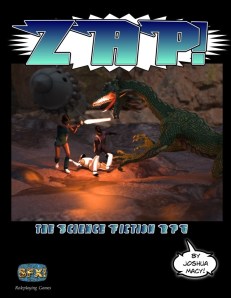
There’s a new version of Zap! on RPGNow.  A lot of work went into this one.  There are some rules clarifications, and significant new optional rules for things like speeding ship-to-ship combat, adding hit locations to regular combat, and pages and pages of new example equipment.  Many of the most useful tables have been added to a new Appendix for easy printing, and there’s a whole bunch of new art, mostly from public domain SF comics of yore.  Plus I’ve included a 5 page Quickstart PDF with just enough rules to generate a character and go.

Also, I’ve been running a lot of G+ Hangout games using Zap!  If you want to join in the fun, follow me or the SFX! RPGs community on G+.  We’re trying to set up an every-Tuesday-night SF RPG hangout, where I’ll be one of the rotating GMs, and I have pick-up games several other nights of the week.  If I can get interest, I’d love to run a longer term campaign instead of pick-up one-shots.  Drop on by!

The Traps of the Santicore

Being a set of tables for generating concepts for traps for any system, with examples and discussion.

Tables

Purpose of Trap (d8)

  1. Capture
  2. Impede
  3. Injure/Kill
  4. Resource Sink
  5. Hazard
  6. Practical Joke
  7. Lock/Barrier
  8. Alarm

Trigger Type (d12)

  1. Pressure Plate
  2. Trip-wire
  3. Opening a container/door
  4. Removing pressure
  5. Occlusion
  6. Heat/Light
  7. Magnetism
  8. Guard-activated
  9. Permanent
  10. Sound
  11. Unusual Sense
  12. Timed

Location (roll separately for trigger and trap, d6)

  1. Floor
  2. Wall
  3. Ceiling
  4. Container
  5. Entrance
  6. Other


Obviously, some effort needs to be spent to make the trap coherent; if the trigger is a pressure-plate on the ceiling for a trap on the floor, it should be something like a place the door will brush as it’s opening, or be part of a feature on the ceiling like a mosaic or chandelier that the players will be tempted to explore.

Mechanism (d10)

  1. Gravity (pit trap, falling block, tilting floor, sharpened pendulum)
  2. Spring-loaded (arrow or spear)
  3. Clockwork (crushing walls, retracting catwalk, portcullis releasing beast)
  4. Hydraulic (liquid filling area, rising floor)
  5. Chemical (gunpowder, chemicals combining to form noxious fumes, acid)
  6. Physical Properties (flammable material, radioactive, poisonous)
  7. Magical (known magical effects and spells, such as magic mouth, or fireball)
  8. Electronic (electrifying areas, as well as hi-tech substitutes for clockwork)
  9. Biological (spores, parasites, released critters)
  10. Arbitrary (magic not using known/documented spells)

Notes

Purpose of Trap

Capture

A Capture trap attempts to hold victims until they can be dealt with later; in some cases the trap is meant to hold them until they expire from natural causes or injuries suffered.

A pit trap is the classic capture trap, though others might throw a net or sticky substance, or simply lock adventurers in a room with no way out.

Impede

Impedance traps are meant to slow down victims, either to make them easier to catch or increase the likelihood of patrols running into them.

Classic impedance traps include mazes, caltrops, sticky or slippery floors, magically darkened areas, or cryptic messages that adventurer’s may waste time trying to decipher.

Injure/Kill

Injury traps are intended to harm the victim, perhaps killing them outright.

Classic injury traps are pit traps (if deep enough or with spikes), spear or arrow traps, swinging blades, falling blocks, crushing walls, poison darts, and the like. Some can be dodged or defended against (particularly ones that poke or slice with a regular weapon), or depending on damage rolled might not injure you that much. Others, such as being dumped into lava or having cockatrice feathers poured down over you, are meant to be lethal so they have to be avoided, whether through noticing the trigger or making a saving throw.

Resource Sink

Traps that cost resources are meant to deplete the intruder’s stock of available resources, softening them up for later, or perhaps stranding them if they turn out not to be carrying enough torches or rope to get through the area.

Resource traps might be stretches that require a lot of technical climbing (with spikes and ropes, or use of fly spells), or passage through long underwater sections, or strong magnets that make the party abandon iron gear (a rust monster is the animate version of this), or contain things like slimes or oozes that eat away at wooden or leather gear.

Hazard

Some “traps” aren’t designed as such at all (or at least not designed by any creatures in the gameworld), but are simply hazardous areas. Narrow mountain passes prone to avalanches, or areas with volcanic fumaroles, or treacherous ice don’t have a specific design goal, they are simply there and dangerous if you try to traverse them.

Practical Joke

Some traps are designed to amuse the placer of the trap, and often do no more than inconvenience or embarrass the victim. These may also serve as alarms or to discourage intrusion in places where it would be unwise to put a trap that can actually injure or kill. E.g. a wealthy merchant probably won’t have a pit-trap with poison spikes in his town-home to keep his servants out of the liquor, but might put lampblack on the knobs of the cabinet to stain their hands.

The real-world version is a bucket over the door or a whoopee cushion. Magical traps of this sort planted by a whimsical wizard or fairy might curse somebody with an animal’s head, or change their sex.

Lock/Barrier

Some “Traps” are just meant to prevent access to unauthorized people. The simplest is just a locked door or gate. Elaborate or magical ones may involve puzzles, perhaps an entire room that forms a puzzle. There might be consequences, including lethal ones, for making a wrong move in the puzzle, the essence is to actually to provide a means of ingress to somebody who knows the secret, not to keep everybody out permanently (as might a rolling boulder or falling block trap in a tomb).
Note that some locks or barriers aren’t there to prevent adventurers from getting in, but to keep something dangerous from getting out….

Alarm

Alarms aren’t intended to directly harm those triggering them, but to alert others to the fact they’ve been triggered.  They might respond by arranging an ambush, or by running away with the treasure.

Trigger Type

Pressure Plate

A Pressure Plate is any sort of pressure sensitive mechanical trigger. It is usually activated by stepping on it, and typically has some threshold weight that is too small to trigger it (whether that’s a coin, a mouse, or a hobbit).

It can typically be detected by careful examination of the area for a mismatch in the height of the material, seams where the plate meets the rest of the area, a slight wobbliness or give if manipulated; because of the presence of a mechanism beneath the plate, sand or water may be able to flow through the seams where it wouldn’t in ordinary crevices.

Pressure plates can often be jammed by wedges in the seams or levered beneath the plate, or can by bypassed by not stepping on them.

High tech or magical pressure plates may be nearly impossible to detect, save by detecting the presence of magic or electricity itself, though a fair trap will still usually a least be triggerable by dropping a sufficient weight on it.

Trip-wire

Trip-wires are any sort of physical wire, rope, or cord that triggers a trap by pulling on something when somebody steps on or through it.

They can often be spotted by visual inspection, though if they are camouflaged, very fine or in bad lighting conditions they can be extremely hard to spot without unusual senses; adventurers of unusual size (small enough to pass beneath) or means of locomotion (always flying) may bypass them without even noticing.  They may also be detected, or at least triggered, by poking ahead with a pole.

They can be bypassed by stepping over or under them, or jammed by preventing the wire from moving or breaking.

Opening a container/door

Opening a container or door can trigger a trap by the mechanical action of the hinges, by the lid or door pushing or pulling something as it changes position, or releasing pressure on a spring, by the twisting or pulling of a knob or handle attached to the catch that holds it closed, by poison on the handle or on something sharp that someone manipulating the handle is likely to cut himself on  or simply because the container or room has something dangerous in it.

Spotting such traps can be difficult unless you have unusual senses allowing you to see inside the container, since all the mechanical parts of the trap may be on the inside.  It might be possible to detect the trap by an slightly higher resistance to opening than expected (particularly if the hinges are well-oiled first) or the sound/feel of something scraping or being pulled.

Such traps can be bypassed by creating a new opening in the container, by breaking a wire or flange that would be pulled out of position by opening the lid, by applying pressure to a spring that would otherwise release, by manipulating the knob or handle remotely or through protective gear.

Removing pressure

Pressure triggers can be set off when something is removed from where it should be, such as when a heavy gold idol is taken off an altar, allowing a spring to uncoil, the other end of a counter-weighted lever to descend, or weight that was held in place by a cord beneath the idol to fall…

Spotting such triggers can sometimes be done by seeing the cord or noticing the seams where the trigger mechanism will move once the weight is gone.

Disarming the trap can be done by swapping the weight for a similar one (be careful that the replacement weight is close enough… particularly if the builders took extra care so that if too much extra pressure was applied to the balance the trap would trigger anyway), or by jamming the balance platform so that it can’t move even if the pressure is removed.

Occlusion

Occlusion triggers are set off when something blocks the sensor, as with an “electric eye.”  These usually require magic or high technology, though a goblin with a peephole would do in a pinch.

They can be spotted by noticing the opening for the sensor, or if the sensor requires a visible beam of light (or one that can be made visible, say with smoke) the beam.

They can be bypassed by avoiding breaking the beam or passing in front of the sensor, or by arranging mirrors to divert the light in a path that reaches the sensor but leaves space to pass.

Heat/Light

Heat/Light triggers are set off by the presence of extra heat or light, such as generated by torches or just by warm-blooded creatures.  The trigger might be an exotic material that melts easily, releasing a spring or a weighted cord, or perhaps the material itself is poisonous once it’s heated enough to form a vapor, or perhaps phototropic plant that pulls or pushes the trigger as it turns toward the light.  Or it could just be magic or tech.

Spotting such traps will be very difficult without some way to observe the trapped area remotely or in perfect darkness.

Bypassing the trap might involve nothing more than being able to pass through the area in darkness, or by interfering with whatever mechanical part is connected to the sensor.

Magnetism

Magnetic triggers will usually have some catch that is pulled out of place by magnetic attraction, generally to the armor to the adventurers wear… though if the magnet is powerful enough it might itself be the trap, pulling the adventurers off a ledge or just immobilizing them unless they abandon their armor.

If it’s not obvious, a magnetic trigger might be detected by its effect on compasses, or by the very subtle pressure it exerts (a realistic magnet would have to be quite powerful if the metal isn’t going to come within a few inches of it, unless it was suspended in something to reduce friction. Otherwise the trap might as well be magical for all the adventurers can do to detect it).

Magnetic triggers can usually be bypassed by being careful not to bring metal near them, or by the usual mechanical jamming methods depending on what they’re attached to.

Guard-activated

Some traps are simply activated manually by a guard from an observation post.

Spotting the trap usually means spotting the guard, or at least the peephole or camera (or magical equivalent) the guard is using to observe the area.

Such traps can be bypassed by avoiding the field of vision of the guard, presenting the guard with a fake or illusory view of the area, taking out the guard, distracting or tricking the guard, or waiting for the guard’s attention to lapse (e.g. fall asleep, or leave the observation post to make rounds or relieve himself).

Permanent

Permanent traps don’t have a trigger, the area is simply dangerous (or dangerous to unprotected/unprepared people) all the time.  A room might be full of poison gas, so the only safe way to enter it would be if you were immune to the poison, took an antidote, or wore protective gear.

Depending on the nature of the danger it might be obvious to any observer, or it might only be revealed if you see somebody aware of the danger taking precautions.

Bypassing the trap usually requires ascertaining what precautions are necessary and taking them, since by definition there’s no way to avoid the trigger.

Sound

Sound triggers are set off by sounds or vibrations; they might be carefully balanced stones or snow (as in an avalanche), or a cavern or other structure that amplifies sound until it’s sufficient to dislodge a lever or weight.

Sound traps might be spotted by the area being unusually quiet or having peculiar echoes, or by observation of whatever pile of rocks or lever/pulley structure that’s the mechanical part of the trap before you get close enough for the sound to dislodge it.

Bypassing the trap could be done by being unusually quiet, by somehow stabilizing the delicately balanced trigger, or by jamming the mechanics if there is an accessible mechanical part of the trap and not just tons of stone that will fall from the ceiling if disturbed by loud sounds.

Unusual Sense

When magic or high tech is involved, many bizarre or nearly arbitrary phenomena might serve as a trigger.  (e.g. the presence of “good alignment”)  These usually can’t be spotted or bypassed unless you have appropriate magic or tech of your own, though you might still be able to infer the presence of the trap by observing the behavior of those “in the know” about it.

Timed

No actual trigger, rather the trap activates periodically, regardless of what’s going on.  A simple example would be a cavern that filled with water at high tide, but more complex ones might be something like pendulums that constantly swing, or walls that crash inward every few minutes.

Detecting timed traps can be done by noticing the remains of previous victims of the traps (since such traps are often unattended and automatically reset, so nobody ever takes the bodies away) or by observing the trap going off (since it will activate whether or not there’s reason to do so).

Bypassing the trap usually consists of figuring out the timing of the activation and passing through the area during the quiescent period.

Complications

Nastier traps often involve traps with precautions, fail-safe mechanisms, extra concealment or misdirection.

Precautions

Extra care might be taken to build the mechanism in such a way that it’s hard to interfere with.  For instance a trap where opening the lid of a box pulls a cord that activates a poison blade on a spring might make the cord out of wire so that it’s hard to cut even if spotted, or include extra metal baffles that extend downward from the lid so that you can’t poke a knife in until the lid is lifted enough for the cord to do its work.

Failsafes

Traps may have extra mechanisms to thwart attempts to disarm them; this can be an entirely separate trap that guards the mechanism of the original trap, or just extra precautions so that obvious ways of trying to disarm the trap trigger it anyway. For instance, using the example of a box and cord again, the trap could have an additional spring mechanism that puts tension on the cord so that if it’s cut the spring contracts and releases the poison blade regardless.  Or a trap that is triggered by a balance arm might be rigged so that it goes off if the balance goes in either direction (the idol is removed from the altar or the idol is replaced by something heavier).

Extra Concealment

Any trap can be made more dangerous by spending extra effort on concealing its mechanism.  This can range from the completely simple (painting the tripwire black, removing the debris from when the trap was activated previously) to the cunning (trompe l’oeil painting to deceive the eye as to the actual dimensions of the room or make the exposed parts of the trap completely blend in) to making the trap magically undetectable to all intents and purposes (illusions and invisibility fall into this category unless the characters have magic to deploy against it).

Misdirection

Some traps are concealed by the presence of obvious other traps or suspicious things.  E.g. an obvious pit-trap with an illusory floor trap just beyond it so that if the characters vault the first they land right in the second.  These are usually more amusing for the GM to contemplate than for the players to encounter, unless they are explicitly attempting to beat a “deathtrap” dungeon and are prepared to spend hours trying to out-paranoid a mad wizard with arbitrary resources in order to cross a 30’ corridor.

Still, in the real world there are such things as fake safes and dummy security cameras, so a certain amount of misdirection is probably allowable without being a complete bastard.

Random E.L.F.s & Espers Character Generation

Start as Follows:

Attributes: Tough: 2 Will: 2 Stamina: 2 Actions: 2
(you may swap points in attributes 1 for 1)

You then get Powers and Shticks, based on what you roll on the following tables.  Don’t worry about the details, just record what you roll and the GM will help you with the rest.  You are free to choose from the table instead of roll (since you could just make up a character from scratch); the tables still provide a handy guide for how common you can expect the entries to be in the setting.

Powers: 3 Powers @ 6
Shticks: 2 Shticks @ 3, or 4 if they fit the stereotype

Restrictions: 1

If rolling on the tables grants you more than 3 Powers, you can change some of them to Shticks or accept more Restrictions.  If you get less than 3 Powers, you can increase an Attribute by 1 for each Power less than 3, or take 2 Shticks.

Type

Roll 2d6

Android
3-4 Evolved/Mutant
5-8 E.L.F.
9-10 Esper
11 Robot
12 Alien

Initiation  (optional)

Roll 1d6.   Choosing an Initiation changes your Template from Unique to either Bad-Ass or Crew, depending on whether you want to be more combat or skill oriented.

1 Technomancer (can operate pentacorders, all-purpose scientific devices; changes your Template to Scientist)
2 Robomancer (can build and control robots)
3 Biomancer (can design and repair E.L.F.s)
4 Roguechemist (can brew potions and fire them with their “casters”)
5 Trooper (can operated powered armor)
6 Archaeomancer (can read ancient scripts, and learn prehistoric languages; lower chance of Mishap when operating ancient tech)

Android

Roll 1d8

1 H-E.M.A.N. (Hyper-Enhanced Male Android Newtype)
2 S.H.E.R.A. (Super Human Emergency Response Android)
3 D.A.T.A (Danger Adapted Terrestrial Android)
4 M.A.R.V.I.N. (Metallic Android Researching Various Induced Neuroses)
5 A.S.T.R.O. (Android System Terrestrial Remote Observation)
6 G.O.R.T. (General Operations Rescue & Training)
7 V.I.C.I. (Voice Input Child Identicant)
8 A.R.A.L.E. (Advanced Research Android Limited Edition)

Evolved/Mutant

Roll 1d6.  1-4 Base is human with 1d4 Mutations; 5-6 Base is animal (1d20 for type) with 1d3 Mutations + Enhanced Intelligence

Animal Type

1 Fish: Bass, Clownfish, Dolphin, Eel, Lionfish, Marlin, Puffer, Shark
2 Bird: Crow, Dove, Egret, Hummingbird, Ostrich, Parrot, Raven, Robin
3 Insect: Ant, Bee, Beetle, Butterfly, Centipede, Cricket, Flea, Fly, Moth, Wasp
4 Arachnid: Mite, Scorpion, Spider, Tick
5 Rodent: Bat, Capybara, Gopher, Mole, Mouse, Rat, Squirrel
6 Canine: Dingo, Dog, Fox, Hyena, Jackal, Wolf
7 Feline: Cat, Cougar, Leopard, Lion, Lynx, Ocelot, Puma, Tiger
8 Bovine: Antelope, Auroch, Bison, Bull, Buffalo, Gnu, Ox, Yak
9 Marsupial: Bandicoot, Kangaroo, Koala, Platypus, Possum, Tasmanian Devil
10 Pachyderm: Elephant, Hippo, Rhino
11 Raptor: Eagle, Falcon, Hawk, Owl, Osprey, Peregrine
12 Amphibian: Frog, Newt, Salamander, Toad, Turtle
13 Aquatic Mammal: Beaver, Manatee, Orca, Otter, Porpoise, Whale
14 Reptile: Alligator, Crocodile, Gecko, Gila Monster, Iguana, Komodo Dragon
15 Snake: Anaconda, Boa, Cobra, Coral Snake, Mamba, Viper
16 Dinosaur: T Rex, Ankylosaur, Triceratops, Allosaur, Pteranodon, Raptor
17 Extinct: Giant Sloth, Mammoth, Mastodon, Saber-tooth Tiger
18 Primate: Ape, Baboon, Chimp, Gibbon, Gorilla, Lemur, Monkey, Orangutan
19 Equine: Camel, Deer, Donkey, Horse, Reindeer, Zebra
20 Invertebrate: Jellyfish, Octopus, Sea Anemone, Sea Urchin, Squid, Starfish

Mutations

Roll a d3 for number of powers: on a 3 you get 2 powers, but re-roll and add; keep doing that until you stop rolling 3’s. (aka 1d3p)  If you roll a power again, increase its Power Level by one.  You get one Defect, plus one more for each time you re-rolled because you rolled a 3.

For each power, roll 1d6 on a 1-5 it’s a physical mutation, on a 6 it’s a mental mutation (roll once on the Esper chart).  Having any Mental mutations automatically means you have an over-sized head, for whatever physical stock you come from.  Roll 2d6 to see what kid of mutation.

Realistic  (an actual mutation such as albinism, extra fingers or limbs, resistance to certain diseases)
3-4 Defect (roll again, except it’s bad; roll a d4, on a 1 the defect is Background, on a 2-3 it’s a Complication, on a 4 it’s a Restriction)
6-8  Plausible (roll on animal chart for some ability from another animal, e.g. a chameleon’s ability to blend in, cobra’s poison fangs, or an electric eel’s shock)
9-10 Science Fictional (immunity to disease in general, or poison, or radiation)
10-11 Magical (ability to use magic; consult the GM)
12 Absurd (comic-book style mutant superpower, e.g. phase through objects, or weather control)

E.L.F.

Roll 1d6

1 D.W.A.R.F.   Deep Warren Adapted Rock Form
2 H.O.B.B.T. Habitat Optimized Biologically Based Technology
3 G-N.O.M.E. Genetic-Nonce Organism, Modified Experimental (roll 1d4 times on Evolved table for animal traits)
4 O.G.R.E. Organism Grossly Reinforced Experimental
5 M.A.G.E. Magically Adept Genetically Engineered + re-roll.
6 C.O.B.O.L.D.s Common Order Biologically Optimized Layered Design
7 Gray E.L.F.  Fungus-based E.L.F.
Green E.L.F. Plant-based E.L.F.

Esper

Espers are big-headed human-stock descendants, though mutants will also sometimes have Esper powers.

Roll a d4 for number of powers: on a 4 you get 3 powers, but re-roll and add; keep doing that until you stop rolling 4’s. (aka 1d4p)  If you roll a power again, increase its Power Level by one.

1 Apportation – Materialization, disappearance, or teleportation of an object.
2 Aura reading – Perception of the energy fields surrounding people, places, and things.
3 Autonomic Nervous System Control – Conscious control over ANS (heart rate, perspiration, pupil dilation, etc.)
4 Astral projection – An out-of-body experience in which an “astral body” becomes separate from the physical body.
5 Bilocation – Being in multiple places at the same time.
6 Clairvoyance – Perception outside the known human senses.
7 Death-warning – A vision of a living person prior to their death.
8 Divination – Gaining insight into a situation via a ritual.
9 Dowsing – Ability to locate objects.
10 Healing – Diagnosing and curing disease
11 Levitation – Bodily levitation or flying.
12 Mental Domination – Controlling somebody else’s mind.
13 Precognition – Perception of future events before they happen.
14 Psychic blast – Causing damage with psi power
15 Psychokinesis – Manipulation of matter or energy by the power of the mind.
16 Psychometry – Obtaining information about a person or object.
17 Remote viewing – Gathering of information at a distance.
18 Retrocognition – Perception of past events.
19 Superior Intellect – genius level intellect
20 Telepathy – Transfer of thoughts or emotions.

Robot

Roll 1d10.

1-3 General Purpose (1-4: Humaniform, 5-6 Functional)
4-5 Industrial
6-7 Heavy Duty Industrial
8-9  Vehicle
10 Military

Alien

Roll 1d6

1 Time Traveler (roll on Temporal Origin)
2-4 Extra-Planetary (1-10 Habitats, 11 Mercury, 12 Venus, 13 Moon, 14 Mars, 15 Asteroid Belt, 16 Jupiter, 17 Saturn, 18 Uranus, 19 Neptune, 20 Pluto)
5-7 Extra-Solar
8 Interdimensional

Temporal Origin

1 Classical (Ancient Greece or Rome)
2 Medieval European
3 Ancient Norse/Viking
4 Feudal Japan or China
5 Ancient Egypt
6 Ancient Africa
7 Biblical Middle East
8 Renaissance European (e.g. Musketeers, Cavaliers)
9 American Old West/Civil War
10 Napoleonic European/American Revolution
11 Pre-Columbian Mesoamerica/South America (Inca, Aztec, Maya, etc)
12 World War I
13 World War II
14 Roaring Twenties America
15 18th Century Pirate
16 Cold War
17 Alternate Dimension
18 Alternate Time-line Earth
19 Pre-Apocalypse Future (compared to now)
20 Far Future

A Brief E.L.F.s & Espers Glossary

E.L.F.  Engineered Life Form

D.W.A.R.F.   Deep Warren Adapted Rock Form
H.O.B.B.T.
Habitat Optimized Biologically Based Technology
G-N.O.M.E.
Genetic-Nonce Organism, Modified Experimental
O.G.R.E.
Organism Grossly Reinforced Experimental
M.A.G.E.
Magically Adept Genetically Engineered
O.R.K.
Organism for Relentless Killing
H-E.M.A.N.
Hyper-Enhanced Male Android Newtype
S.H.E.R.A.
Super Human Emergency Response Android
C.O.B.O.L.D.s
Common Order Biologically Optimized Layered Design