The Tomb of Horrors and Player Mindset

https://plus.google.com/111524822183500809557/posts/Zyjv6epapwJ

https://plus.google.com/111524822183500809557/posts/Zyjv6epapwJ

Stuart Robertson talks about his group’s experience with the infamous Tomb of Horrors back in 1987 over on G+.  Spoilers abound, so don’t read that or this if you care.  The gist of it is that after the players lost a bunch of PCs in the initial false entrances, and the party got down to about half the original PCs they gave it up as a bad job.  Stuart then goes on to complain about The Tomb of Horrors being badly designed by the lights of this (perfectly reasonable) Gamasutra article.  The following is my reaction, which got a little long for a comment.

Honestly, if you lose any PCs to the fake entrances, your group isn’t nearly paranoid or prepared enough to have any chance with the Tomb of Horrors. I mean, in one case the group marches into a corridor with cobwebs thick enough to obscure the ceiling without a care in the world as to what might be lurking above, in the other not only don’t they send anything ahead capable of triggering the trap nor react quickly by retreating during the slow count to 10, but despite being 10th-14th level nobody has Rock to Mud, Disintegrate, or Stone to Flesh prepared or the equivalent in items.

A lot of the traps in the Tomb aren’t particularly lethal for a character of that high level (e.g. 1d4+1 d6 of damage), especially since the party should always be pretty close to full health: the Tomb has no wandering monsters, even in the area around it, or any time pressure from plot events, and characters of that level typically have access to a lot of healing. There are some nasty exceptions, but a 10th level Cleric can Raise Dead twice a day, so it’s not like most of the deaths in the Tomb need be irrevocable.

I have some quibbles about specifics of the Tomb (like I think preventing Passwall from being one of the spells that can get you out of the sealed fake corridor is kinda cheap), but I think if you see it as a series of uninformed choices you’re just not used to the style of play. Players have lots and lots of ways, mundane and magical, of gaining information to turn blind choices into informed choices…which is why some but by no means all of the tricks and traps specify certain divination/magic tricks that won’t work.  That’s not random: I think the clear presumption is that the players are going to be moving carefully through the tomb, casting various detect spells on anything that seems suspicious and poking and prodding everything from a safe distance. I dare say most of the decisions in the Tomb are actually dilemmas: how many resources to expend to turn it into an informed decision. Relatively few are “weighted” (in the Gamasutra sense of being balanced between pros and cons): if you can figure out a safe path, there’s usually no reason not to take it.

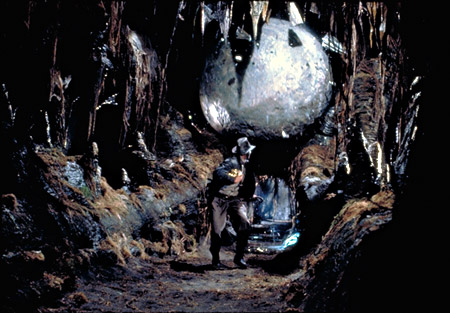
Obviously it’s not a style of play suitable for everyone, but that doesn’t make it badly designed. One of my favorite memories of dungeoneering when I was a lad was finally beating my step-brother’s death-trap dungeon (not Tomb of Horrors, but same basic idea, heavily inspired by Raiders of the Lost Ark)… The character I had that finally beat it was pretty powerful and equipped with a ring of regeneration, but I was soloing it, so those kind of balanced out.   In role-playing terms there was a reason the forces of good needed the treasure the dungeon guarded, but at this date I can’t recall at all what the treasure was or its significance, while I clearly recall the feeling of getting it and getting out again and even the details of some of the ingenious traps. I’m not ordinarily a challenge-based player, and it’s not something I’d want to do every day, but the satisfaction of completing it and being the first of the various players who’d attempted it to succeed was a thrill like no other

Running Sailors on the Starless Sea

So I’ve run my holiday-themed re-skinning of Sailors on the Starless Sea twice so far… the most recent time, last Friday, ended in a TPK. Everybody had fun, and wanted to play some more DCC, but I think it pointed out a gotcha in the scenario that I’d want to address before I ran it again for some other group.  Spoilers ahead if you haven’t played it.

Specifically, if the players skip the Charnel Ruins… and both my groups wanted to because of how foreboding it was, though the first reconsidered after a bit… then when it comes time to meet the Leviathan, they’re screwed. Unless they’re willing to make a human sacrifice (fat chance, at least with my typical players), even if they chum the waters to distract it, they need to spend at least 2 rounds in the water (if they can even swim) both coming and going from the ship with the Leviathan getting 6 attacks per round… what actually happened Friday is they ended up fighting the Leviathan on the deck of the ship and losing. Which is fine: fighting the Leviathan straight up should be a losing proposition. But that means that there need to be either more ways around it or the single way that’s there needs to be on the main path.

Sailors on the Starless Sea is a very linear adventure: after the choice of the initial approach there are a couple of side areas, but no real branches.  That’s not necessarily bad for something that’s supposed to be a short adventure, but it means sticking the key to completing the adventure in one of the few skippable side areas is a problem.  That’s compounded because once they meet the Leviathan there’s no retreating and regrouping or exploring what they might have missed: it’s deliberately set up so if they don’t have the censer they’re stuck either halfway across or 50′ from the far shore if they come up with the chum-the-waters trick.  IMO, that’s pretty mean, and not really in keeping with the best Old School principles of letting the players pick their fights and routes.  I also think the set up gives perhaps unfortunate psychological pressure on the players to hurry along to rescue the villagers instead of poking their noses into everything the way a more “let’s loot the ruins” party would.

Having said all this, I think there’s a pretty simple fix: since the Leviathan basically acts like a gate that requires a key, make it so you can’t open the gate without the key.  Take away the candle at the top of the menhir, and make it so that lighting the censer (or sacrificing a victim) both summons the ship and placates the Leviathan.  That way if they make it that far without getting the censer, they can figure out they’re missing something… and if they don’t immediately, then if they swim out to the ship the Leviathan can attack the swimmers while they still have a chance of retreating.  It also makes the mosaic a better clue, since the action depicted in the mosaic of using the censer while standing on the menhir now matches how you’re supposed to deal with the Leviathan.

A more radical fix would be to have the Leviathan’s blood-lust be sated as soon as each tentacle seized and dragged somebody off; then even if the party just bulls through they won’t lose more than 7 characters.  It’ll hurt, but at least it might be enough to finish the module, particularly if you have a lot of players.

Brownies of Salmagundi

brian-froud-gnome

A new race for D&D 5e Brownies are small humanoids that help with domestic chores in return for gifts.  They pride themselves on living honestly and virtuously, and view theft and fraud with disgust. They bargain hard, but their word is their bond.  In lands above-ground they are generally found as merchants, tinkers, scribes and explorers, their diminutive size compared to many surface-dwellers not making them as well-suited to manual labor or the arts of war.

Stats: +2 Wis Size: Small (approx as Halfling) Speed: 25 Age: Brownies reach maturity at age 20, and may live a century or more. Alignment: lawful

Shrewd: Advantage on Insight vs. chicanery and fraud. Proficiency in double-entry bookkeeping.

Industrious: your training times (but not costs..it still costs 250 GP for one extra proficiency) are halved, as you make efficient use of your spare time to practice new skills.

Thrifty: you may maintain yourself in a lifestyle up to Wealthy for the price of one life-style lower due to your ability to find bargains and make do. Does not apply to the Aristocratic life-style, since that requires conspicuous consumption.

Languages: speak, read, and write Gnome, Dwarf and Common.

Tool Proficiency: Proficiency in a set of craftsman’s tools of your choice.

Subtype

Eccentric

Once in a while a Brownie is seized by some big idea, and becomes monomaniacal.  Such Brownies are likely to throw aside the usual Brownie interests and pieties in  pursuit of a singular field of knowledge or art, including performing arts.

Ability Score Increase: +1 Int or +1 Cha

Inspiration: Gain Expertise (double proficiency bonus) in a single field of art or knowledge of your choice.

Obsessive: Working in your field invigorates you, and counts as a Short Rest.

Space Hostilities

Apropos of nothing at all, the following example characters from Zap!

Solitaire Jones

Template: Bad-ass
Drive: Get rich
Toughness: 3, Stamina: 2, Will: 3, Actions: 2
Powers
Gunslinger 5 – shoots first
Alertness 5 automatic defense
Hotshot Pilot 6
Shticks
Maintenance 4
Knows a guy 4 – knows people everywhere
Charming Rogue 4
Smuggler 4
Complications
Major: Wanted by the law: Jones has outstanding arrest warrants on most of the central planets.
Minor: Bad at fast talk: If Jones attempts to talk his way out of a situation, he usually makes it worse.
Minor: Never tell me the odds: Jones is a lousy gambler.
New Powers begin @ 5 New Shticks begin @ 4

Vehicle: The Peregrine

Hull: 4, Toughness: 2, Power: 2, Crew: 0
Powers
Movement 5 (D) Power-up to 7 w/chance of Burn-Out
Deflector Shields 4 automatic defense
Gun Turrets 4
Shticks
Cargo Bay A 5
Cargo Bay B 5
Power Plant 5
Sensor Dish 5
Restriction: Cranky. Each session roll a random system that has the Erratic Disadvantage for that session
Complications
Mortgaged; Jones has to keep working to pay off the ship, or it’ll be repossessed.
New Powers begin @ 5 New Shticks begin @ 4

Parsifal Farmer

Template: Bad-ass
Toughness: 3, Stamina: 2, Will: 3, Actions: 2
Powers
Photon Blade 5
Pilot 5
Star Knight Intuition 5
Star Knight Danger Sense 5 automatic defense
Shticks
Dirt Farmer 4
Mechanic 4
Star Knight Traditions 4
Star Knight Psi 4 (D) Slow (requires 2 actions), (A) Flexible: telekinetically move small objects, telepathic communication, detect psi powers, mind shield
Equipment
Photon Blade d8
Complications
Major: Easily swayed by a pretty face
Minor: Orphan
Minor: Sister issues
New Powers begin @ 5 New Shticks begin @ 4

Grr’onk, Trog Co-pilot

Template: Unique
Toughness: 4, Stamina: 2, Will: 3, Actions: 2

Powers
Big 6 Half again as big as a human, and strong to
boot
Hairy 6 automatic defense thick hair is hard to penetrate, and even if  something does it’s hard to tell where the vital spots are in there
Pilot 4 Can operate most of the ships systems, but starship piloting isn’t typical of Trogs

Shticks
Starship Maintenance 3 can fix systems that go wrong, sort of
Wilderness Survival 4 Trogs are at home in the jungles and forests
Complications
Major: human-sized gear doesn’t fit
Minor: Can’t speak Galactic, though he understands it; his voice box and lips aren’t shaped correctly.
Minor: Fastidious. Doesn’t like to do anything that will make him have to clean all that hair.
New Powers begin @ 6 (or 4 if they don’t fit the stereo-type) New Shticks begin @ 4 (or 3 if they don’t fit)

Dungeon Survivors

Apropos of a discussion on G+ started by John Williams of starting a D&D campaign with the characters being the henchmen and hirelings of a high-level group of heroes and a suggestion by Ed Hackett that play begins after a TPK of the high-level heroes I think a scenario like that might be a fun 0-level DCC funnel if they were trapped far down in a dangerous dungeon. Even in straight D&D it might be interesting to run it as a survival horror-style game where the players started with 2-4 characters each so you don’t have to pull the punches to keep it from being a TPK in the first few minutes of the game.

I think they need to be stuck somewhere hostile, otherwise I’d expect them to just run and the whole thing becomes nothing more than the back-story of how they met.  If I did that, though, I’d probably bend over backward to make sure that it was designed so that every trap and every fight was avoidable if the players are careful enough. E.g. Random encounter would have a “tell” depending on the kind of monster, either something that would alert the players the monster was on the move, or that the area was infested with them and they need to seek another way around, or maybe the monster moves by a strict schedule.

Time, encumbrance and resources need to be a big thing since pretty much the whole point is that no fight is survivable (though no fight should be a one-round TPK either, unless that fact is telegraphed well in advance), but there need to be ways to replenish those so that it’s interesting pressure not an inexorable no-win scenario.  In fact, if you ever get to the point where given the current situation it’s impossible for the characters to survive and escape, you should probably just call it instead of playing it out ’til the last character drops.

I’d be sure to use all the rules like unintelligent monsters being distracted by food, intelligent ones by treasure, individual init plus whoever retreated last turn automatically wins init so that in a pursuit at least some of the party might get away if there’s a chase, monster reaction rolls so that they might not always be interested in a fight, factions the players can try to ally with, etc.  Basically everything that I can to give players a chance to retreat from a disastrous encounter without turning it into, no problem if we find something that’s too dangerous we’ll just run and repeat that until we’re free of the dungeon.  Each time they find themselves in over their heads should have a chance of a cost.

The dungeon would need multiple routes through it, and spaces that are definitely safe to hole up in and rest…at least at certain times and if precautions are taken.  And if possible, I’d probably try to make it so that all the “dungeon dressing” was meaningful: everything is a potential clue to survival, either providing information about the inhabitants of the dungeon, what’s in which direction, where resources and allies might be found, or something that could be used as a resource, like maybe you can use those charred bones to mark your way or as fodder to distract an ooze. The meaning of the info might not be readily apparent, but I think it would be good to avoid complete red herrings and bizarre random stuff that’s just to provide atmosphere.  In a normal dungeon that kind of thing is fine, and gives the players’ imaginations something to chew on besides fighting monsters, but the players can choose the balance they want between the risk of missing something and the tedium of investigating meaningless clues, since  the penalty for ignoring a clue is usually not very severe: a missed opportunity to find a short-cut or hidden treasure. In a dungeon where there’s a risk of TPK for any ignored clues, it strikes me as a real drag on play to make the players spend time sifting out the red herrings.

I don’t know if my home-group of players would be too into this, but it might be fun to try as a hangout game.


There Ain’t No Sanity Clause

So, I’m running my home group, The Rambling Bumblers through a Dungeon Crawl Classics 0-level funnel, a re-skinning of Sailors on the Starless Sea by Harley Stroh as a holiday-themed adventure.  Details below the cut, and if you’re one of my players don’t read it yet, since we stopped at about the 2/3’s point last night.
Continue reading “There Ain’t No Sanity Clause”

Group Initiative

Lately I’ve had a strong preference for group initiative. Despite individual initiative giving a more fluid and chaotic battlefield, as well as scope for per-character bonuses and penalties, it seems more trouble than it’s worth. Tracking who goes when is a hassle,particularly if you’re tracking each NPC separately, and players seem to get more bummed out when they consistently roll crappily than they are pleased to roll well.

But because I like to tinker, I’m considering the following house rule:

In order of preference each turn initiative goes to:
1. The side that ran away last turn, as long as they’re still running.
2. The side that downed the most foes last turn.
3. The side that hit the most foes last turn (failed saves count as being hit).
4. The side that rolls highest on a d6 plus any CHA bonus for the designated leader.

I Don’t Know, Does That Look Like 11 Hit Dice To You?

I don't know, does that look like 11 hit dice to you?
I don’t know, does that look like 11 hit dice to you?

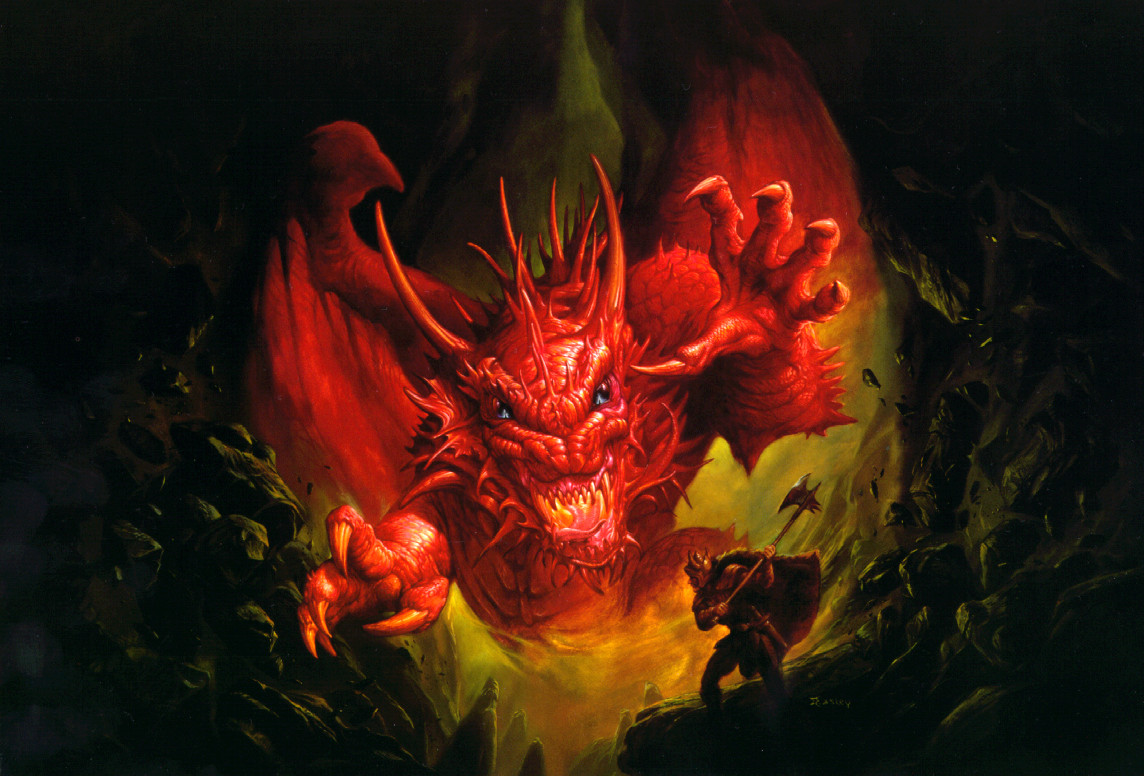
Apropos of Delta’s discussion of big cats in D&D,  I suddenly realized after all these years that a saber-tooth tiger was nearly as many HD as a red dragon.

Welcome To Skull Tower, Part XI | Lizard’s Gaming and Geekery Site

http://mrlizard.com/reviews-and-walkthroughs/arduin/welcome-to-skull-tower-part-xi/#comments

Just spent way too long reading this wonderful multipart series on the first two books of the Arduin Grimoire trilogy, which was my gaming jam back in the day.

Weirder Fantasy

So, my Monday group has been talking a bit about a post by Ken on running a low-magic, restricted race and class (Human only, Fighter and Thief only) setting. A bunch of my thoughts on “low magic” and what feels magical have appeared on my blog (e.g. Niven’s Law and Low Magic) but I want to offer some further comments.

  1. I’m in favor of streamlined, quick systems in general, though you can take it too far. E.g. Systems which boil down to one roll for everything are usually too bland; it often ends up feeling like it makes no real difference whether you do something clever or stupid, expected or unexpected, genre-plausible or not: you end up rolling pretty much the same either way.
  2. Rare != weird or wonderful. It doesn’t matter if it’s the only one in the world, a +1 sword is still dull. Even if something is ubiquitous in the setting, it can still give the players a thrill (e.g. space-ships in an SF game).
  3. Whether something counts as wonderful or prosaic is entirely based on the players’ experiences, not the typical inhabitants of the setting.  A peasant in a no-magic setting might be completely freaked out if somebody actually casts a spell like Levitate; the player of that peasant won’t be.  Even if the player roleplays it well, experience with other fantasy outside the campaign is going to color whether the player feels awe.
  4. Finally, to Ken’s specific idea about a fantastic dungeon in a decidedly non-fantastic world, unless the characters spend a lot of time outside the dungeon, contrast makes little practical difference.  I’ve only played a few sessions in Monteporte, but all of them were so far down in the megadungeon the outside world might as well not have existed except as a source of back-story.

This isn’t to say that I’m against the idea of low-magic settings or stripped down character options, but I think to accomplish Ken’s stated goals, it’s best to concentrate on achieving them directly.  The bullet  points are Ken’s goals, followed by my commentary.

  • Focus play on exploration, rather than tactical combat.

Players are goal oriented. E.g. in D&D if you stick closely to OD&D xp (award XP for gold, minimal XP for killing things), or you directly award XP for exploring new areas, players will naturally shift their focus to exploration.  Of course, you have to make the exploration itself interesting, with new and startling alien vistas, things to interact with and decisions to make.  Resource management can be a big part of this, if you can do it in a non-boring way.

  • Focus the players to find different and creative solutions to challenges poised by having such limited options.

I find this to be more a matter of the GM’s openness to out-of-the-box thinking than limiting the mechanical options available to the players.  At worst having lots of mechanical options acts as friction, where play slows down for the players to review their options and make sure they haven’t missed any application of mechanics before they start poking at the problem space with off-the-wall thinking.  Limiting mechanics can help there, but it doesn’t actually spur the players to creative solutions unless the GM is willing to consider them. I’ve seen plenty of minimalist games bog down with the GM shooting down all the options until the players come up with the solution the GM is looking for.

  • Highlight the sense of danger and weirdness with regards to the dungeon.

This is best done by making the dungeon dangerous and weird in comparison to the things the players are familiar with, ignoring whether it would seem weird simply in comparison to the rest of the world or the characters’ expectations.  Eliminating PC MUs and Clerics helps establish a certain Conan-esque baseline for the world, but they won’t automatically ooh and ahh if they finally encounter an NPC capable of casting Magic Missile or even Sticks to Snakes.  A related point is that in order to establish a contrasting baseline it’s more important how the NPCs behave than what the PC options are.   Even if you have a stereotypical anything-goes group of oddball PCs (lizardman, elf, gnome, ninja), as long as the rest of the world treats them like a freakshow you get much the same effect.  In Rob’s game playing an elf feels special because the NPCs treat elves like they’re special, even though it sometimes seems like half of all PCs are elves.

  • Magic items become highly prized.

Useful and bizarre magic items are highly prized even in high-magic settings; worthless or dull ones aren’t, even if they’re unique.  Even if you can buy a +1 sword or a healing potion in Ye Olde Magick Shoppe, a collar that you can wear around your neck that lets you detach your head and fly it around is something the players will covet, (Not a random example, this was something that turned up in my Friday night GM’s game a bunch of years ago, and that particular bit of foolishness is still remembered fondly.)  Boots of elven kind that just add 5′ to your speed, not so much.

One last thought.   Consider a world (like our own in olden times), where superstition is rife.  People will leave milk out for brownies, put horseshoes over their doors for luck, even burn people alive for witchcraft.  Is there anything actually to be gained by having it be a no-magic world and telling the players that while their characters probably believe it, it’s all a bunch of hooey?  Or is it better to leave it open whether things like charms against the evil eye work, or they need to be careful when travelling through the forest at night lest they meet a Will o’ th’ Wisp or troll? Or even better to have a world where such things are absolutely possible?

My own preferences for a setting that emphasized the weird and dangerous would be to make magic and supernatural creatures real, and potentially lurking around any corner, but have most magic be dangerous and mistrusted, while certain types of superstitions be well-known and effective.  I think it’s weirder and scarier when, say, the players feel the need to seek a church-yard when they fear they’re pursued by fey creatures than when they know for a fact that since they’re not in the dungeon those sounds were at worst bandits.  Dungeons can be a higher concentration of weirdness and danger, making them strange and spooky places. but leeching that stuff from the world at large in hopes of increasing the impact by contrast doesn’t really pay off  But that’s me.