You want to know what manner of man is Joshua,
What manner of man, you want to know....
A man of the moment is Joshua,
and when the moment leads, there do I go!
I live to love, I love to live!
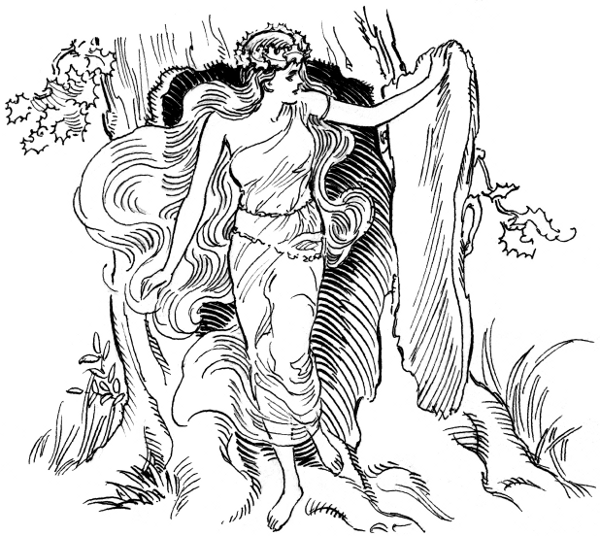
Naiads are spirits of the waters. In their natural form they actually appear made of water, though they feel like flesh to the touch. They are fully capable of operating normally on land, though few choose to do so; they are at a Disadvantage when making survival rolls in Desert conditions.
Stats: +2 Dex Size: Medium
Speed: 30 swim/30 walk Age: Naiads reach maturity at age 14 and can live many centuries. The oldest may be as old as the world itself.
Alignment: Chaotic Good.Languages: speak Naiad, Fish, and Common.
Weapon Training: proficient with spear, trident, and net.
Low-light Vision: Naiads can see normally underwater and in low-light conditions with no penalty.
Water breathing: Naiads can breathe underwater regardless of form; they can only breath in the air if they are not in fish form.
Form Change: as an Action Naiads may change form into fish, half-humanoid/half-fish, or fully humanoid. In their fully humanoid form they can pass for human or elf; in their fully fish form they can pass for an ordinary fish (albeit Medium sized). A given Naiad has one specific appearance in each form.
Liquefy: Naiads may become fully liquid as a Reaction; this will generally let weapons and objects pass harmlessly through them (Successful Dex save for no damage from ordinary weapons, fail and take half damage. Magical weapons and spells still harm them). Re-solidifying takes an Action. If they become fully liquid on land, their movement rate drops to 0, and they cannot speak or take any Actions until they solidify. In water they may move freely, speak, and take actions that don’t involve physically interacting with objects (which means they can cast spells that require no material components).
Siren’s Call: May cast Charm Person once per day. If you are a spell-caster it doesn’t count against your prepared spells, but you may still spend slots to cast it additional times per day.
Subraces
Oceanids
Oceanids are the Naiads of the ocean. They are fiercer and wilder than their cousins, the Neriads.
Ability Score Increase: +1 Con
Wild Form: an Oceanid’s fish form may include sea creatures such as sharks, octopuses, porpoises, manta rays and the like, and may be size Large although their normal form remains size Medium. The Wild Form has the movement, attack, and other attributes of a natural creature of its type.
One with the Seas: you are never lost as long as you are in the ocean or within sight, sound, or smell of the shore.
Neriads
Neriads are Naiads of brooks, streams, fountains, and lakes.
Ability Score Increase: +2 Cha
Watery Embrace: You have Advantage when trying to Grapple while standing in water.
Gift of Breath: while you hold another creature with at least one of your hands, you may permit it to breath normally under water.
Naiad Notions
Elves: “Cousins but not for the kissing.”
Dwarves: “Dwarves sink like stones sink like Dwarves.”
Humans: “Fun right up until the drowning part. And sometimes a little after.”
Halflings: “Some were took but some fewer were taken.”
Naiad Personality Traits
Roll in addition to or instead of Personality traits associated with your background.
Everything’s better, down where it’s wetter, take it from me!
Full fathom five thy father lies, and of his bones are coral made…
I want to be where the people are…I want to see them dancing.
I’ll destroy any man who dares abuse my trust!
Wey, hey, blow the man down!
She pushed her in to the river to drown, Oh the wind and the rain
and watched her as she floated down, oh, the dreadful wind and rain
I’m marching inland from the shore, over m’ shoulder I’m carrying an oar,
When someone asks me: “What – is that funny thing you’ve got?”
Then I know I’ll never go to sea no more, no more
‘Tis not too late to seek a newer world.
Push off, and sitting well in order smite
the sounding furrows; for my purpose holds
To sail beyond the sunset, and the baths
Of all the western stars, until I die.
I’ve long been a fan of Trollsmyth’s Death & Dismemberment table for D&D-like games… Arduin’s Critical Hits are more amusing, but quite a bit deadlier than I’m usually willing to play with (though I read somewhere recently that the way Dave Hargrave used them they were only 1 in 400 chance… a 20 followed by a 20 required a roll on the Crit Chart, rather than just a 20 the way we did back in High School.) At any rate, one of the things that kind of bothers me about 5e Basic is that there’s not really any way to sustain a real injury. I’m OK with Hit Points representing pure Stamina, or at least I’m willing to give it a try and see how my players like it, but it kind of bugs me that except by GM fiat there really isn’t any way to suffer a broken bone or serious laceration. Even if your HP go to 0 and you have to start making saves against Death, once you’ve stabilized a Long Rest will patch you right up.
So my current thought is to use a slightly modified version of Trollsmyth’s D&D chart to fix that. We’ll ignore the time-to-death results from the original chart, and just use the 5e three success before three failure Death save to determine when and if you die.
If you get taken down to 0 HP, and every time you get hit when you’re at 0 HP, roll on the following table. Apply a -1 modifier to the die roll for each time you’ve failed your Death save, a +1 for each success.
2 or lower
Grievous wound: Increase Exhaustion Level by 5, if that would take you to 6 Instant Death (decapitation or the like).
3
Fatal wound (gutted, stabbed through lung, broken back, etc.); Increase Exhaustion Level by 4.
4
Severed limb (DM’s choice or roll randomly); Increase Exhaustion Level by 3.
5,6
Severe Wound. Needs surgery. Increase Exhaustion Level by 3.
7,8
Broken bone (DM’s choice or roll, randomly); Increase Exhaustion Level by 2. Requires 2d4+9 weeks to heal; can’t use the bone until that first 2d4 weeks have passed. After that are at a Disadvantage for checks that rely on it until it’s healed the rest of the way.
9
Moderate Wound. It’s going to need stitches. Increase Exhaustion Level by 2.
10
Light wound: cut, gash, contusion in random place, and according to weapon type. Needs bandaging. Increase Exhaustion Level by 1.
11
Knocked out for 2d6 rounds, unless wearing a helm. With helm, only stunned for 1 round. Increase Exhaustion Level by 1.
12+
a surge of adrenaline returns 1d4 hit points per HD; these vanish at the end of combat & you gain 1 level of Exhaustion.
The upshot of using this table is pretty much anything that takes you to 0 HP will also give you at least one level of Exhaustion… I think that’s fair for an ever so slightly grittier take one what it means to be out of HP and dying. If you want to stick to straight 5e for HP and conditions, you could just use the wounds as flavor text with no mechanical effect.
For an even grittier, though still not super-gritty, effect you can also use the table for critical hits in a variant on the Hargrave method: a crit is double damage, and 1/20 chance of having to roll on this or some other favorite critical hit table.
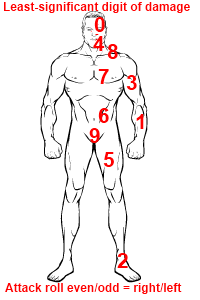
And as an added bonus, I’m reposting the Quick Hit Location Chart I posted on G+ a little while back, which lets you quickly determine a hit location without an extra die roll, and a relatively sensible weighting of heavier hits with more dangerous places:
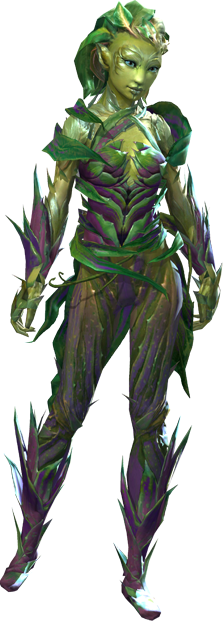
A new race for D&D 5e Dryads are a race of humanoid plants. Their appearance generally matches that of the vegetation in the region they’re from: a Dryad from a coniferous northern forest might have evergreen needles for hair and bark-like skine, while a dryad from a marshy area might look more like cattails and algae.
Stats: +2 Dex Size: Medium Speed: 30 Age: Dryads mature at approximately the same rate as trees, and can live many centuries. The oldest may be as old as the world itself. Alignment: Chaotic Good.
Camouflage: Dryads may take a Hide action as a bonus action as long as they are in natural surroundings similar to their homelands.
Tree Merge: Dryads may merge into trees or other substantial vegetation (at least as big as they are) as a half move. Once merged with a tree they may move their consciousness from tree to tree at their normal pace, re-emerging from another suitable tree; during any turn that they are in transit and not currently occupying a tree they may not take any action except move, not even a free or bonus action, and are not really aware of their surroundings beyond knowing where the vegetation in the area is in relation to themselves; they may not re-emerge as a physical body until they reach a tree at least as big as their body. If they are occupying a tree, they may take such actions as don’t require appendages or speech, and can perceive normally (facing as if they retained their normal form inside the tree). If the tree is destroyed with the Dryad in it, the Dryad is forced out but does not suffer damage; the Dryad may choose whether to re-emerge physically or travel spiritually to a different tree.
At One With Nature: need not eat as long as there is sunlight and water available; without water needs both food and water to survive.
Languages: speak Dryad and Common.
Weapon Training: proficient with blowgun, net, and whip
Subraces
Wilder
Wilder Dryads are humanoid in shape but are clearly plants in all other respects. Wilder Dryads tend to prefer the deep wilderness, and rarely interact with other races except Wood Elves.
Ability Score Increase: +1 Con
Tough Hide: Natural AC 12, does not stack with metal armors.
Natural Weapons: Thorns (d4 piercing, finesse, light) or Spores (poison, basic, save DC10 or d4, thrown range 5/15)
Wild Aspect: Wilder Dryads may alter their appearance to make themselves look more like a natural feature, giving them Advantage when hiding in undergrowth.
Fairer
Fairer Dryads are more human in appearance, and more interested in other races and civilization.
Ability Score Increase: +2 Cha
Natural Grace: proficiency in Song and Dance.
Charming: You may cast Charm as a Cantrip.
Fair Aspect: Fairer Dryads may alter their appearance to fully pass as Elf or Human: this just serves to conceal their Dryad features, it does not amount to disguising themselves as somebody else entirely.
Sunny Disposition
Elves: “The Wood Elves are so much fun, and they dance so well. The High Elves know ever so many of the old songs.”
Humans: “They can be quite vexing, they just don’t seem to be able to see a tree without wanting to chop it down. But they come up with the most astonishing and delightful variety of things…it’s always something new with them!”
Halflings: “They’re quieter in the woods than human children, but otherwise quite hard to tell apart. You generally only find them in the tamed areas, unless they’re picking mushrooms.”
Dwarves: “What are they?”
Dryad Personality Traits
Oh, that looks fun, can I try?
Woodman, spare that tree!
The forest shall feast on your bones, intruder!
Won’t you tarry with me a while?
I go where the wind takes me.
Friendship starts as an acorn, but can grow into a mighty oak.
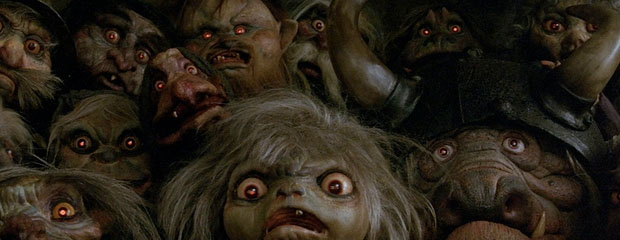
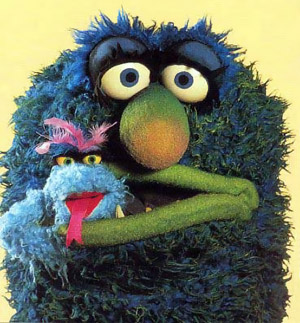
A new race for D&D 5e Goblins are evil, or at least mischievous, creatures, no two of whom are alike. Skin, eye, and hair color vary as do number and arrangement of eyes, limbs, ears, mouths, etc. Every goblin should roll on the Goblin Random Features chart (see bottom of post). Goblins are often employed by evil wizards, because of their large numbers and lack of fear…but their equal lack of discipline makes them less than ideal as guards.
Stats: +2 Dex Size: Small (approx same as Halfling) Speed: 25 Age: Goblins reach maturity at age 3, and while max lifespan is 100+ years, average is closer to 20. Alignment: Chaotic
Foolhardy: Advantage on saves vs. Fear; Disadvantage on Wisdom checks related to prudence or patience (such as Perception checks on guard duty, but not while skulking around looking for a snack or treasure).
Goblin Nimbleness: Can move through the space of any creature at least 1 size larger
Darkvision: you can see in total darkness
Sneaky: can attempt to hide even when only obscured by a creature at least 1 size larger than you.
Languages: speak Goblin and Common.
Subraces
Gapmaw
It had better be food, ’cause I’m gonna eat it!
Ability Score Increase: Str increases by 1.
Iron Stomach: Advantage on Poison Saves and Resistance to poison.
Devour: During a grapple, you may attempt to use a Shove attack to shove the grappled creature in your mouth. Creatures so grappled may attempt to escape as usual, but the Grappled condition does not end automatically when you are incapacitated (though the next attempt to escape the grapple will succeed since you can no longer resist it), and things that move you (such as a Thunderwave spell) will move both of you instead of disrupting the grapple.
Nobonz
Sticks and stones? It is to laugh.
Ability Score Increase: Con increases by 1
Boyoyoing: Advantage on saves vs. falling and crushing. Resistance to Bludgeoning damage.
Squeeze Through: You can move through openings as small as a key-hole. This takes your full move (so you start and stop on either side of the opening), and the distance you can traverse while squeezing yourself through a narrow opening can be no greater than the length of one of your limbs (you have to be able to shove one of your body parts through before the rest can follow…)
Hathedz
Ability Score Increase: Cha +1
Behatted: you can (and usually do) fit your entire body except your feet into a Medium-sized creature’s hat. Any Prodigious physical features also stick out (see chart). You may also fit as much gear as you can carry unencumbered…any gear over that has to be carried outside the hat. You may use gear and wield weapons normally, by extending your hands and arms outside while you’re using them. The hat does not interfere with your perception.
Poker Face: you gain Advantage when trying to brazen things out (resisting Insight), but not on your own attempts to persuade.
Sneakz
Ability Score Increase: Wis +1
Nimble Escape: may take the Disengage or Hide actions as bonus actions in any turn.
Full of Attitude
Elves “If they had those sticks any farther up their butts, they’d be dryads”
Dwarves “If rocks could make beer, Dwarves would never get invited to another party.”
Halflings “Come the Revolution, they’ll be first up against the wall!”
Humans “OK, I guess. Really, really touchy about sharing their children. You’d think they can’t just make more.”
Goblin Personality Traits
You may roll on this instead of, or in addition to, the Personality Traits associated with your Background
What’s mine is mine, and what’s yours is mine!
That looks edible/drinkable/humpable!
Boom! Hahahaha!
Pull my finger!
I will hug him and pet him and squeeze him and call him George!
Gee, it never hurts to help!
What’s the matter? You wanna live forever?
When the going gets weird, the weird turn pro.
Goblin Random Features
Roll d20
Scaly skin (roll d8 randomly for ROYGBIV, reroll twice and you’re spotted/checked/striped/plaid)
Prodigous feature (counts as Tool):
Ears
Eyes
Nose
Lips
Hands
Arms (extremely long and bendy, not beefy)
Legs (extremely long and froglike)
Feet
Hair
Tail
Gut
Genitals
Hairy to the point no other features visible
1d4 extra (on a 4 re-roll and add), arranged (1-3 Symmetrically, 4-Asymmetrically):
Eyes
Ears
Noses
Arms
Legs
Mouths
Tiny fanged mouth on the tip of a serpentine tongue.
Big sad puppy eyes.
Webbed fingers and toes. And arms. And legs.
Sloughing leprous skin.
Second Head
Part creature:
spider
bird
shark
bear
monkey
bat
wolf
horse
goat
choose
Part random element
fire
water
ice
air
dark
Earth
Fur (random ROYGBIV)
Can climb walls like a gecko or spider
Antennae
Big butterfly wings
Blind, uses sonar to identify targets.
Two hearts (gets an extra save vs. Dying before expiring at 0 HP)
Is much larger than the average goblin (counts as Medium instead of Small)
Is much smaller than the average goblin (counts as Very Small)
So, the 1st level Sleep spell in D&D bugs me. I don’t actually mind that it’s an encounter-ender for low-level characters… in fact I regard it as a bigger problem that 1st level MUs don’t really have any other spells nearly as worthwhile. Maybe Charm Person, at least outside of a dungeon, but that’s about it. But being awesome once a day isn’t a deal-breaker. No, what bugs me is the ritual of going around and killing all the sleeping foes afterwards. Not only is that particularly unheroic (granting that not everybody needs to play a heroic character) it just doesn’t feel particularly like the magic in stories that inspired it.
Over the years I’ve played with a number of DMs that had various solutions to this: some made you roll for damage against the sleeping foe, and if you didn’t kill him in one blow he woke up. That mainly served to make players more cautious about arranging a gang-stabbing of any multi-hit die creature they slept and sometimes the spell being wasted; not trying to kill the creature almost never came up. A free round of attacks was basically the best chance you were ever going to have, and chances are you’d be meeting it again. One DM made you roll to hit as well, though at least she applied bonuses. I think I recall one in the early days of playing who would count it as an alignment infraction if a Lawful (or maybe */Good… can’t recall which edition) character killed a sleeping foe; hardly anybody played Lawful characters at his table. A couple have removed Sleep from the game, or made you start with random spells and by the time you found a spell book with Sleep you likely had better mass-murder spells. Some have allowed saves against sleep in addition to the max number of creatures affected (not necessarily horrible if you extend the same thing to the PCs). But nothing I’ve encountered really did more than make the process of casting Sleep then slitting throats a bit more risky and likely to fail.
So I’m considering the following house rule: if you try to attack or move a magically slept creature, you fall under the spell as well. No save, no limit on the max HD. To me that feels a lot more like the sleep spell in literature, including spells like abandoned castles with all the inhabitants sleeping for a hundred years. The 1st level Sleep spell would just be a lesser version of that.
Another version I considered would be the spell would be broken on all sleepers if any of them were attacked, but that seems like it leaves too much room for rules-lawyering it. E.g., trying simultaneous attacks, tying them all up and throwing them off a cliff all at once, smacking your own companion with a small attack to wake the rest, and so on. They could all probably be patched, but I think the result would be a multi-paragraph list of conditions like a 3rd edition spell.
One thing that I think is attractive about this, besides having more of a fairy-tale or fantasy feel, is the way it makes Sleep a very different spell, with different purposes, than something like Fireball or Cloud Kill. You always need to think about what you’re going to do when they wake up… are you using it to cover your retreat, give yourself time to burgle the place, pass deeper into the dungeon and figure you’ll deal with them on the way out, or what. You can’t count on clearing the level one sleep spell at a time. And on the flip side, if an enemy spell caster uses sleep on you it’s no longer time to roll up a new character unless the GM is having the monsters be far more merciful than the players ever are.
I guess my one worry is whether it’s just too different from the way players are used to using Sleep. The whole reason for using D&D instead of something like Zounds! is because of the instant familiarity and buy-in. There’s definitely a certain amount of tweaking and house-ruling that just the way D&D works, but there’s a point beyond which you might as well play something else, and changing one of the most reliable 1st level spells gives me some pause.
Doing this all in one post, ’cause I can’t be bothered to schedule a post a day for all of Feb.
1: First person who introduced you to D&D? Which edition? Your first Character?
I picked up the original “White Box” D&D from the local game store, before anybody else I knew had ever heard of it. This was back in 1975, so nobody outside of Lake Geneva and a few college towns even knew what it was. I don’t remember my first character, but I was the DM of most of the games I played until my brother Alex started his own campaign. My first player character was actually probably in a game that my 6th grade science teacher agreed to run for us, once we explained what it was. My first PC that I clearly remember was Berken the Bold, but that was later, after we had switched out the D&D “alternate” combat system for Melee/Wizard.
2: First person YOU introduced to D&D? Which edition? THEIR first character?
Hm. Probably Alex, maybe my best friend at the time, Ike. Still White Box, and no idea what the character’s name was. The first Alex character I actually do remember was a Traveller character, Lord Admiral Death Vendor, M.D. (crazy Traveller career-path character generation).
3: First dungeon you explored as a PC or ran as a DM.
Something I created based on the example in book 3. I don’t think I gave it a name, even, it was “the dungeon”. At that point I’m not even sure there was a town outside, I think I had a shop on the first level, because the players had to buy stuff somewhere, right?
4: First dragon you slew (or some other powerful monster).
Now this I do remember: we killed a T-Rex in the dungeon that my 6th-grade teacher ran after school. That was an epic battle… I think only a couple PCs were killed, but I think we each had only a few HP left.
5: First character to go from 1st level to 20th level (or highest possible level in a given edition).
I don’t think I’ve ever hit max level in 40 years of playing. I did have one character (Berken) who graduated to demi-godhood because he became so powerful he was boring to play, but by that point we were playing Alex’s house-rules and I don’t think there officially were levels any more.
6: First character death. How did you handle it?
Roll up a new character, of course. After a while we made resurrection pretty cheap and easy, just because it was getting boring rerolling scrubs.
7: First D&D Product you ever bought. Do you still have it?
The old white box… and no, I don’t, more’s the pity. I think it got junked when my mom moved while I was in college (along with a lot of my comics… the age-old tragic story).
8: First set of polyhedral dice you owned. Do you still use them?
Purchased separately, and good grief, no. I don’t think they lasted a year before we’d lost some or all of them.
9: First campaign setting (homebrew or published) you played in.
I think the first actual campaign setting was based on Arduin… before that it was just “the dungeon” and later “the town.” Inspired by that we made whole campaign worlds and solar systems. My biggest and longest-lasting setting at the time was The Four Kingdoms, though later on Neng lasted more years but with different groups of players. Alex’s world started out without a name, but eventually there was Sorrock’s World and… um, I forget. Cargoth’s World?
10: First gaming magazine you ever bought (Dragon, Dungeon, White Dwarf, etc.).
Dragon, but I was a much bigger fan of The Space Gamer. I pretty much fell out of playing actual D&D pretty early on, certainly before Basic was released. We moved on to different systems and homebrews.
11: First splatbook you begged your DM to approve.
Splatbooks are after my time.
12: First store where you bought your gaming supplies. Does it still exist?
The Games People Play, in Cambridge, MA. And yep, it’s still there.
13: First miniature(s) you used for D&D.
I think we got some Ral Partha minis? But mostly we were playing “theater of the mind” style. Minis were expensive, and we had no money. I remember I had to save up my allowance for 2 months (maybe more) to buy Empire of the Petal Throne… still probably the most expensive game relative to my income I have ever bought.
14: Did you meet your significant other while playing D&D? Does he or she still play? (Or just post a randomly generated monster in protest of Valentine’s Day).
No, but she plays now.
15: What was the first edition you didn’t enjoy. Why?
AD&D 1e… too fiddly and complex, and by the time the DMG was released I thought I was done with D&D forever.
16: Do you remember your first edition war? Did you win? 😉
The only winning move is not to play. How about a nice game of chess?
Actually I did used to get involved in edition wars, except it was D&D versus other “better, more realistic games.” I’m kind of ashamed of that, but in my defense a lot of the vocal D&D supporters I was arguing with were big “you’re playing RPGs wrong!” dicks.
17: First time you heard D&D was somehow “evil.”
All during the Satanic Panic I never actually met anybody who held that view, it was just something stupid in the news. Even now, I never have, though I’ve met people whose parents actually fell for it.
18: First gaming convention you ever attended.
Only ever attended some mini-cons, or SF cons that had some gaming events.
19: First gamer who just annoyed the hell out of you.
One of my high school “friends” was a complete “Loony” player… looking back I’m pretty sure he only played because it’s what the rest of us were doing, but he had no real interest in anything except being disruptive.
20: First non-D&D RPG you played.
Traveller. SF was more my bag than fantasy, anyway, so my longest running HS campaign was actually a Traveller campaign.
21: First time you sold some of your D&D books–for whatever reason.
I don’t think I ever did. You kids with your internets and ebays don’t know what it was like back when you threw stuff out because how the hell would you ever find somebody to buy it, even if you thought it was “worth something”?
22: First D&D-based novel you ever read (Dragonlance Trilogy, Realms novels, etc.)
I think I got through Quag Keep, but remember nothing. I know I never finished the first Drizzt book. I’ve read a bunch of stuff that was inspired by or parodying D&D and/or RPGs in general (e.g. the Joel Rosenberg Guardians of the Flame series), but I’ve never really cottoned to any of the official D&D published fiction. They mostly came out during the phase when I was snobbishly avoiding D&D, but nothing I’ve really heard about them since has convinced me they’re a treasure trove awaiting discovery.
23: First song that comes to mind that you associate with D&D. Why?
Behold the wizard! Beware his powers! Unspeakable powers!
because that’s what I want my D&D games to be like.
24: First movie that comes to mind that you associate with D&D. Why?
25: Longest running campaign/gaming group you’ve been in.
My current gaming group has been together for 13 years, I believe. Not the same campaign, though. My Friday night group has been only a decade, but we actually don’t play D&D as much in the past few years… more board-games and the like. Still, when we do play, it’s the same campaign… though the GM makes us create new characters whenever we get to around 5th or 6th level, since she thinks 1-5th is the “sweet spot” for D&D adventures.
26: Do you still game with the people who introduced you to the hobby?
I did the introducing, and not really. Alex and my siblings are the only folks I still see from back then, and they’ve mostly fallen away from gaming.
27: If you had to do it all over again, would you do anything different when you first started gaming?
I would do everything differently. Well, maybe not, but I’d like to think I’ve learned a bunch about what’s fun and what’s not over the years, and wouldn’t make a lot of the same mistakes. A lot of that is captured in this blog.
28: What is the single most important lesson you’ve learned from playing Dungeons & Dragons?
Rules make good servants but poor masters.
Powered by Linky Tools
Click here to enter your link and view this Linky Tools list…
Having played Numenera again, I’d have to say that the two biggest fun-sucks are deciding whether to save XP for improvements or spend it to reroll or avoid GM Intrusion, and the decision as to whether to spend the XP to avoid GM intrusion and if you accept it having to decide who to give the extra XP to. These are terrible, terrible things to force the player to do in the middle of every exciting situation, wrenching the players out of any immediate visceral reaction to the what’s happening in the fiction and forcing them to consider long-term character goals and emphasizing the fact that its fiction at the worst possible moment by making potentially exciting twists and developments provisional upon the players’ decision about whether to spend resources to prevent it. It is in a word, bletcherous, and it doesn’t need to be.
In order to dial up the awesomeness in Numenera, you only need to make two house rules:
First Make GM Intrusions compulsory, but allow the players to mitigate them instead of retconning them. Instead of saying “This happens, unless you choose to spend now to make it unhappen” say “This happens, what do you do?” Then allow the players to either spend XP to automatically succeed at some attempt to cope, or proceed normally with the usual rolls. Thus instead of “GM Intrusion: You drop your weapon!” “Spend an XP. I refuse.” it becomes “GM Intrusion: You drop your weapon!” “But I manage to catch it with my other hand! Spend an XP!” or “They grab you from behind!” “Just as they do I catch a glimpse of them reflected in the shop window and manage to wrench myself out of their grasp!” Or if the player doesn’t feel like spending the XP, “I try to wrench myself free. (Rolls)” It may seem trivial, but keeping it so the fiction always moves forward with no “taps back” is, imo, really important for maintaining a high level of engagement.
Second Reward players for spending XP on immediate and short-term benefits by making it required. In fact, instead of calling what you get awarded for accepting GM Intrusion and discovery XP, let’s call it Numenera Points, or NP. NP can be spent on anything except Long Term Benefits and Character Advancement. XP are gained by spending NP. XP can only be spent on Long Term Benefits and Character advancement. If you keep the ratio of spent NP to XP earned at 1:1 characters will advance a bit faster, so if you like you can adjust this for your campaign so that, e.g. you spend 2 NP to gain 1 XP. This automatically solves the problem of hoarding NP… there’s no real reason to, and if players do, they gain no particular benefit; it’s not like they are trying to save to improve the character at the same time as keeping a bank to use during play. Those functions are now handled separately by XP and NP, and you can adjust the conversion ratio for any desired pace of advancement. Most importantly, players are now rewarded instead of punished for engaging with the mechanics of the game when they spend NP.
To a lot of people these differences are too subtle to care about; they’re perfectly happy to stop playing their character and ponder how to manage their resources or discuss tactics and rules minutia with other players mid-sword-swing, and rewinding what’s going on in the game is no more distressing than playing an interrupt card on an opponent in Magic the Gathering. On the other hand, there are people like me who are really bugged by “dissociated mechanics” to the point where it can be really hard to care much about what happens to the character, who becomes a token to push around on the board. The thing is, people who don’t mind dissociated mechanics aren’t bugged by associated mechanics; in fact many of them seem to be completely blind to the difference between them… so tweaking things to make the mechanics associated with what’s going on in the game world is a win-win. Engagement with the mechanics is still perfectly satisfactory for those that don’t care how its connected to the fiction, and those that do care can now use the mechanics without the pain of having to step back from the fictional world to make OOC decisions.
Basically DungeonPunk applies the gritty, cynical aesthetic of CyberPunk to heroic fantasy, usually with magic as tech. Sometimes this is just a surface gloss: long coats & mirror shades on your dual-pistol wielding dwarf warrior. What I’m looking to do is emphasize some of the things that I see as making the “Punk” part:
The street finds its own uses for magic (tech)
Criticism of conformity: you can have a comfortable life, or freedom, but not both. Opting for freedom drops you into the seamy underbelly of society, scrabbling for a living. You’re not really a punk, imo, if the Establishment is universally hated and despised. Fighting against alien invaders who want to eat you isn’t punk; fighting against alien invaders who want to give you boring 9-5 jobs with health and dental in alien call centers is.
The protagonists are society’s outcasts and losers, not the movers and shakers. Being a high-level adventurer doesn’t get you an audience with the king and the hand of the prince/princess, it gets you an unpleasant interview with the head of the secret police where he offers to drop the charges if you do a little job for him…


 rays and the like, and may be size Large although their normal form remains size Medium. The Wild Form has the movement, attack, and other attributes of a natural creature of its type.


 Tales of the Rambling Bumblers
