It’s Marvelous!

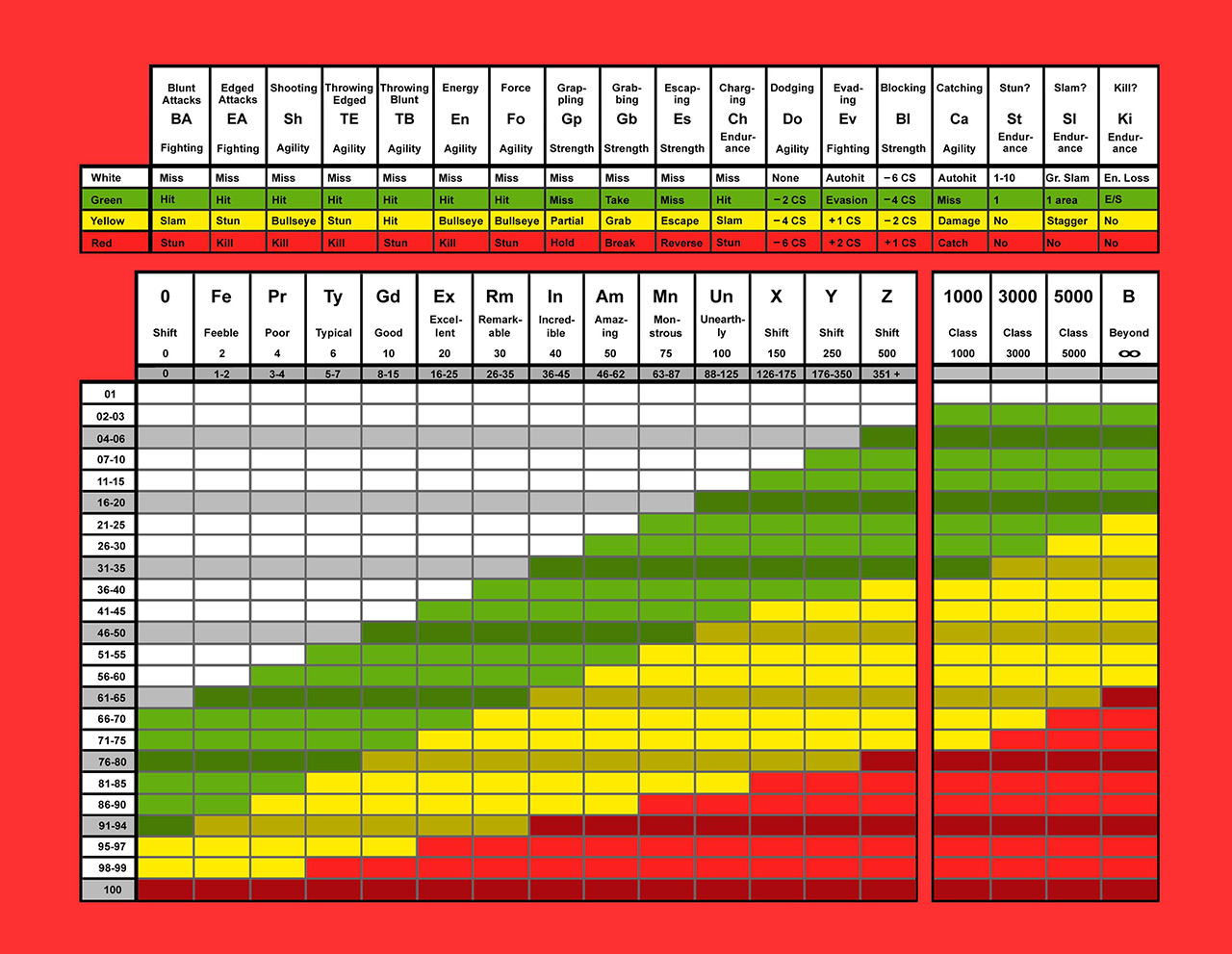
A while back I wrote a web page to help play Marvel Super Heroes, by automating the roll on the “Universal Power Chart” to show you exactly what cell and color your percentile roll lands in based on the Power Level Column (the old Feeble, Poor, Typical, Good, Remarkable, Incredible, Amazing, etc. rating that MSH gave character’s powers). I don’t think it actually got much use, because it does require that you have a browser open when you play… but that was before plague stalked the land like some great stalking thing. Now that folks are doing most of their gaming online, it might be a bit more useful

Marvel FASERIP Universal Power Chart

I’ve moved it to github, since Google is closing down the classic Google Sites where I used to host it.

Oh, and if you have never played it before and want to get into it, you can check out the Classic Marvel Forever website.

Excelsior!

Quick Thoughts on Risus

We tried Risus for the first time last Sunday, for another round of the episodic space horror game I run when the mood hits me.  Even though Risus is officially a humorous game (Risus being Latin for laughter), it’s still a reasonably good fit.  Humor and horror have a good deal in common as far as RPGs go: they both de-emphasize realism and tactical play in favor of evoking certain emotional responses, and are well-served by games with simple resolution that emphasize description over game mechanics.

I think the experiment was largely successful, but there are some things that I want to do differently when we resume the game in two weeks.  In particular, I want to encourage the players to be more assertive over the applicability of their Cliches.    There was a bit too much “mother may I?” in our session, with the players asking whether their Cliches cover certain actions they want to take, and too much peering at the super-simple character sheets as if an appropriate Cliche would suddenly jump out at them.  Does Deep-Space Scoutship Captain cover firing a pistol?  It does if you say so, Captain.

As GM I think I need to be more generous with setting target numbers according to the Cliche being used.  I’m used to setting a target and then everybody just sees if they can beat it, but Risus doesn’t exactly work that way.  Making a tricky pistol shot should probably be something like TN 10 for Deep-Space Scoutship Captain, and only 7 for Gold-Medallist Pistol Champion.

Names and Language in Nonesuch

Anything the players want.  That’s what they do anyway, and I know from bitter experience that once I start in on listing appropriate names for cultures and races it’s just a short step to a naming language and then a full-blown death spiral into conlangs.  So Umbry, Auxi-lock, Revenge, Expendable 1401, Tomato, Hermia/Horatia, Caboose, Hurlon, Poden Persas, welcome to the Land of Nonesuch!  Hope you survive the experience!

Well, except for you Revenge, better luck next life.

One thing I haven’t really settled is how many languages there are and how many the characters know.  Originally I was allowing each character one extra language per INT bonus, so pretty much all the characters had one or none. Everybody in the kids’ game wanted Orc, because that was the first group of humanoid monsters they ran into, and they were fun to talk to.  Now I’m thinking that will be kind of dull when they run into other monsters, unless they speak common, and I’m also wondering if I’m taking too American a view of foreign languages.  In a setting where you’re exposed to them regularly, it probably shouldn’t be so hard to pick them up.  Maybe one extra spoken language per point of Int over 9, and one dead language per Int Bonus?  It would be something to do with Int for non-Mages, given the system doesn’t really emphasize skills.  And I want characters to be talking to the monsters, even the hostile ones, because that’s where the RP is.

Thoughts and suggestions?  How do you handle it in your games?

Thinking of the Children

I’m going to be running a game for my friend Mac and her three children (ages 7 through 12) in the near future.  She’s been playing D&D with them for a few months now, and I’ve been a player for some of the sessions.  When I mentioned that even though I sometimes had a hankering to run the kind of dungeon-crawlish games that she runs, none of my regular players was into them,  she suggested that I should run for them sometimes.  Among other things, she’d like them to have experience with GMs other than her, so they don’t become one of “those kind” of players who insist that there’s only one right way to play, coincidentally the way their first GM ran things.

I’m not quite sure what I want to run, though.  Mac has been running what she calls D&D pretty much the same way, in the same setting, for almost 27 years now, but with house rules so extensive that it scarcely seems like D&D sometimes (e.g. rolling 3d6 lower than Dex to hit, armor doing damage reduction only, magic via a spell-point system, clerics using a different seemingly ad-hoc system, etc).  That’s what the kids and I have been playing, but I wouldn’t be able to run it even if I wanted to since so much of it seems to exist only in her head.  I gave the two elder children their own copies of one of the retro-clones for Christmas (Basic Fantasy Roleplaying Game, not to be confused with the Chaosium Basic Roleplaying) and the younger of the two has actually been using it, more or less, to create dungeons and play with his friends.  He’s already added a new Body Builder class to the game though I’m not sure anybody he’s played with has yet met its rather stringent stat requirements….

So my first thought was to run that, since the rules are sort of familiar to them, and I would rather spend my time playing the game than explaining the difference between the rules they have (or their mom uses) and the rules I’m using.  My second thought, though, is to use Tunnels & Trolls, since I’d kind of like to try GMing that…. but I know that there’s some stuff about it (particularly the very abstract combat) that may be just too different from what they’re used to.  Mac basically uses a blow-by-blow accounting of combat, with turns lasting a couple of seconds, if that.  So my third thoughts have to do with either swiping a couple of things I really like from T&T and putting it into BFRPG, or vice-versa.  One thing I always get hung up on is that I don’t really like the magic system in the retro-clones.  Magic as ammo loads just doesn’t thrill me, unless you go full out Vance with it as depicted in the Dying Earth… but then you have to tweak both the spells and the MU’s combat capabilities anyway.  And Mac hates Vancean magic almost as much as she hates point-buy systems where you can design a character that’s practically a super-hero from the outset.

And finally, my fourth thoughts are to go ahead and finish the retro homebrew that I was working on, which would finally give me an old-school inspired system that really fits the way I’d like to play as well as players who will be happy to play it….  as usual with me when I start a project I ping-pong back and forth, unable to settle on any one option. I have a couple of weeks, at least, before we’d first play, so I don’t have to decide tonight, but I should decide soon and start working on a dungeon for them.

Tunnels & Trolls 5.5 vs 7.5

An overview of the changes that I’ve noticed between T&T v5.5 and v7.5  All the comparisons phrased in terms of what 5.5 has/lacks vs. 7.5, since I read 7.5 first and went over it extensively.  Also, some of the changes in 7.5 appeared in 5.5 in a couple-page appendix of Ken St. Andre’s house rules:

Chargen

  • No WIZ stat, spells are powered by STR.  Advantage: 7.5  STR to power spells isn’t a deal-breaker, but it makes the archetype of the frail old but nonetheless mighty wizard a problem.
  • SPD is an optional stat only used for movement rates, which are fairly complicated. It can’t be increased.  Advantage: 7.5  Even if you view Speed strictly in terms of how fast you can run, that’s certainly something you can improve with training, at least as much as you can improve your Intelligence or Charisma.
  • No Triples Add and Roll Over. Advantage: 7.5   Not a big deal, but it’s kind of cool. (This is one of the KsA houserules.)
  • Weight Possible and Weight Carried emphasized more in 5.5 including rules for how long you can carry how much.  Advantage: 7.5  I’m not enough of a Grognard to value the added bookkeeping.  It’s good to have a rule-of-thumb, but I don’t like tracking it.
  • No Specialists or Citizens.  Advantage: 7.5  Anything that increases the number of viable archetypes without unduly burdening the system with complexity is a win in my book
  • Warriors don’t get Level adds in Combat Adds. Advantage: 7.5  Something besides the armor bonus as a reward for leveling up is nice to have.
  • Warrior-Wizards instead of Paragons. Toss-up. It’s harder to be a Paragon (you need a triple somewhere in your roll-up, not just everything >=12), but the 7.5 advantages are better: they get to double their armor instead of add 1, they get to invent new spells once they reach 10th level, the Wizard’s Guild will sell them spells.  Both versions are rare enough that I doubt it matters which you use.
  • No Talents.  Advantage: 7.5. I like Talents…maybe the most out of any skill system I’ve seen published.

Saving Rolls

  • Saving Rolls have a minimum for success of 5, and are calculated as the SR – Luck = number to beat (instead of roll +Luck > SR?). Advantage: 7.5   The mechanical result is the same, but roll+add is easier for most people; whether it’s better to have 3 is an automatic failure or <=5 is a toss-up, but I’d personally give the edge to the players succeeding more often.

Combat

  • Monster dice as well as adds get reduced as Monster Rating goes down during combat; this produces a much sharper death-spiral effect.  Advantage: 7.5  I don’t really see any advantage to having nearly every combat the PCs win end with several anti-climactic rounds that are rolled (if at all) just to see how fast they can finish.
  • 5.5 Makes it clear that armor doesn’t subtract from hits for magic (though a magic amulet might).  Advantage: 5.5
  • Missile fire isn’t added into the side’s Total Hits, but some magic is–at least up until the point when it would double-count hits.  Advantage: 7.5  This rule actually puzzles me in 5.5.  If you’re worried about double-counting damage, why does magic get to (semi) double-count and not missiles?  There’s a sort of explanation that Take That You Fiend! jars or shocks nearby foes and makes them less effective, reducing their attack up until it makes them lose the round but never delivering more hits than the magic’s damage, but Freeze Please and Blasting Power are spread out, while other spells don’t, and…It’s far simpler to my mind to just add everything up, and that lets your rear-rank guys like archers and wizards actually figure into whether you win or lose the round.  The whole “the monster can lose the combat because of magic adds, but not take extra damage” calculation makes my eyes water.
  • Damage is divided evenly between all the losing side, except that if it doesn’t come out evenly the Wizard (if any) can take the smaller parcel.  Advantage: 7.5   Dividing the damage up is one of the few tactical decisions that the party gets to make during a turn, and I like the idea that the fighters can choose to bear the brunt of it and protect the weaker party members.  I can see play-by-post going with even splits to reduce the back-and-forth, but flavor-wise I think 7.5 is much more interesting.
  • Missile weapon fire requires multiplying a distance factor by a size factor to get the SR level, but archers get twice the DEX adds when firing a bow. Advantage: 7.5
  • Dodging is handled by an SR against Luck if the players agree that monsters get the same SR. Advantage: 7.5.  There are several points in 5.5 where the rule to be used is negotiated with the players, which I kind of like, but the 7.5 version of just doubling the SR level if the target is dodging or moving erratically is easier and quicker.
  • No spite damage.  Advantage: 7.5  Even a stronger party bears some risk of injury in combat, and combats tend to get resolved faster because spite damage bypasses armor.
  • Rules for too-heavy weapons.  Advantage: 7.5  While it’s nice that 5.5 has an answer to what happens if you try to wield a weapon too big for you, the answer being that you knock yourself out in short order (your STR is damaged by the difference each round, with it increasing each round as your new STR is even less) is probably worse than just saying you can’t use it effectively.
  • Rules for Movement.  Advantage: 7.5  The 5.5 rules are simultaneously complex, with varying formulas based on encumbrance and type of activity (looking carefully, normal dungeon speed, sprinting) and fatigue rules based on CON and abstract, yielding nothing more than a rating of feet/minute traveled.

Monsters

  • No special abilities for monsters. Advantage: 7.5  The whole spite-damage activates special monster abilities like stoning gaze or fiery breath makes them a lot less bland, IMO.
  • Wandering monsters.  Advantage: 5.5  5.5’s rules are vague, but at least it has some.
  • Monster reaction chart.  Advantage: 5.5  Another inexplicable hole in 7.5 is no discussion at all of anything monsters might do except attack and fight to the death.

Magic

  • No Kremm resistance.  Toss-up.  I don’t really know whether the whole kremm resistance thing is worthwhile, and I suspect I won’t until I’ve played a bunch.

There’s more, including stuff on learning languages, berserk fighting, a really elaborate set of optional marksmanship rules, hirelings and slaves, some nice discussion of designing a dungeon, and so forth, but that’s the gist of it.  There’s also a fairly substantial (and controversial) change in how experience is allotted, going from advancement in level granting you the right to improve one attribute by an attribute-specific formula (e.g. +your new level to your STR, but only 1/2 your level rounded down if added to your DEX) to a uniform spend your current attribute x 10 xp to raise it by one, with level back-figured from changes to one of your class’ primary attributes, but I haven’t yet bothered to figure out what that would mean for a typical character at various levels.  I suspect 5.5 would tend to preserve initial differences in stats more, since you can only pick one stat to advance per level, and levels take more and more XP to achieve as you advance.

As you can tell, by and large I think V7.5 is an improvement in most ways.  I think 5.5 is a better introduction to RPGs…I’m not sure somebody new to RPGs could really understand what to do with 7.5, and certain things are either cryptic or accidentally ommitted in 7.5 (such as what the 2nd figure for DEX under DEX required for knives meant), but most of the individual rules changes in 7.5 are in the direction of making things simpler and more uniform, and where they add complication (Talents, Specialists) they get a lot of bang for the buck.  Still, I’m very pleased to have both sets of rules now, and I like T&T even more for having read where it is coming from.

update: Commenter G’Noll points out that I was confusing the requirements for Paragon with the other Specialists; Paragons in 7.5 have the same basic requirements as in 5.5: 12+ in every attribute before Kindred modifiers are applied, though that’s much harder to do with an extra two attributes.

Huzzah! It Must Be Is Mine!

Tunnels & Trolls Version 5.5 just arrived in the mail.

What, you thought just because I had 7.5, I’d stop there?

You don’t know me very well, do you?

4e For Grognards?

The Core Mechanics offers up 10 House Rules to Make Grognards Like 4th Edition Dungeons & Dragons. Unfortunately, most of the house rules are of the Racing Stripes on a Yugo variety. (Or, if you’re a 4e fan, putting Fuzzy Dice and lowrider hydraulics on a Formula 1.)  Except for Rule 7 (Don’t scale the Campaign Setting), they change the surface details like number of classes or races without getting at the essence of the play style.  For instance, Rule 4: Limit Races to 3.  White Box D&D from 1974 had the rule

There is no reason that players cannot be allowed to play as virtually anything, provided they begin relatively weak and work up to the top, i.e., a player wishing to be a Dragon would have to begin as let us say, a “young” one and progress upwards in the usual manner, steps being predetermined by the campaign referee.

So it’s not the Dragonborn that are keeping the Grognards away, ok?  (Btw, just for comparison, that single rule is the same amount of space as devoted to Halflings, and only about a sentence or two shorter than the rules for Elves or Dwarves.)

So what would you really have to do to make 4e Grognard-friendly, assuming you wanted to?  There are really three major things, and they’re comparatively simple, but profound.

First, you have to reverse the direction of causality in the system: cause and effect have to flow from the game-world to the rules, not from the rules to the game-world as it currently stands.  What does that really mean for 4e?  It means that you have to visualize what’s really going on in the world, and reason out the consequences from there.  What 4e calls “the flavor text” is the power.  You can’t just invoke “Tide of Iron” and move the mini, it actually has to make game-world sense that the character be able to push the opponent in that direction given everything you know about the combatants such as their relative mass, whether one of them is made of some substance that makes pushing/being pushed wierd or would have some other consequence–think about using your shield to shove a Gelatinous Cube around and you’ll see what I mean. And if the effect is not supposed to be magical, if you can’t explain how it would actually happen (frankly, most of the pull and slide powers) then you can’t do it.  If the flavor text of the power causes small flames, that’s different from a power that creates icicles, even if the rules are otherwise identical.  And just because two powers have rules that interact (the whole “exception-based design”) means nothing if it’s not clear how the interaction would play out/make any sense in the game-world.  I expect that a lot of 4e players would balk at this, despite it being the same as Mike Mearls’ advice on running 4e without minis, but do you want to game with Grognards or don’t you?

The second thing you have to do is eliminate any vestiges of any rule or mechanic that can’t be understood in game world terms, and talked about in-character.  That doesn’t mean that the characters have to use the exact same terms, but they have to be able to think about the concept.  A Fighting Man might not actually say “Saving Throw”, but he could fully understand and discuss with the other characters that he’s much better at dodging a death ray or beam from a magic wand than he is at resisting a spell.  He can talk about how hard it is to hurt or kill something, even if he doesn’t literally say AC or HP, and how experienced he is even if he doesn’t divide it into points of XP.  For 4e that means dropping Skill Challenges.  Sorry, but there’s no in-game way I can conceive of to explain the spooky action at a distance implied by the accumulating successes and failures (particularly the failures).  You’re just going to have to do it the old-fashioned way, by reasoning about the logical consequences of each individual failure and success and whether there’s any causal reason one would influence the next.  You also have to eliminate Action Points, possibly Healing Surges, and probably a raft of other things (“minions” for instance–a creature of the same type as another you’re fighting that can only take 1/100th or less damage can really put a dent in the old verisimilitude).  You could try to “reify” them…make them actual things that the game-world inhabitants really do understand  and talk about (perhaps with magical or divine explanations), but you risk turning your game into The Order of the Stick.

The final thing that you have to do, and this is really the culmination of the other two, is that you have to stop looking at the character sheet and the rulebooks to tell you whether you’re permitted to do something.  If the player can describe the action in such a way that it makes a lick of sense in the game-world, the character can attempt it.  The GM can assign a probability to whether it works (even if it’s so low as to be in effect impossible), or just rule directly, but everybody can attempt anything they can imagine unless it’s specifically called out as forbidden to their class (e.g. fighters learning spells, magic users wearing armor).  Skills, feats, powers…they mean you’ve got a better shot, but the lack of one should never be cause for the GM to say no.

And that’s it. You don’t have to strip out the laughable names “Moon Prism Power Divine Strike!â„¢”  “Bloody-Riptooth All Cool And Spiky Badass MoFo Crocodileâ„¢.”   You don’t have to put save-or-die effects in, enforce completely random chargen, have level-draining undead, or make magic Vancian.   All of those things were indeed common enough back in the day…but they weren’t the essence of game-play; plenty of undeniably old-school games didn’t have those features….even if they were using a system that did (3d6 in order was one of the first things that many groups discarded; by the time of Basic D&D there were official, if optional, rules for discarding characters with no score above 9, or swapping attributes).  You could add one or more of those, but the plain truth is that the Grognards who would insist on them aren’t likely to touch even a revamped 4e with the proverbial 10′ pole, and those are the things that 4e players are most likely to strongly object to.  On the other side, I think that many of the things that are show-stoppers for the Grognards literally fall beneath the 4e fans’ notice….in prior conversations trying to explain the differences I get the distinct impression that they don’t even realize (and some don’t believe) that these actually are differences between the way the editions work, or they discuss them solely in terms of design goals (this is faster, everything you need to know is written on this card) without even considering whether it has implications for how you think about the world.

So on the one hand, I do actually think a 4e for Grognards is possible…in some sense even easy: just ignore a bunch of these rules, and interpret these ones in a different light.  On the other, I’m not entirely sure whether the result would be still be 4e.

Obligatory St. Patrick’s Day Post

Just want to point out that Leprechauns are one of the five “common” Kindred in Tunnels & Trolls.  Their modifiers are:

STR 0.5
CON 1
DEX 1.5
INT 1.5
LK 1.5
CHR 1
WIZ 1
HT 0.25
WT 0.33

Leprechauns are automatically Wizards, and they have a natural Wink-Wing (teleportation) spell that they can do without magical training or cost (though that means that they can’t pump extra WIZ into it for more distance).

So play a Leprechaun today!

Multi-Classing

The Valley of the Blue Snails, a really interesting blog mostly about an unusual setting that Canecorpus has created, has a post about Multi-Classing in his D&D setting:

Valley of Blue Snails: Multi-Classes Revisited

I will be changing a few of the multi-class titles though I’m a bit mixed on what direction to take it. The titles are similar to normal class titles (Veteran, Cutpurse, Wizard, etc) in that they are mostly for fluff with perhaps a minor ability to adhere the two classes better. I’m deciding on wither to make it very setting specific or use more intuitive titles.

Example, a Fighter-Cleric would be a Paladin. Pretty intuitive. Setting specific would be something like a Dwarven Fighter-Cleric would be a Whitebeard. Not so intuitive but perhaps a better choice since this sort of multi-class fluff is well outside of the realm of B/X anyhow. The main problem is the setting specifics titles would indeed be rather specific, slanting towards race with specific classes.

I did something similar for a (for now abandoned) retro game I was working on, which I might as well share in case somebody finds it interesting:

Primary/Secondary Fighter Mage Priest Thief Actor Ranger
Fighter Warrior Magic Knight Paladin Brigand Swashbuckler Barbarian
Mage Wizard Mage Seer Warlock Witch Hermit
Priest Monk Thaumaturge Priest Charlatan Oracle Druid
Thief Rogue Mountebank Fraud Thief Spy Outlaw
Actor Bard Conjurer Idol Jester Actor Minstrel
Ranger Scout Shaman Pilgrim Vagabond Emissary Ranger

Basically, there are six primary classes (one for each of the six standard stats) and they combine into 36 different classes, with differing emphasis depending on whether a particular class is primary or secondary.  Somebody who’s primarily a Thief but uses magic to steal and con is a Mountebank, while somebody who is primarily a Mage, but uses stealth and deception to accomplish his ends and impress people with his power is a Charlatan, etc.  You mostly got the armor restrictions of your primary class, and the weapon restrictions of your secondary class, with most other abilities splitting the difference.  Spell user progressed as in their primary as if they were one level lower, and their secondary two levels lower.  And so forth.

I actually think it’s pretty workable, but it’s not something my main face-to-face play group would be interested in, and I have too much on my plate right now to pursue it further.  If I start a play-by-forum or play-by-post campaign, I’ll probably use Tunnels & Trolls instead of trying to sell people on and play-test some wacky homebrew.